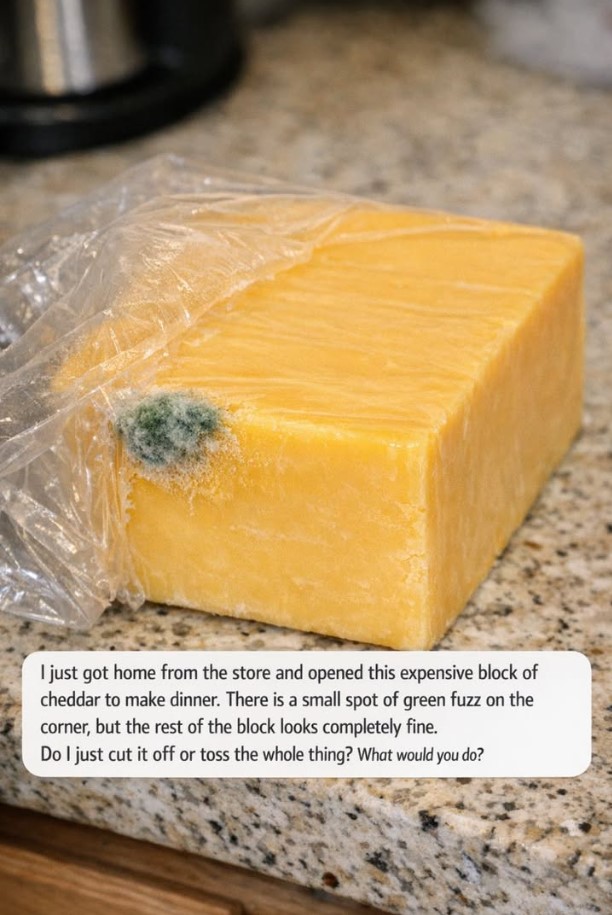
You finally get home, ready to cook, and open a fresh block of cheddar—only to spot a small patch of green fuzz on the corner. Instantly, your appetite disappears and a question takes over: Is this still safe to eat, or is the whole block ruined?
It’s a common situation, especially with cheese. Because cheese naturally ages and contains bacteria, it can sometimes develop mold in ways that feel confusing. The good news is that not all mold on cheese means you have to throw it away—but it depends on the type of cheese and how you handle it.
Let’s go step by step so you can decide confidently.
The key factor: cheddar is a hard cheese
Cheddar belongs to the category of hard or semi-hard cheeses, and this makes a big difference.
Unlike soft cheeses, hard cheeses are dense and low in moisture. This means mold:
- Usually stays on the surface
- Does not easily spread deep inside
Food safety experts confirm that with cheeses like cheddar, mold typically doesn’t penetrate far beyond what you can see.
So… can you just cut it off?
Yes—if handled correctly
If the mold is:
- Small
- Localized (just one spot)
- On a solid block (not shredded or sliced)
You can safely cut it off and use the rest.
But there’s an important rule:
- Cut at least 1 inch (2.5 cm) around and below the mold
- Keep your knife away from the mold itself to avoid spreading spores
This removes both the visible mold and any invisible growth nearby.
Why this works
Mold grows roots (called hyphae), but in hard cheeses:
- These roots don’t travel far
- The dense structure limits spread
That’s why removing a generous portion around the mold is considered safe for cheddar and similar cheeses.
When you should NOT eat it
Even with cheddar, there are situations where you should throw it away:
- Mold is spread across multiple areas
- The cheese smells sour or unpleasant
- The texture feels slimy or unusually soft
- The cheese is shredded, sliced, or crumbled
In these cases, mold may have spread more than you can see.
Also, if you’re in a higher-risk group (pregnant, elderly, or immunocompromised), it’s safer to discard it completely.
Important distinction: soft vs hard cheese
This rule only applies to hard cheeses like cheddar.
For soft cheeses (like cream cheese, ricotta, or cottage cheese):
- Mold spreads easily throughout
- The entire product should be thrown away
Experts are very clear on this difference.
What about the green color?
Green fuzz is typically a common mold (often from the Penicillium family).
- It’s not the same as the controlled mold used in blue cheese
- It’s considered unwanted, but not automatically dangerous in small amounts on hard cheese
The main concern is not just the mold itself, but the possibility of bacteria growing alongside it.
Best practice going forward
To avoid this situation again:
- Wrap cheese properly (not too airtight, not too exposed)
- Keep it refrigerated consistently
- Use clean utensils when cutting
- Check it regularly
Good storage slows mold growth significantly.
The bottom line
If you found a small patch of green mold on a block of cheddar:
- You do not need to throw the whole thing away
- Cut off at least 1 inch around the mold
- The remaining cheese is generally safe to eat
However, if anything seems off—smell, texture, or widespread mold—it’s better to discard it.
Conclusion :
Finding mold on an expensive block of cheddar can feel frustrating, especially when you were just about to cook. Fortunately, in most cases, it’s not a total loss. Thanks to the dense structure of hard cheeses, a small amount of surface mold can be safely removed without wasting the entire block.
The key is knowing the difference between situations where trimming is safe and those where it’s not. With a careful approach and a bit of knowledge, you can avoid unnecessary waste while still protecting your health.
When in doubt, trust your judgment. If something doesn’t seem right, it’s always better to be cautious.