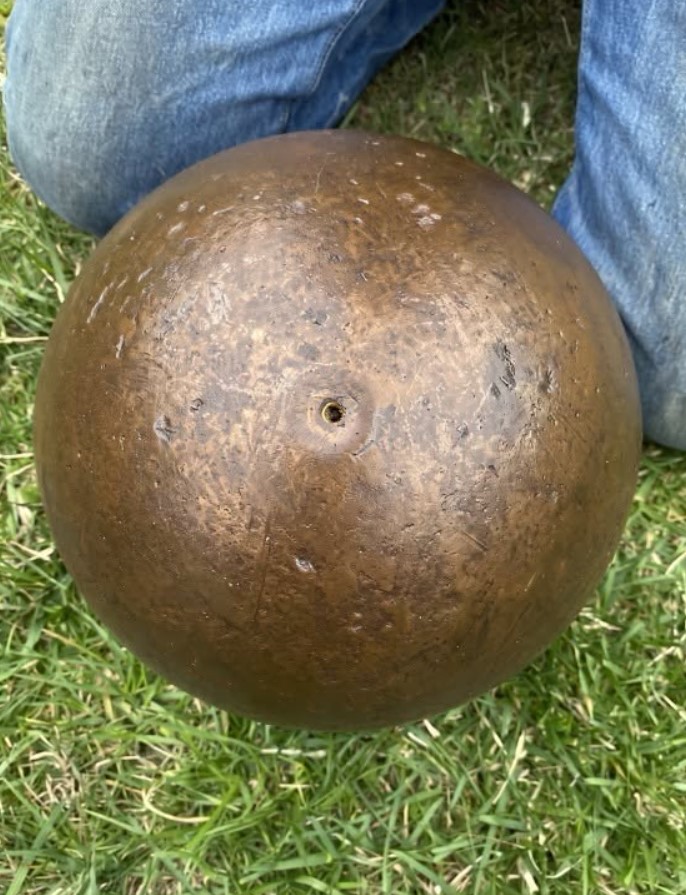
Imagine walking through a quiet wooded area and suddenly noticing something enormous sitting in or beside a creek.
At first, you might assume it is an old piece of machinery, a strange rock, or perhaps some forgotten piece of construction equipment.
But then you get closer.
It’s a gigantic steel sphere.
Weathered by years of exposure, partially surrounded by vegetation, and completely out of place in its natural surroundings, the object looks like something that shouldn’t be there.
So naturally, the question arises:
What is this massive metal ball, and how did it end up in a creek?
The answer is connected to a fascinating chapter of industrial history.
What looks like an unexplained piece of scrap metal was actually a specialized tool used in enormous industrial machines known as ball mills.
These machines played an important role in processing raw materials, and the seemingly simple steel balls inside them were designed to withstand incredible amounts of force.
A Strange Discovery in an Unexpected Place
The sight of a huge steel sphere sitting in a creek is enough to make almost anyone curious.
Unlike ordinary machinery, the object doesn’t immediately reveal what it was designed to do.
There are no obvious handles, gears, wires, or moving components.
Just a massive, solid ball of steel.
Its unusual appearance makes it particularly mysterious when found away from an industrial facility.
Over time, abandoned industrial equipment can become surprisingly difficult to identify. Factories close, mines shut down, processing plants disappear, and machinery is eventually dismantled or forgotten.
Sometimes pieces of that equipment remain behind.
Other times, heavy objects are moved, discarded, or simply left where they are no longer needed.
That may explain why an object originally designed for a massive industrial operation could eventually find itself surrounded by trees, water, and vegetation.
It Wasn’t Just an Ordinary Steel Ball
The enormous sphere was not manufactured simply to be heavy.
It had a specific job.
Large steel grinding balls were used inside ball mills, machines designed to reduce hard materials into much smaller particles.
The basic idea behind a ball mill is surprisingly straightforward.
A large rotating chamber contains the material being processed along with heavy grinding media.
As the chamber rotates, the steel balls are lifted and then tumble downward.
The repeated impacts between the balls and the material gradually break larger pieces into smaller ones.
In other words, the machine uses impact and abrasion to accomplish something that would otherwise require enormous amounts of manual effort.
How Ball Mills Work
Picture a giant cylindrical container rotating continuously.
Inside are hundreds or thousands of heavy steel balls along with whatever material needs to be ground.
As the cylinder turns, the balls move upward with the rotating chamber.
Eventually, gravity takes over.
The balls fall or tumble through the material.
Then the process repeats.
Again and again.
The repeated collisions create tremendous mechanical force.
Large chunks of material are gradually broken apart until they become much finer.
The concept may sound simple, but operating this process efficiently on an industrial scale requires careful engineering.
The grinding balls need to be strong enough to survive countless impacts.
Their size and composition also matter because different materials and industrial processes require different grinding conditions.
So that mysterious sphere was actually a highly specialized piece of industrial equipment.
Where Were These Giant Balls Used?
Ball mills have been used in a variety of industries.
One of their best-known applications is mining and mineral processing.
After minerals are extracted from the ground, they may need to be crushed and ground into much smaller particles before additional processing can take place.
Grinding can help separate valuable materials from unwanted rock and prepare the material for later stages.
Ball mills have also been associated with industries such as:
- Mining
- Mineral processing
- Cement manufacturing
- Ceramics
- Metal processing
- Chemical production
- Other heavy industrial operations
The exact application depends on the type of mill and material being processed.
But the basic principle remains similar: use controlled mechanical energy to reduce material size.
Why Would Something So Simple Be So Important?
It’s easy to underestimate an object like a steel grinding ball because its design is so basic.
There are no complicated electronics.
No sophisticated-looking mechanisms.
No elaborate shape.
Just a carefully manufactured sphere.
But simplicity can be incredibly effective.
The round shape allows the grinding media to move and tumble efficiently inside the rotating mill.
Its substantial weight provides the impact force needed to break down hard materials.
Its durability allows it to survive repeated collisions.
The effectiveness comes from the combination of weight, hardness, movement, and repetition.
That simple formula made these objects extremely useful in industrial processing.
Imagine the Environment Where It Once Worked
The contrast between the quiet creek and the object’s original environment is remarkable.
Imagine seeing this same steel ball inside a huge industrial facility.
Instead of birds, trees, and flowing water, there would have been enormous machinery surrounding it.
A working ball mill could be loud and imposing.
Rotating equipment would operate continuously.
Grinding media would tumble and collide.
Conveyors would move materials through different stages of production.
Dust, heat, vibration, and machinery noise could become part of everyday working conditions.
For workers, this wasn’t an interesting historical artifact.
It was simply part of the job.
The People Behind the Machinery
Industrial equipment doesn’t operate itself.
Behind every large machine are people responsible for keeping everything running.
Workers would have needed to inspect equipment, monitor production, maintain machinery, handle materials, and repair components when something went wrong.
The conditions could be demanding.
Heavy machinery requires constant attention because even relatively small mechanical problems can interrupt an entire production process.
A failed component could mean hours of downtime and expensive repairs.
The steel grinding balls were one small part of this much larger system.
They performed their job repeatedly until they became worn and eventually needed to be replaced.
Steel Balls Don’t Last Forever
Even extremely durable steel eventually wears down.
Every collision inside a ball mill produces some amount of wear.
Over time, the grinding balls become smaller.
Their surfaces can change as material is gradually removed.
Eventually, they may no longer be the correct size or condition for efficient operation.
That’s one reason industrial facilities periodically replace grinding media.
The discarded balls may then be recycled, stored, reused in another application, or simply left behind.
This process can help explain why old industrial steel objects sometimes appear in unexpected locations long after the original facility has disappeared.
How Could One End Up in a Creek?
That’s perhaps the most intriguing part of the mystery.
Without specific historical information about the location, it’s impossible to say exactly how a particular steel sphere arrived at a creek.
It could have been transported there during the movement of old industrial equipment.
It could have been discarded decades ago.
It may have been associated with an abandoned industrial site that once existed nearby.
Natural forces could also have moved smaller objects over time, although an extremely heavy steel sphere would obviously require significant force or human involvement to travel very far.
The surrounding landscape may look completely natural today, but that doesn’t mean it has always been untouched.
Industrial activity has transformed enormous areas of land over the past century.
Old mining sites, factories, quarries, railways, mills, and processing plants can disappear from the landscape while leaving behind physical remnants.
A Forgotten Piece of Industrial History
That’s what makes discoveries like this so interesting.
An object that initially looks meaningless can actually tell a story about the past.
The steel sphere represents a time when industrial production depended heavily on enormous mechanical systems.
It was part of a process designed to turn raw materials into something useful for other industries.
It may have helped process minerals that eventually became part of buildings, roads, machines, household products, or other manufactured goods.
Yet the sphere itself was never meant to be noticed.
It was simply a tool.
Its purpose was to work continuously in the background.
Why Industrial Artifacts Fascinate People
There is something uniquely fascinating about abandoned industrial objects.
Unlike traditional historical artifacts, they often don’t look particularly impressive.
A rusty piece of machinery might appear worthless.
An old pipe might look like trash.
A giant steel ball might appear completely mysterious.
But once its original purpose is understood, the object becomes a window into another era.
It reminds us that modern life depends on countless industrial processes most people rarely think about.
We see the finished products.
We don’t always see the machines that helped create the raw materials behind them.
The Mystery Is More Interesting Than the Object
At first, the question might simply be:
“What is that giant ball?”
After learning its history, the question becomes much more interesting.
Where was it originally used?
What material did it grind?
How long did it operate?
How many times did it tumble inside a mill?
How far did it travel before ending up beside the creek?
And how long had it been sitting there before someone finally noticed it?
Those questions may never be answered.
That’s part of what makes discoveries like this so compelling.
A Reminder of How Quickly Landscapes Change
Industrial sites that were once filled with machinery can eventually become forests, fields, or wetlands.
A place that was once noisy and crowded with workers may become almost completely silent.
The machinery disappears.
Buildings are demolished.
Roads are reclaimed by vegetation.
But occasionally, something remains.
A concrete foundation.
A piece of rail.
A rusted pipe.
Or a gigantic steel grinding ball.
These objects act as physical reminders that the landscape we see today may have looked dramatically different decades ago.
From Industrial Workhorse to Curiosity
The transformation of the steel sphere is almost poetic.
During its working life, it was part of a demanding industrial process.
It was designed for repetitive, heavy work.
It was exposed to constant impact.
Its value came from its ability to perform a specific mechanical task over and over again.
Today, sitting quietly in a creek or wooded area, it has an entirely different purpose.
It makes people stop.
It makes them wonder.
It becomes a curiosity rather than a tool.
Final Thoughts
What initially appears to be a bizarre metal object abandoned in a creek may actually be a fascinating reminder of industrial history.
The massive steel sphere was associated with the grinding technology used in ball mills, where heavy steel balls tumble inside rotating chambers to break down minerals and other hard materials through repeated impact and abrasion.
These seemingly simple spheres were built to perform demanding work.
They had to be durable enough to withstand countless collisions, heavy enough to provide substantial impact, and manufactured to work efficiently within industrial grinding systems.
Ball mills have played important roles in industries ranging from mining and mineral processing to cement, ceramics, metalworking, and chemical manufacturing.
Perhaps the most fascinating part of the discovery isn’t the steel ball itself.
It’s the story it represents.
An object that once operated inside a noisy industrial machine may eventually become a silent relic hidden among trees and water. The factory may be gone, the workers may have moved on, and the machinery may have disappeared—but a single piece of that enormous industrial process can remain behind.
So the next time you come across something strange in an old industrial area, beside a creek, or hidden in the woods, don’t immediately assume it’s worthless scrap.
It might be a small piece of a much larger story.
And sometimes, the most ordinary-looking objects have the most extraordinary histories.