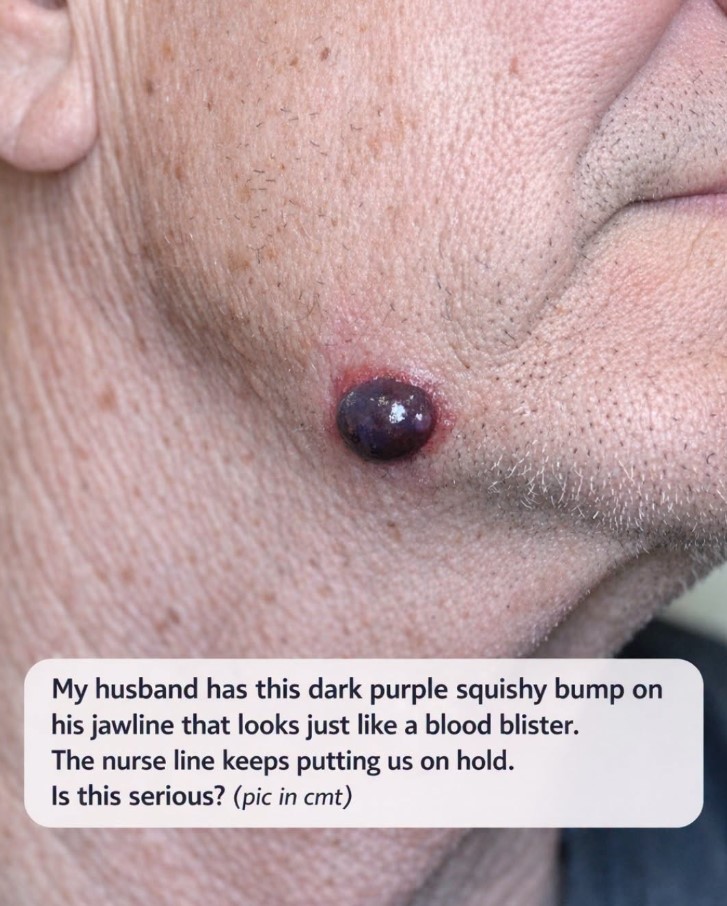
Finding an unusual bump on someone you love can immediately make your mind jump to the worst possibilities. A small dark-purple spot may look harmless at first, but when it appears suddenly on the face—especially around the jawline—it is understandable to wonder whether it is simply a blood blister, a harmless skin growth, or something that needs medical attention.
A soft, dark blue or purple bump that resembles a tiny blood blister can sometimes be a venous lake, a generally harmless type of vascular lesion that occurs when a small vein near the surface of the skin becomes widened. These lesions are often soft, compressible, and blue-purple in appearance, and they commonly occur on sun-exposed areas of the face.
However, appearance alone cannot confirm what a skin lesion is. Several different conditions can create similar-looking bumps, which is why a new or persistent lesion should be evaluated by a healthcare professional if there is any uncertainty.
Here is what to know about a mysterious purple bump on the jawline, what features may point toward a venous lake, and which warning signs mean it should be checked sooner.
What Is a Venous Lake?
A venous lake is essentially a small, widened vein located close to the surface of the skin. Because blood collects inside the enlarged vessel, the area can appear dark blue, purple, or even blue-black.
These lesions are usually small, often measuring only a few millimeters across, although some can be larger. They are most commonly found on areas that receive significant sun exposure, particularly the lips, ears, cheeks, and other parts of the face. The jawline can also be affected.
One of the reasons venous lakes can be alarming is their appearance. A person may look at one and immediately think, “That looks like a blood blister.”
In many cases, however, a venous lake is not dangerous.
The important distinction is that a venous lake is generally a persistent vascular lesion, whereas a conventional blood blister usually develops following some type of trauma.
Why Does It Look Like a Blood Blister?
Blood blisters form when small blood vessels are damaged while the skin’s surface remains intact. This can happen after pinching, friction, biting, shaving irritation, or another minor injury.
The trapped blood gives the blister a red, purple, or dark appearance.
A venous lake can look remarkably similar because it also contains blood close to the surface of the skin. The difference is often the history and behavior of the lesion.
A blood blister generally changes as it heals. It may become darker, flatten, dry, and eventually disappear.
A venous lake, on the other hand, can remain in the same location for weeks, months, or even longer. It may also be softer and more compressible than a typical blister.
That is why a purple bump that simply refuses to go away deserves a closer look rather than being automatically assumed to be an old blister.
What Does a Typical Venous Lake Look Like?
Although only a healthcare professional can determine what a particular lesion is, several characteristics are commonly associated with venous lakes.
They may be:
- Dark blue, purple, or blue-black
- Small and rounded
- Smooth and dome-shaped
- Soft or compressible
- Relatively painless
- Located on sun-exposed skin
- Stable in size for long periods
Some may partially flatten or become lighter when pressure is applied because the blood can temporarily move out of the superficial vessel.
Doctors can sometimes use this behavior as one clue during an examination. They may also use a dermatoscope—a specialized magnifying device—to inspect the lesion more closely.
Still, these characteristics should not be used as a substitute for a professional diagnosis.
The Location Can Provide a Clue
Where a lesion appears can sometimes help doctors determine what possibilities to consider.
Venous lakes are especially associated with sun-exposed areas. The lower lip is a classic location, but lesions can also appear on the ears, cheeks, and face.
The jawline may receive more sun exposure than people realize. Years of outdoor activities, driving, gardening, walking, or simply spending time outside can contribute to cumulative ultraviolet exposure.
This does not mean that every purple bump on a sun-exposed area is a venous lake. It simply explains why clinicians may consider a vascular lesion when they see a small, soft, blue-purple spot in this region.
When It May Not Be a Simple Venous Lake
Not every purple bump behaves like a venous lake.
Certain features should make someone more cautious, particularly if the lesion is new or changing.
For example, it deserves professional evaluation if it:
- Becomes firm or hard rather than soft
- Grows noticeably over a short period
- Becomes very painful or tender
- Feels warm
- Develops crusting
- Bleeds repeatedly without obvious trauma
- Changes shape or color
- Has an irregular or jagged border
- Contains several different colors
- Continues changing over several weeks
A lesion that looks like a deep lump underneath otherwise normal-colored skin may also have a different cause from a superficial vascular spot.
These signs do not automatically mean something serious is happening. They simply mean that guessing at home is not the best approach.
Other Conditions Can Look Similar
A purple bump on the jawline has several possible explanations.
Besides a venous lake, possibilities can include a darkened cherry angioma, a small hemangioma, a hematoma caused by minor trauma, a bruised cyst, a pyogenic granuloma, or another vascular lesion.
Less commonly, a pigmented skin cancer can resemble a benign-looking spot, which is one reason persistent or changing lesions should not be ignored.
This is especially important with a new lesion that appears without an obvious explanation.
The goal is not to become an expert at diagnosing skin conditions from a description. Instead, the goal is to recognize when an unusual lesion should be examined.
When Should You Seek Medical Attention?
A small, stable, painless bump with no other symptoms generally does not sound like an emergency based solely on this description.
Nevertheless, a new lesion on the face should be monitored, and a routine appointment with a primary-care clinician or dermatologist can provide reassurance and an accurate diagnosis.
Prompt medical evaluation becomes more important if the bump changes quickly or is accompanied by other symptoms.
Seek urgent medical attention if there is:
- Bleeding that does not stop after about 10 minutes of firm, steady pressure
- Rapid enlargement over a day or several days
- Severe pain
- Significant facial swelling
- Fever
- Pus-like drainage
- Difficulty opening the mouth
- Trouble swallowing
- Trouble breathing
- Significant or uncontrolled bleeding
These symptoms are not typical features of an uncomplicated venous lake and warrant prompt assessment.
How a Doctor May Examine the Bump
The evaluation may be quite straightforward.
A healthcare professional will usually begin by examining the lesion closely and asking several questions.
They may want to know:
- When was it first noticed?
- Has it changed in size?
- Has its color changed?
- Does it hurt?
- Does it bleed?
- Was there any recent injury?
- Has the area been shaved or irritated?
- Has he had similar spots previously?
- Does it become lighter or flatter with gentle pressure?
A dermatologist may also use a dermatoscope to examine structures that are difficult to see with the naked eye.
In some cases, the appearance is characteristic enough that no additional testing is needed. If the lesion looks unusual or cannot be confidently identified, a dermatologist may recommend additional evaluation, including a biopsy when appropriate.
What Happens If It Really Is a Venous Lake?
If the bump is confirmed to be a venous lake and it is not causing problems, treatment may not be necessary.
Many people simply leave these lesions alone.
Treatment may be considered when the lesion is cosmetically bothersome, repeatedly irritated, or prone to bleeding—for example, when it gets nicked during shaving.
Depending on the location and characteristics of the lesion, a dermatologist may consider options such as vascular laser treatment, electrocautery, cryotherapy, or minor surgical removal.
Because the jawline is part of the visible face, cosmetic considerations are important. A dermatologist will generally weigh the expected result against possible scarring, pigment changes, and other skin changes before choosing a treatment method.
What You Should Not Do at Home
A mysterious purple bump can be tempting to squeeze, pop, drain, or otherwise “fix.”
That is not a good idea.
Do not attempt to puncture it with a needle, cut it open, freeze it with a wart-removal product, tie anything around it, or repeatedly squeeze it to see what happens.
A vascular lesion can bleed, and manipulating a lesion on the face can increase the risk of infection, irritation, and scarring.
The safest approach is simple: leave it alone and have it examined if it persists or behaves unusually.
Keep Track of Any Changes
If the appointment cannot happen immediately, keeping a simple record can be useful.
Take a clear photograph in good natural light and note approximately when the bump first appeared. If possible, photograph it from the same angle every few days or weeks rather than constantly touching it.
You can also record:
- Approximate size
- Color
- Whether it hurts
- Whether it bleeds
- Whether it changes shape
- Whether it becomes flatter or darker
- Whether anything seems to trigger a change
This information can help a clinician understand how the lesion has evolved.
How to Describe It to a Nurse or Doctor
When speaking with a medical professional, a detailed description is much more useful than simply saying there is a “weird purple bump.”
For example, you could explain:
“He has a small, raised, soft, dark-purple bump on his jawline. It looks similar to a blood blister. We first noticed it about two weeks ago. It isn’t painful, there was no obvious injury, and it hasn’t significantly changed in size.”
Adding information about bleeding, tenderness, rapid growth, fever, swelling, and other symptoms can also help the healthcare professional determine how quickly it needs to be assessed.
The Bottom Line
A dark-purple, soft, squishy bump on the jawline can certainly look frightening, particularly when it appears without an obvious explanation. One possible cause is a venous lake, a usually benign vascular lesion that can resemble a small blood blister because of its blue-purple color and soft, compressible appearance.
The reassuring part is that a venous lake is generally not considered an emergency, and many require no treatment at all.
But there is an important limitation: a description alone cannot establish a diagnosis.
If the bump is new, persistent, changing, repeatedly bleeding, becoming painful, or otherwise behaving differently from a typical stable lesion, having a doctor or dermatologist examine it is the sensible next step.
Most importantly, don’t panic and don’t try to remove it yourself. A small purple spot does not automatically mean something dangerous, but unusual lesions deserve appropriate attention rather than weeks of guessing.
If there is rapid growth, uncontrolled bleeding, significant swelling, fever, difficulty swallowing, or any trouble breathing, seek urgent medical care rather than waiting for a routine appointment.
In situations like this, the best balance is reassurance without complacency: it may be something harmless, but getting a professional opinion is the best way to know for sure.