Puzzles and riddles have fascinated people for centuries. From ancient brain teasers carved into stone to modern-day logic puzzles shared online, they continue to challenge how we think and interpret language. Unlike straightforward questions, riddles often rely on misdirection, wordplay, and hidden meanings that force us to step outside normal patterns of thinking.
The riddle we explore here is a perfect example of this mental trickery. At first glance, it seems like a simple family-based question, but the answer depends entirely on how carefully you read the wording. Let’s break it down step by step.
The Riddle Setup
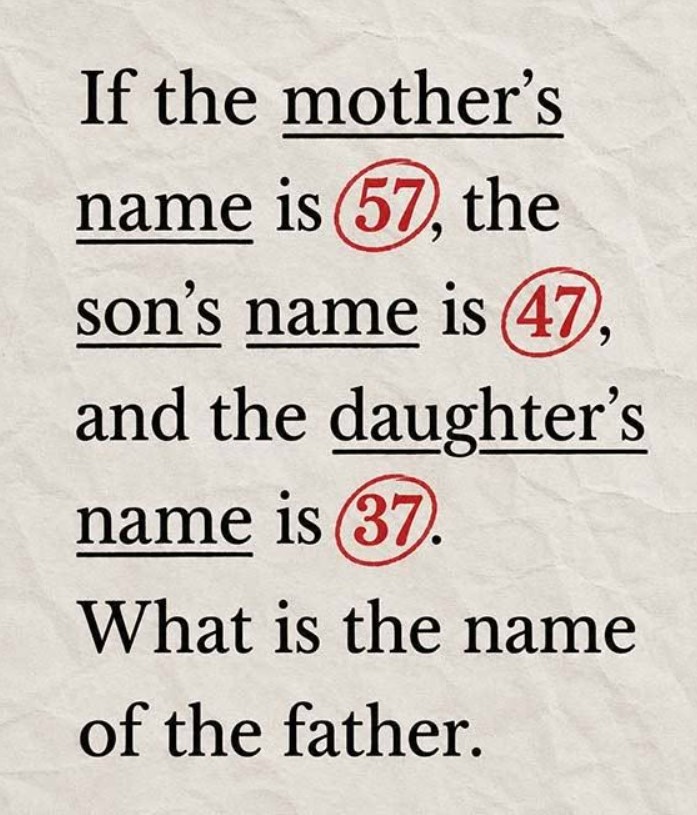
The puzzle presents a small family scenario:
- The mother’s name is 57
- The son’s name is 47
- The daughter’s name is 37
At this point, everything appears unusual but still logical within the context of a riddle. It is not uncommon for puzzles to assign numbers or symbols as names, so the brain begins to accept this pattern.
Then comes the final question:
“What is the name of the father?”
This is where the trick lies.
Thinking Beyond the Obvious
Most people instinctively try to look for another number or hidden clue in the image or text. They assume the father’s name must follow the same pattern as the rest of the family.
However, riddles often depend on breaking expectations rather than following them.
The key to solving this puzzle is realizing that not every word in the question is part of the coded pattern.
The Hidden Trick in the Wording
The solution comes from carefully reading the final sentence:
Most readers interpret this as a question to be answered. But in reality, the phrase itself contains the answer.
In this riddle, “What” is not an interrogative word—it is actually the father’s name.
This means the sentence is deliberately constructed to mislead the reader into searching for a hidden numerical or symbolic answer when the solution is already embedded in plain sight.
The Answer Explained
- Mother’s name = 57
- Son’s name = 47
- Daughter’s name = 37
- Father’s name = “What”
The entire trick relies on interpreting language literally rather than contextually. Once you stop assuming the question requires deeper mathematical or symbolic decoding, the answer becomes clear.
Why This Riddle Works
This puzzle is a classic example of linguistic misdirection. It plays with how our brains automatically process questions. Instead of reading each word individually, we tend to interpret meaning as a whole.
Riddles like this are designed to:
- Challenge assumptions
- Encourage careful reading
- Test attention to detail
- Highlight how easily language can be misinterpreted
They are not about intelligence alone, but about perspective.
What This Teaches Us
Beyond entertainment, this riddle reminds us of an important cognitive lesson: sometimes the simplest answer is the correct one. Overthinking can often lead us away from obvious solutions.
It also demonstrates how powerful wording can be. A single sentence, structured cleverly, can completely change the way we interpret information.
Conclusion :
The riddle “What is the name of the father?” is a clever play on language that tricks the mind into searching for complexity where none exists. The answer—“What”—is hidden in plain sight, proving that sometimes we are misled not by the problem itself, but by how we choose to read it.
In the end, this puzzle is less about logic and more about perception. It reminds us to slow down, read carefully, and question our assumptions before jumping to conclusions.