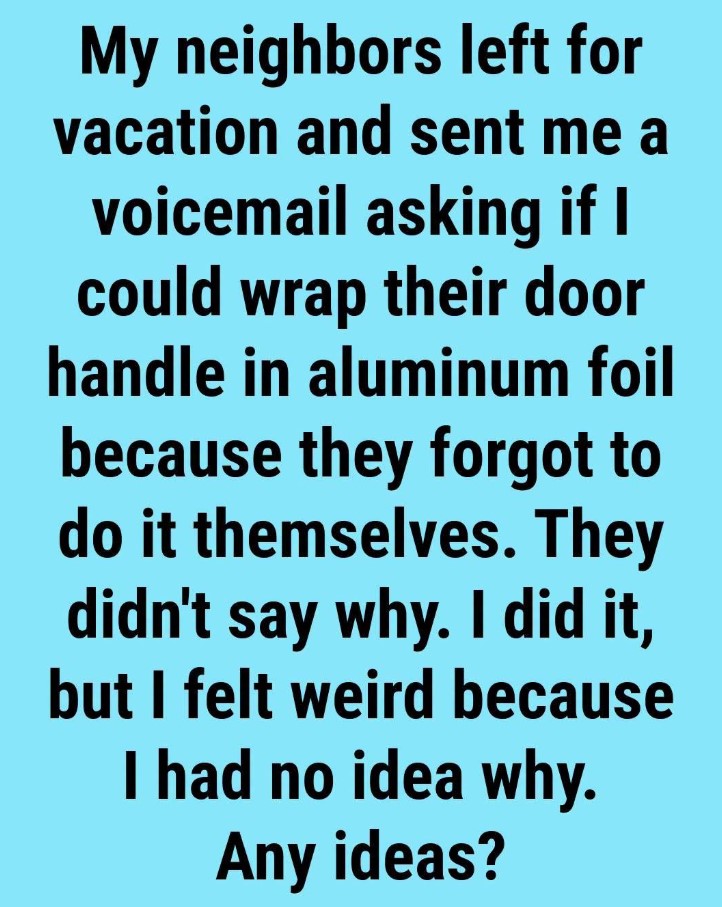
There is something irresistible about a household trick that promises to make your home safer using something you probably already have in the kitchen. Aluminum foil is inexpensive, easy to find, and useful for countless everyday tasks, so it’s no surprise that the idea of wrapping foil around a door handle has attracted attention online.
The viral hack is often presented as a simple security trick. Depending on the version of the claim, aluminum foil around a door handle is supposed to make an intruder think twice, create a noticeable sound if someone touches the handle, or reveal that somebody has attempted to enter.
But there is an important distinction between a clever household experiment and a genuine security measure.
The aluminum foil itself does not provide meaningful physical protection against someone determined to enter a home. As the original article notes, the trick should not be treated as a substitute for a proper lock, reinforced door, alarm, camera, or other security device.
That doesn’t mean the idea has no possible use. A piece of foil can potentially function as a simple visual or tamper indicator under certain circumstances. The key is understanding exactly what it can—and cannot—do.
What Is the Aluminum Foil Door Handle Hack?
The basic idea is extremely simple.
A person takes a piece of aluminum foil and wraps it loosely around the exterior door handle or another accessible part of the door hardware.
Online versions of the hack make several different claims about what happens next.
Some suggest that an intruder touching the handle will disturb the foil, producing a noticeable crinkling sound. Others claim that the unusual appearance of the foil might discourage someone from touching the door. Another version treats the foil as a simple indicator: if it is torn, moved, or no longer positioned as you left it, you may know that someone interacted with the handle.
These are very different claims.
Foil may be capable of showing that something disturbed it, but that doesn’t mean it can prevent entry. The original article specifically emphasizes that the material offers little or no meaningful resistance against someone attempting to get through a door.
That distinction is important when evaluating viral home-security advice.
Why Did This Trick Become So Popular?
The appeal is easy to understand.
A traditional security system can require an upfront investment, installation, maintenance, and sometimes a monthly subscription. Reinforcing a door can also involve tools, hardware, and professional work.
Aluminum foil, by contrast, is inexpensive and already present in many homes.
The hack also looks convincing in a short social-media video. Someone wraps foil around a handle, demonstrates how easily it crinkles, and presents the result as a low-cost security solution.
The simplicity makes the idea memorable.
But simplicity shouldn’t be confused with effectiveness.
A home-security measure needs to accomplish a specific objective. If the goal is preventing unauthorized entry, the measure needs to make entry more difficult, detect an attempted entry reliably, or summon assistance.
A thin sheet of foil doesn’t accomplish those things by itself.
What Can Aluminum Foil Actually Do?
The most reasonable way to think about the trick is as a temporary visual or tamper indicator, rather than a security barrier.
Imagine that you wrap a small piece of foil around a handle in a particular way and leave it there.
If someone grabs the handle, the foil may become wrinkled, torn, displaced, or otherwise visibly different.
In that narrow sense, it could provide a clue that the handle was disturbed.
However, there are obvious limitations.
The foil can fall off because of wind, humidity, accidental contact, pets, children, or ordinary household activity. Someone could also touch the handle without disturbing it significantly.
Most importantly, the foil does not tell you who touched the handle or why.
It provides, at best, a very basic indication that something may have changed.
Why It Doesn’t Actually Secure the Door
This is the most important point.
Aluminum foil is extremely thin and easy to tear. It does not reinforce a door, strengthen a lock, prevent someone from turning a handle, or stop someone from forcing an entry point.
If someone is genuinely attempting to enter a home, a sheet of foil is unlikely to create a meaningful obstacle.
The original article therefore warns against confusing a temporary tamper indicator with a real security device.
This is a useful lesson for evaluating many viral household hacks.
A trick can be interesting without being an effective security solution.
Could the Noise Help?
One of the claims associated with the foil trick is that an intruder touching the handle will create a noticeable crinkling sound.
There is some logic behind the idea. Aluminum foil is noisy when crushed or moved, and a loosely wrapped piece can certainly make a sound when disturbed.
But relying on that sound as an alarm is unreliable.
A person could touch the handle gently and produce little noise. Meanwhile, the foil could make noise because of completely harmless movement.
There is also no guarantee that someone inside the house would hear the sound, particularly if they are sleeping, wearing headphones, watching television, or located far from the entrance.
A purpose-built door alarm or sensor is designed to detect specific events and provide a much more dependable notification.
Could It Discourage Someone From Touching the Door?
Possibly, but there is no reason to rely on that possibility.
An unusual-looking door handle might make someone curious or cause them to hesitate. But someone intent on entering a home is unlikely to be stopped by a piece of aluminum foil.
A visible security camera, alarm-system sign, motion-activated lighting, or properly secured door communicates a much stronger deterrent.
This is why security professionals generally recommend layers of protection rather than relying on one unusual trick.
Think in Terms of Layers
A safer way to approach home security is to use multiple measures that complement one another.
For example, a basic security setup might include:
- A strong exterior door
- A quality deadbolt
- Securely installed door hardware
- Adequate outdoor lighting
- Properly secured windows
- A doorbell or security camera
- An alarm or door sensor
- Good visibility around entrances
- Sensible privacy practices
Each layer addresses a different part of the problem.
A strong lock makes entry harder.
A camera can provide information about activity around the entrance.
A motion-activated light improves visibility.
An alarm or sensor can alert you when a door or window is opened.
Together, these measures are considerably more useful than relying on a piece of foil.
The Door Itself Matters More Than the Handle
If you’re genuinely concerned about home security, start by looking at the door rather than experimenting with the handle.
A strong door is only as effective as its frame, hinges, strike plate, and locking hardware.
Even an expensive lock cannot provide its intended protection if the surrounding structure is weak or improperly installed.
Check that the door closes securely and that the locking mechanism works correctly.
Look at the condition of the frame and hardware.
If you’re unsure whether your entrance is adequately secured, a qualified locksmith or security professional can provide more useful advice than a viral social-media hack.
Don’t Forget Windows and Other Entry Points
Front doors often receive most of the attention, but they aren’t the only potential access points.
Depending on the home, other areas may deserve attention:
- Back doors
- Garage doors
- Basement windows
- Ground-floor windows
- Sliding doors
- Side entrances
- Gates leading into the property
A security plan is only as strong as its weakest accessible entry point.
There is little value in spending a great deal of money securing one entrance if another easily accessible entrance remains vulnerable.
Motion-Activated Lighting Can Be More Useful
If you’re looking for an inexpensive addition to a home-security setup, outdoor lighting is worth considering.
Motion-activated lights can illuminate an entrance or pathway when movement is detected.
This can make it easier for you to see what’s happening around your property and may make an entrance less appealing to someone who prefers to operate in darkness.
Good lighting is also useful for everyday safety. It can help you see steps, walkways, packages, and other obstacles when arriving home at night.
Unlike the foil hack, proper exterior lighting provides a practical benefit regardless of whether anyone is attempting to enter your home.
What About Security Cameras?
A camera can provide something aluminum foil cannot: information.
If a camera is positioned appropriately, it may allow you to see activity around a door or other entrance.
Modern systems can sometimes send notifications when movement is detected, allowing you to check what is happening even when you’re away.
However, cameras also have limitations. A poorly positioned camera may capture very little useful information, while poor lighting can reduce image quality.
A camera should therefore be considered part of a broader security strategy rather than a complete solution by itself.
Smart Door Sensors Are Another Simple Option
For people who want to know when a door is opened, a door or window sensor can be considerably more reliable than a piece of foil.
Many smart-home sensors consist of two small components that detect when a door or window changes position.
Depending on the system, an alert may appear on your phone when the sensor detects an opening.
These devices are specifically designed for monitoring entry points, whereas foil was never designed for that purpose.
That difference matters.
When evaluating a security idea, ask a simple question: Was the object actually designed to perform the job you’re asking it to do?
Be Careful With Viral Security Hacks
The aluminum foil door-handle trick is part of a much larger category of viral household advice.
Some of these tips are harmless experiments. Others are exaggerated. A few can potentially be dangerous if people interpret them as substitutes for proper safety equipment.
Before following any viral security recommendation, consider:
What exactly is the trick supposed to accomplish?
Does it physically prevent entry? Detect movement? Notify someone? Or simply make you feel more secure?
Then ask whether there is a more reliable tool designed specifically for that purpose.
This simple way of thinking can help separate useful ideas from internet myths.
When a Simple Trick Is Still Useful
Not every household hack needs to be a professional-grade security device to have some value.
If you want to use foil as a temporary visual indicator while you’re experimenting with a routine, there is little harm in understanding its limitations.
For example, you might use a piece of foil to see whether a particular handle is being disturbed during a short period.
But don’t interpret an undisturbed piece of foil as proof that nobody has entered your home.
And don’t assume that disturbed foil necessarily means someone tried to break in.
It is simply an unreliable clue.
Privacy Is Part of Home Security Too
Security isn’t only about locks and alarms.
Think about what information you reveal publicly.
Avoid unnecessarily sharing details about when your home is empty, especially on public social-media accounts.
Be cautious about posting vacation plans in real time.
Consider how visible your belongings are through windows.
And make sure deliveries, mail, and packages don’t accumulate outside for long periods when you’re away.
These habits don’t require expensive equipment, but they can reduce the amount of information strangers can learn about your routine.
Don’t Let Security Advice Create Fear
One potential downside of viral security content is that it can make ordinary life feel threatening.
Seeing dozens of videos about intruders can create the impression that someone is constantly watching every house.
That’s not a healthy way to think about home security.
The purpose of reasonable precautions is to improve your peace of mind, not to make you afraid to open your own front door.
You don’t need to inspect every shadow or assume that every unfamiliar person is suspicious.
Instead, focus on practical measures that improve your home’s security without disrupting your everyday life.
A Better Low-Cost Security Checklist
If you want to improve your home security without spending a fortune, start with the basics.
Make sure exterior doors close and lock properly.
Check that accessible windows can be secured.
Replace damaged locks or hardware.
Keep entrances and pathways adequately illuminated.
Trim vegetation that blocks visibility around doors and windows.
Consider inexpensive door or window sensors.
Use curtains or blinds where appropriate to protect nighttime privacy.
Avoid publicly advertising when your home will be empty.
If you have the budget, consider adding a camera or professionally installed alarm system.
These steps provide considerably more practical value than relying on a sheet of foil.
Final Thoughts
The aluminum foil door-handle hack is a perfect example of how an entertaining internet trick can contain a small grain of usefulness while being greatly overstated.
Yes, foil can make noise when disturbed. Yes, a carefully positioned piece could potentially serve as a crude visual indication that a handle has been touched. But it does not meaningfully strengthen a door or prevent someone from entering a home.
That doesn’t make the idea completely worthless. It simply means you need to understand what you’re actually using it for.
If your goal is genuine home security, concentrate on the fundamentals: strong locks, secure doors and windows, good lighting, sensible privacy habits, and reliable detection systems.
The best security solutions are usually not the most mysterious or viral ones. They are the simple, proven measures that make unauthorized entry more difficult, provide useful warnings, and give you better information about what is happening around your home.
So, if you happen to see a piece of aluminum foil wrapped around someone’s door handle, don’t automatically assume they’ve discovered a revolutionary security system. It may be an interesting DIY experiment—but when it comes to protecting your home, a good lock and a thoughtful security plan will always matter far more than a sheet of kitchen foil.