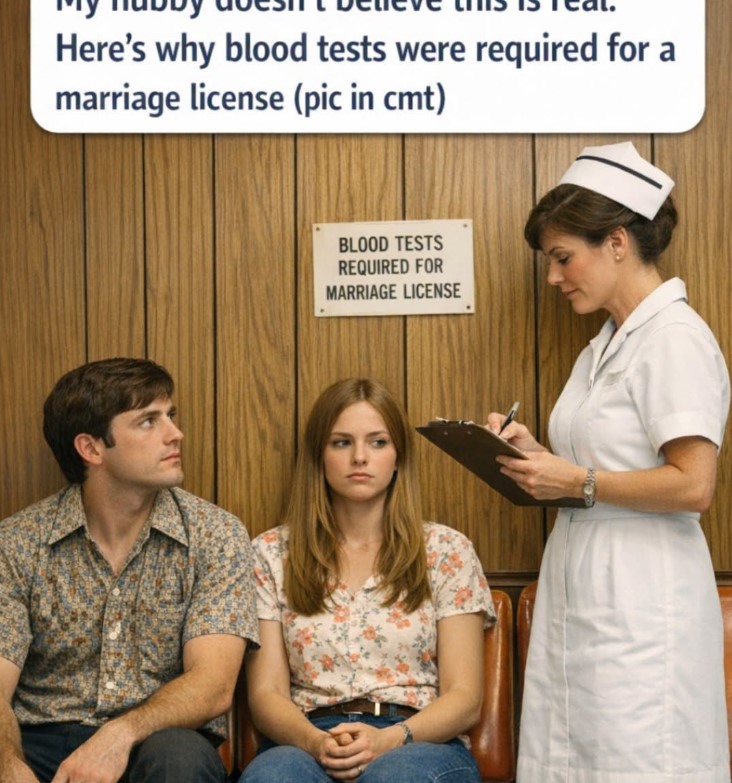
When I first learned that couples in many parts of the United States once had to undergo a blood test before they could obtain a marriage license, I could understand why someone might think it sounded made up.
Today, getting married generally involves identification, paperwork, a fee, and whatever other requirements apply in the particular state or locality. The idea that a couple could be told to visit a doctor or laboratory, have blood drawn, and provide medical documentation before being legally allowed to marry feels surprisingly intrusive by modern standards.
But it really happened.
For decades, premarital medical examinations and blood tests were a genuine part of marriage licensing in much of the United States. The main purpose was to screen for syphilis, a serious infectious disease that could be transmitted between sexual partners and from a pregnant woman to her unborn child. In some places and periods, requirements also involved screening for or documentation of immunity to rubella, because infection during pregnancy could cause severe complications for a developing baby.
The story is more complicated than simply saying that governments wanted couples to have a medical checkup. These laws reflected the medical knowledge, public-health concerns, social attitudes, and government policies of their time. Eventually, better treatments, improved screening strategies, changing disease patterns, and the administrative burden of the requirements caused states to abandon them.
Here’s a closer look at why these unusual marriage requirements existed and why they eventually disappeared.
What Exactly Was the Premarital Blood Test?
A premarital blood test was a medical screening that had to be completed before a marriage license could be issued in jurisdictions where such laws were in effect.
Depending on the state and the period, the requirements varied. Some couples had to provide proof that both partners had been tested, while other laws applied different requirements based on factors such as sex, age, residency, or other circumstances.
The test was usually connected to a physician’s certificate or laboratory report. A couple might visit a doctor’s office, clinic, or hospital laboratory, have a blood sample taken, and then bring documentation of the results to the office responsible for issuing the marriage license.
In other words, getting married could involve considerably more than filling out forms.
The Cooktop Cove article describes couples having to coordinate medical appointments, laboratory testing, official paperwork, and deadlines before the license could be issued. In some places, certificates had to be completed within a specific period, meaning that even a delay could interfere with wedding plans.
Why Was Syphilis the Main Concern?
To understand why lawmakers considered this reasonable, it helps to look at the medical situation of the early 20th century.
Before modern treatment transformed the disease, syphilis was a major public-health problem. Untreated infection could eventually affect the nervous system, cardiovascular system, and other organs.
There was another especially serious concern: pregnancy.
A pregnant woman with untreated syphilis could transmit the infection to her developing baby. Congenital syphilis could result in miscarriage, stillbirth, severe illness, or long-term complications.
Public-health officials therefore looked for ways to identify infections earlier.
Marriage seemed like a convenient checkpoint.
Large numbers of adults passed through the marriage-licensing system, and lawmakers believed that requiring testing before marriage could identify infections, encourage treatment, and reduce transmission within families.
Historical medical literature from the 1940s confirms that the goal of many premarital examination laws was to prevent the spread of syphilis through marriage.
When Did These Laws Become Common?
Premarital examination laws existed before the major wave of syphilis-testing requirements, but the practice expanded dramatically during the 1930s and 1940s.
Connecticut, for example, enacted a premarital examination law in 1935 that required testing for syphilis before a marriage license could be issued. Similar laws spread to numerous other states. By the early 1940s, historical records show that dozens of states had adopted some form of premarital examination requirement.
By the middle of the 20th century, premarital blood testing had become familiar enough that an American couple getting married might have considered it a normal part of the process.
That’s one reason the fact can sound so strange today. A practice that was once ordinary eventually disappeared so thoroughly that younger generations may have never heard of it.
What Did Couples Actually Have to Do?
The process was considerably more complicated than today’s typical marriage-license application.
A couple might first have to determine exactly what their state required. Then they would arrange an appointment with a physician, clinic, or laboratory.
A blood sample would be collected and analyzed.
Afterward, the couple might receive a certificate or medical statement that had to be submitted to the appropriate government office.
The timing could matter as well. Some jurisdictions required testing within a particular period before the marriage-license application. If the paperwork was incomplete or a test was considered too old, the couple might have to repeat part of the process.
This created additional expenses and logistical problems.
There could be costs associated with the physician, laboratory, transportation, and time away from work. For couples with limited income or limited access to medical facilities, those requirements could be considerably more burdensome than they appeared on paper.
The original article also points out that access to healthcare was not equal for everyone. A couple living in a major city with a nearby physician and laboratory could face a very different experience from a rural or low-income couple who had to travel considerably farther.
What Tests Were Used?
Early syphilis screening included tests such as the Wassermann test, while later decades saw the use of other methods, including VDRL and RPR-type screening.
These tests were valuable public-health tools, but they were not perfect.
Screening tests can produce false-positive or false-negative results, and a preliminary positive result could require additional medical evaluation.
That meant a couple could potentially encounter a frightening or confusing situation shortly before their wedding.
A positive screening result did not necessarily mean that the person was definitively infected. Further evaluation could be necessary.
Nevertheless, because syphilis was considered a serious disease, policymakers accepted some of the limitations of the testing systems in an effort to identify infections.
What Happened if Someone Tested Positive?
A positive result did not necessarily mean that the person would be permanently prohibited from marrying.
The consequences depended on the law in effect in that particular state and period.
In some jurisdictions, additional medical evaluation or documentation of treatment could be required. A marriage license might be delayed until the necessary medical requirements had been satisfied.
This could be stressful for obvious reasons.
Imagine planning a wedding, arranging a venue, inviting family members, and organizing travel—only to discover that an unexpected medical result has created another legal and administrative hurdle.
There was also a social dimension.
Syphilis carried considerable stigma, so being told that a screening result required further investigation could have been emotionally difficult even when the result ultimately turned out not to represent an active infection.
Rubella Became Another Concern
Syphilis was the best-known reason for premarital blood testing, but it wasn’t the only health issue associated with marriage-license requirements.
Some jurisdictions eventually focused on rubella, also known as German measles.
The concern was different from syphilis. Rubella can be particularly dangerous during pregnancy because infection can cause serious problems for a developing fetus, including congenital abnormalities.
As medical understanding of pregnancy and rubella developed, some states required women seeking marriage licenses to provide evidence related to rubella immunity or testing.
The purpose was to identify women who might be vulnerable to infection and pregnancy-related complications.
However, as vaccination became an increasingly important part of rubella prevention, marriage-license testing became a less useful way to address the problem. Broader vaccination programs could reach people without waiting until they were preparing to get married.
Penicillin Changed the Story
One of the biggest changes came from advances in treating syphilis.
The widespread availability of penicillin transformed the management of the disease.
Syphilis remained a serious infection, but early detection followed by effective treatment changed the public-health equation considerably.
Instead of relying heavily on marriage as a checkpoint for screening, health authorities could increasingly use other strategies.
These included:
- Sexual-health clinics
- Routine medical care
- Prenatal screening
- Public-health investigations
- Targeted testing
- Treatment programs
This meant that the marriage-license office was no longer the obvious place to conduct broad medical screening.
The medical system had better ways to identify and treat infections without attaching the process to a couple’s legal decision to marry.
Why Did the Laws Eventually Disappear?
The disappearance of premarital blood-testing requirements wasn’t caused by one single event.
Several factors came together.
First, the effectiveness of universal marriage screening became increasingly questionable. Large numbers of couples were being tested, but the number of previously unknown infections identified through the process could be quite small.
Second, the system was expensive.
Someone had to pay for laboratory testing, medical appointments, administration, and paperwork. Government agencies also had to maintain systems for collecting and processing the documentation.
Third, better alternatives were available.
Prenatal screening and targeted public-health programs could address infectious diseases more directly.
Finally, attitudes toward privacy and government involvement in personal relationships changed.
A mandatory medical test before a legal marriage began to look increasingly outdated.
States gradually repealed their requirements over the latter part of the 20th century and into the 21st century. Montana was the last state to eliminate its remaining premarital testing requirement, doing so in 2019.
How Much Did These Requirements Really Accomplish?
This is where the history becomes particularly interesting.
The idea behind the laws was understandable: identify serious infections before marriage, encourage treatment, and protect spouses and children.
But public-health policy has to consider not only whether a program sounds reasonable but also whether it actually produces enough benefit to justify its costs and burdens.
As disease patterns changed and medical care improved, lawmakers increasingly questioned whether requiring every marrying couple to undergo testing was the most efficient strategy.
Someone who wasn’t getting married would not be reached by a marriage-license screening program, even though they could still have an infection and transmit it.
That made targeted screening and broader medical programs more practical.
The marriage-license system was simply not the ideal place to manage every public-health problem.
There Was Also a Social and Cultural Side
The history of premarital medical requirements isn’t purely a story about medicine.
Marriage laws have historically been connected with broader ideas about family, morality, sexuality, reproduction, and social policy.
Syphilis was heavily stigmatized, and public-health campaigns sometimes mixed legitimate medical goals with moral judgments about sexual behavior.
That makes these laws interesting from a historical perspective.
They show how governments once viewed marriage as more than a private relationship between two adults. Marriage could also be treated as a point where the state could intervene in matters involving health, family formation, and social policy.
Some historical premarital examination laws also intersected with broader eugenic ideas about who should marry or reproduce, although the later syphilis-screening laws were generally framed primarily as public-health measures.
The Experience Wasn’t the Same for Everyone
A requirement that looks simple on a legal document can have very different consequences depending on someone’s circumstances.
For a couple living in a city with easy access to doctors and laboratories, a blood test might have been an irritating but manageable task.
For someone living in a rural community, transportation alone could become a problem.
Someone working an hourly job might lose wages by attending an appointment.
A person without easy access to healthcare might face additional costs or delays.
These practical considerations help explain why administrative requirements that appear neutral can affect people differently.
The process wasn’t simply about drawing a small tube of blood. It involved time, money, transportation, medical access, paperwork, and sometimes anxiety.
Why This Sounds So Strange Today
The reason this historical fact feels almost unbelievable is that the marriage-license process has changed so much.
Today, people generally think of a marriage license as an administrative document confirming that two people meet the legal requirements to marry.
The idea that a government office once expected medical documentation before issuing that license seems extraordinary.
But history contains countless everyday procedures that eventually disappear.
Once something becomes obsolete, it can vanish from common memory surprisingly quickly.
Premarital blood testing is a perfect example.
For people who lived under these laws, it was simply another step on the road to marriage. For younger generations, it can sound like something invented for a movie.
But it was real.
Are Blood Tests Still Required for Marriage Today?
For the overwhelming majority of people getting married in the United States, the answer is no.
According to current legal references, no U.S. state has a general premarital blood-test requirement for obtaining a marriage license. Montana became the last state to eliminate its remaining requirement in 2019.
There is, however, an unusual historical/legal footnote involving New York and sickle-cell screening. Current legal references note a limited statutory requirement affecting certain Black and Latino marriage-license applicants, but the result does not determine whether the couple can legally marry, and religious exemptions are available.
Marriage requirements can also change, so anyone planning a wedding should check the current rules of the state or locality where the license will be obtained rather than relying on historical information.
What This Strange Rule Teaches Us
The story of marriage-license blood tests is more than an odd historical fact.
It demonstrates how quickly laws can change when medicine, technology, public-health strategies, and social attitudes evolve.
At one point, requiring a blood test before marriage seemed like a reasonable way to identify a dangerous disease.
Later, better treatments and more effective screening strategies made the same requirement less useful.
Eventually, the administrative burden and privacy concerns outweighed its benefits, and the laws disappeared.
This pattern appears repeatedly throughout history. A policy is created to solve a particular problem under the circumstances of its time. Decades later, circumstances change, and the policy may no longer make sense.
Conclusion :
So, yes—blood tests before marriage really were a thing.
For decades, many American couples had to provide medical documentation before they could receive a marriage license. The primary concern was usually syphilis, a serious infection that could harm adults and cause devastating complications when transmitted from mother to child during pregnancy. Some jurisdictions later incorporated concerns about rubella and pregnancy-related risks as well.
What initially seemed like a practical public-health measure eventually became outdated. Advances in treatment, vaccination, prenatal care, targeted screening, and public-health programs offered better ways to address these diseases. At the same time, the financial and administrative burden of testing every marrying couple became increasingly difficult to justify.
By 2019, Montana had eliminated the last general premarital testing requirement in the United States, bringing an unusual chapter of marriage-license history to an end.
Today, most couples can apply for a marriage license without scheduling a blood draw first. That may seem obvious to us, but history reminds us that even the most ordinary parts of getting married can change dramatically over time.
So if someone says, “There’s no way people actually had to get blood tests before getting married,” you can tell them they aren’t imagining the absurdity of it. It really happened—and for millions of couples, it was once just another item on the pre-wedding checklist.