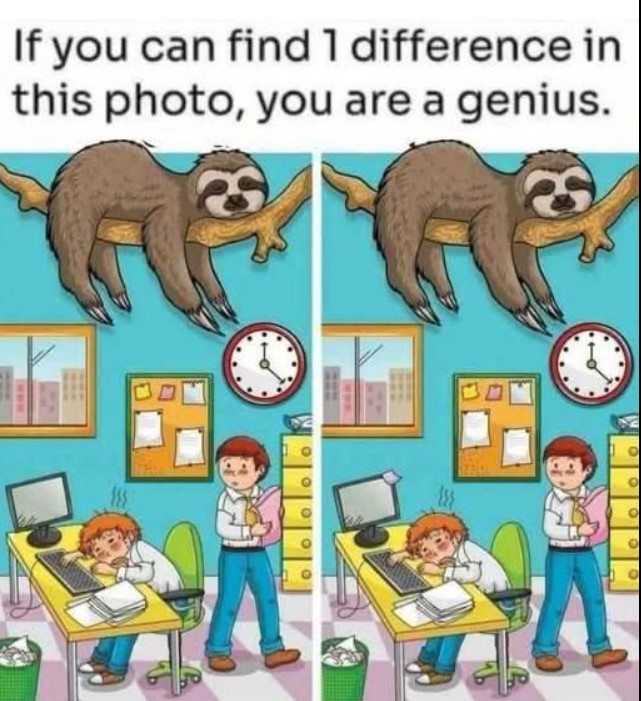
At first glance, these two pictures look almost exactly the same. A sleepy sloth hangs lazily from a tree branch above a busy office scene, while an employee works at a desk and a coworker stands nearby. The colors, characters, furniture, clock, bulletin board, and other small details appear to match perfectly.
But there is one small difference hiding somewhere in the image.
Can you find it without looking at the answer?
This kind of spot-the-difference puzzle is designed to test how carefully you observe visual details. The challenge may look simple, but when two images contain so many similar shapes and colors, your eyes can easily overlook one tiny change. Spot-the-difference puzzles are commonly used to develop visual scanning, discrimination, attention, and observation skills.
So before scrolling down for the solution, take a moment and examine both pictures carefully.
Can You Find the One Difference?
The challenge is straightforward: compare the picture on the left with the picture on the right and identify one detail that does not match.
Don’t rush.
Start by looking at the largest objects first. Compare the sloth, the tree branch, the wall clock, the office worker, the desk, the computer, and the furniture.
Everything seems to be in exactly the same position.
Now start paying attention to smaller objects.
Look at the desk.
Look at the computer.
Look at the objects surrounding the sleeping worker.
Look at the background.
You may notice that one tiny detail near the computer monitor doesn’t look quite right.
Did you spot it?
If not, don’t worry. This difference is deliberately subtle.
A Closer Look at the Scene
The picture contains several elements that make the challenge more difficult than it initially appears.
At the top, a large sloth is comfortably resting on a tree branch. Its relaxed expression and hanging position immediately attract attention, making it one of the first things most people examine.
Below the sloth is a colorful office environment.
A wall clock hangs near the upper-right portion of the scene. A bulletin board sits nearby with several pieces of paper and notes attached to it. There is also a window showing buildings outside.
In the lower portion, an employee appears to have fallen asleep at the desk. A computer monitor, keyboard, papers, and other office supplies are scattered across the workspace.
Another employee stands beside the desk holding what appears to be a folder or document.
Because there are so many objects to compare, your brain naturally tends to focus on the larger characters instead of tiny changes in individual objects.
That’s exactly what makes this puzzle tricky.
The One Difference Revealed
The difference is on the computer monitor.
Look closely at the monitor on the desk.
In the right-hand image, there is a small pink/purple detail near the upper-right corner of the monitor.
In the left-hand image, that small colored detail is missing.
That’s it!
The two illustrations are otherwise remarkably similar, which is why the difference can be so easy to overlook.
If you found it without help, congratulations—you have a very sharp eye.
Why Was This Difference So Difficult to See?
The difference is small, colorful, and positioned among many other details.
Your brain is naturally good at recognizing large objects and familiar shapes. When you look at the two pictures, you quickly register that the sloth is the same, the clock is the same, the people are the same, and the furniture is in roughly the same places.
Once your brain decides that the pictures are nearly identical, it becomes easier to overlook a tiny modification.
This is one reason spot-the-difference puzzles can be surprisingly challenging even when there is only one answer.
The goal isn’t simply to look at the picture.
You need to compare the pictures.
Why Spot-the-Difference Puzzles Are So Engaging
These puzzles are popular because they combine entertainment with focused observation.
Instead of simply looking at an image passively, you have a specific goal: identify something that doesn’t belong.
That goal encourages you to examine details more carefully.
Educational resources that use spot-the-difference activities describe them as useful for practicing visual scanning, visual discrimination, attention, cognition, and related observation skills.
They can also be used as simple warm-up activities, classroom exercises, or recreational challenges.
Of course, a single puzzle isn’t going to transform your memory or concentration overnight. The real value comes from the process of deliberately focusing your attention and comparing visual information.
A Good Strategy for Solving These Puzzles
If you frequently struggle with spot-the-difference challenges, don’t simply stare at both images randomly.
Use a method.
Start at the Top
Begin with the upper section of the image.
Compare the sloth carefully.
Look at its face, eyes, legs, claws, body, and the branch beneath it.
Then compare the surrounding background.
Move Across the Middle
Next, examine the clock, window, bulletin board, and wall.
Compare colors, shapes, numbers, lines, and small objects.
Sometimes a difference is hidden in something as tiny as a missing line or altered color.
Examine the Desk
The desk is often one of the most important areas in an office-themed puzzle because it contains many small objects.
Look at the computer.
Then compare the keyboard, papers, cups, accessories, and other objects.
In this particular puzzle, this method brings you directly toward the answer.
Check the Characters
Finally, compare the people.
Look at their clothing, hair, facial expressions, hands, shoes, and posture.
Even if you don’t find the difference immediately, this systematic approach prevents you from repeatedly examining the same areas.
Don’t Let the Most Interesting Object Distract You
The sleepy sloth is probably the most eye-catching part of this puzzle.
It’s large, unusual, and positioned prominently at the top of the image.
That makes it an obvious place to look.
But puzzle creators understand this.
A difference doesn’t have to be placed in the most interesting part of the image. In fact, hiding the answer somewhere less noticeable often makes the challenge much harder.
The computer monitor is a good example.
Because it occupies relatively little space compared with the sloth and the people, your attention may automatically move past it.
This is an important lesson for solving visual puzzles: the smallest objects deserve just as much attention as the largest ones.
Try the Challenge Again
Now that you know the answer, look at the original image one more time.
Don’t immediately focus on the highlighted detail.
Instead, compare the two pictures again from top to bottom.
You’ll probably notice that the tiny difference becomes much easier to see once you know where it is.
This is common with visual puzzles. Something can remain invisible for several seconds, then suddenly become completely obvious once your attention is directed to the right area.
That’s part of the fun.
What Does the Scene Tell Us?
The illustration itself is also amusing because it combines two completely different ideas.
At the top, the sloth represents relaxation and sleep.
Below, the office represents work and productivity.
Meanwhile, one of the office workers appears to have fallen asleep at the desk.
The result is a playful scene that immediately draws your attention.
The artist has filled the image with enough objects to make the comparison challenging without making the scene impossible to understand.
The colorful design also gives your eyes plenty of visual information to process.
Challenge Yourself With a Time Limit
Want to make the puzzle more difficult?
Try solving it under a time limit.
Give yourself 30 seconds and see whether you can identify the difference.
If that feels too easy, try 15 seconds.
You can even challenge a friend or family member to see who notices it first.
A time limit changes the experience because you have less opportunity to inspect every tiny detail individually. Instead, you need to scan the image efficiently and recognize inconsistencies quickly.
This is also why many online spot-the-difference puzzles use a seven-second or similar time challenge. The pressure encourages faster visual searching and makes the activity more exciting.
What If You Couldn’t Find It?
Don’t feel bad if you missed the difference.
The puzzle is specifically designed to make the answer difficult to notice.
The two images contain almost identical characters, colors, positions, and objects. Your brain is constantly looking for patterns, and once it recognizes that the two scenes are nearly the same, a tiny change can easily slip through unnoticed.
The important thing is not whether you found the answer instantly.
It’s how you approached the challenge.
With practice, you can become more systematic when comparing images. Instead of jumping randomly from one object to another, you’ll naturally begin dividing the image into sections and checking each area carefully.
The Best Way to Approach Future Puzzles
For future challenges, try this simple routine:
First: Compare the overall layout.
Second: Scan from top to bottom.
Third: Compare large objects.
Fourth: Examine small objects and accessories.
Fifth: Pay attention to colors and patterns.
Sixth: Check unusual or isolated objects.
Finally: Revisit any area that looks slightly different.
This method can be much more effective than staring at both pictures and hoping the difference suddenly appears.
Final Answer
If you haven’t found it yet, here’s the answer one more time:
The difference is the small colored mark on the computer monitor.
In the right-hand picture, a small pink/purple shape appears near the monitor’s upper-right corner. That detail is absent from the monitor in the left-hand picture.
It is an excellent example of how a tiny change can hide in plain sight.
Conclusion
The “Find 1 Difference: The Sleepy Sloth and Busy Office” puzzle may look easy because the scene is colorful and the two pictures appear almost identical. But that is precisely what makes the challenge entertaining.
The single difference is hidden in a small detail on the computer monitor—a tiny colored mark that is easy to overlook when your attention is drawn toward the sleepy sloth, the clock, the people, and the larger objects in the room.
If you spotted it without help, well done. You demonstrated strong attention to detail and careful visual comparison. If you missed it, don’t worry at all. These puzzles are meant to challenge you, and the more you practice looking systematically, the easier subtle differences can become to recognize.
The next time you encounter a similar puzzle, remember not to focus only on the biggest or most interesting objects. Scan the entire image, divide it into sections, compare colors and shapes, and pay special attention to tiny objects that might otherwise disappear into the background.
And most importantly, have fun with it. Sometimes a few minutes spent searching for one tiny difference is exactly the kind of simple mental challenge we need to slow down, concentrate, and give our eyes and attention something interesting to do