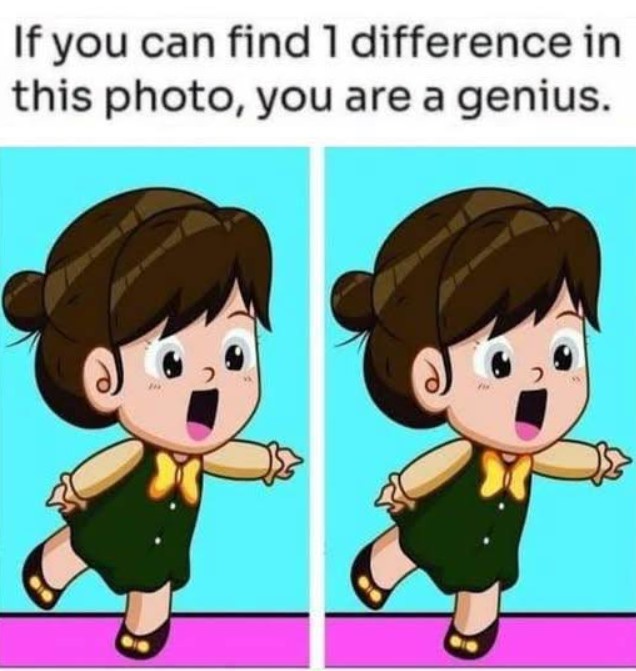
Some puzzles look easy until you actually try to solve them. This Spot 1 Difference challenge is a perfect example. At first glance, the two illustrations appear to show exactly the same cheerful girl wearing a beautiful green dress. Her expression, hairstyle, clothing, and pose all seem to match, making it difficult to imagine that anything could be different.
But somewhere in the two pictures, one tiny detail has been changed.
The challenge is to find it before you give up or look at the answer.
Spot-the-difference puzzles are popular because they turn an ordinary picture into an active observation exercise. Instead of simply looking at an illustration, you have to compare two versions carefully and notice a small inconsistency. The original puzzle presents a girl with brown hair styled in a bun, a dark green long-sleeved dress, a yellow bow around her neck, and dark shoes with yellow details.
So, how sharp are your eyes?
Take a Good Look Before Searching for the Answer
Before revealing anything, spend a few moments studying both pictures.
Don’t immediately jump from one obvious feature to another. Instead, try to compare the images systematically.
Start with the girl’s head.
Look at her brown hair and the way it is tied. Compare the shape of her bun and any loose strands.
Then move down to her face.
Check her eyes, eyelashes, eyebrows, nose, cheeks, and open mouth. A difference involving one small facial feature can be surprisingly difficult to notice because our brains tend to recognize the face as a whole rather than examine every individual line.
Next, look at her outfit.
The green dress contains several areas that could potentially hide a small change. Compare the neckline, sleeves, collar, folds, and lower portion of the dress.
Don’t forget the yellow bow around her neck.
Then move toward her arms, hands, legs, and shoes.
Finally, examine the background.
Sometimes puzzle creators hide the difference in an object or line away from the main character. The original puzzle itself encourages solvers to examine not only the girl’s appearance but also the background for possible clues.
The Girl in the Green Dress
The main character immediately attracts attention because of her bright, expressive appearance.
She has large eyes and an animated facial expression that makes her look surprised, excited, or perhaps delighted by something happening just outside the frame.
Her brown hair is gathered neatly into a bun, giving her a simple but recognizable hairstyle.
The dark green dress contrasts with the yellow bow at her neck, while her dark shoes feature small yellow decorations.
Her pose makes the scene especially playful. She appears to be moving quickly, almost as if she is skipping, dancing, or trying to keep her balance.
Because the illustration contains so many recognizable details, your brain quickly builds a mental picture of the girl.
And that is exactly what makes the challenge difficult.
Once your brain decides that the two girls are the same, it becomes much easier to overlook one small alteration.
Why One Difference Can Be So Difficult to Find
Our eyes don’t examine every part of a picture with equal attention.
When we look at an image, our brains rapidly identify important shapes, faces, colors, and objects. We don’t normally inspect every line individually.
That is useful in everyday life because it allows us to understand a scene quickly.
But it can work against us during a spot-the-difference puzzle.
If both pictures contain the same general character and composition, your brain may conclude that they are identical before you consciously verify every detail.
A tiny change can therefore hide in plain sight.
The challenge is not simply to look.
It is to compare.
Try a Systematic Search
If you’re having trouble finding the difference, stop scanning randomly.
Use a structured approach.
Step 1: Compare the Head
Start at the top.
Look carefully at the girl’s hairstyle.
Compare the bun, hairline, individual strands, and overall shape.
Then examine her face.
Check her eyes and eyelashes first, followed by her mouth and other facial features.
Step 2: Examine the Neck and Bow
Move downward and compare the yellow bow.
Look at its shape, size, position, and individual loops.
Small accessories are often excellent hiding places for differences because they contain multiple little shapes.
Step 3: Inspect the Dress
Now focus on the green dress.
Compare the neckline and sleeves.
Look at the folds and lines in the fabric.
Then examine the lower section of the dress.
Try not to assume that a difference must involve color. It could involve a missing line, an altered shape, or a tiny change in position.
Step 4: Check the Arms and Hands
Look at both arms carefully.
Compare the sleeves, hands, fingers, and the direction in which her arms are positioned.
Because the character is in motion, your eyes may naturally focus on her overall pose rather than the details of her hands.
Step 5: Compare the Legs and Shoes
Move down to her legs.
Look at the position and shape of each leg.
Then compare the shoes.
The yellow decorations on the dark shoes are particularly worth examining because small accessories can easily contain a hidden alteration.
Step 6: Scan the Background
Finally, stop focusing on the girl and compare everything behind her.
Look for changes in lines, colors, shapes, or small background elements.
This last step is important because solvers often spend the entire time staring at the main character.
Don’t Be Fooled by Similarity
One of the cleverest aspects of a good spot-the-difference puzzle is that most of the image is supposed to match.
If every part of the picture were different, the answer would be obvious.
Instead, almost everything remains exactly where your eyes expect it to be.
The green dress is the same.
The yellow bow appears the same.
The girl’s hair looks the same.
Her facial expression looks the same.
Her shoes appear the same.
This creates a powerful visual illusion: because so much information matches, your brain tends to assume that everything matches.
The single altered detail therefore has to compete with a huge amount of identical visual information.
Challenge Yourself to One Minute
Want to make the puzzle more exciting?
Give yourself 60 seconds.
Start a timer and see whether you can find the difference before the minute ends.
Don’t zoom in immediately. Try solving it using your natural eyesight first.
If you find the answer quickly, try again with a shorter time limit.
You could challenge yourself to 30 seconds, then 20 seconds, and eventually 10 seconds.
You can also compete with a friend or family member.
Show both people the same puzzle at the same time and see who identifies the difference first.
The winner isn’t necessarily the person who has the fastest eyesight. Often, it is the person who uses the most effective search strategy.
Why These Puzzles Are Fun for All Ages
Spot-the-difference puzzles are simple enough for children to understand but challenging enough to entertain adults.
They require no complicated rules.
You simply compare two images and look for something that doesn’t match.
That makes them an easy activity for a quiet afternoon, family gathering, classroom break, or casual online challenge.
They can also encourage people to slow down and focus on one task instead of constantly switching their attention.
The original puzzle specifically presents the activity as a way to exercise concentration and focus, while encouraging readers to challenge themselves against a one-minute goal.
A Helpful Trick: Compare One Area at a Time
One of the biggest mistakes people make is looking at the two pictures as complete scenes.
Instead, divide each picture into sections.
For example:
Top: hair and head
Upper middle: face, neck, and bow
Middle: arms and dress
Lower middle: legs and clothing
Bottom: shoes and surrounding details
Background: everything outside the character
Then compare each section before moving on.
This reduces the amount of information your brain has to process at once.
It’s much easier to compare two small areas than to compare two complete illustrations simultaneously.
Look for Missing Details
Another useful technique is to search specifically for things that might be missing.
Don’t only ask, “What was added?”
Ask:
- Is there a line in one image but not the other?
- Is a decoration missing?
- Does one sleeve have a different detail?
- Is one part of the hairstyle slightly different?
- Has a small shape disappeared?
- Is a background line incomplete?
This mindset can help because many spot-the-difference puzzles use subtraction rather than obvious additions.
Look for Changes in Shape
Color is usually the easiest difference to spot.
A bright red object becoming blue would stand out immediately.
But when a puzzle is designed to be difficult, the difference may involve shape instead.
A curve may be slightly different.
A line may be shorter.
A small object may have a different outline.
An accessory may be missing one portion.
When you have already checked the colors, start comparing shapes.
Don’t Forget the Tiny Details
The girl’s large eyes and green dress are visually dominant, but they may not be where the answer is hiding.
Pay attention to the little things.
Her bow.
Her shoes.
The lines in her clothing.
Her fingers.
The individual strands of hair.
Small background marks.
These details are easy to ignore because they don’t define the overall scene.
But in a spot-the-difference puzzle, they can be the most important parts of all.
What Makes This Puzzle Tricky?
This particular image uses a simple character design with strong colors and a clean illustration style.
That makes it easy to recognize the main elements but also creates a challenge because the two versions are so visually similar.
The green dress occupies a large part of the image.
The girl’s brown hair creates another strong visual feature.
The yellow bow provides a bright contrast.
Her dark shoes add another recognizable detail.
Your brain can therefore identify the character almost instantly without checking every individual feature.
That is why the puzzle requires deliberate attention.
Found It?
If you’ve already identified the difference, congratulations!
Don’t immediately stop there.
Take another look at both pictures and see whether you can explain exactly what changed.
Being able to describe the difference is a useful way to confirm that you weren’t simply guessing.
If you haven’t found it yet, keep going.
Start again from the top and move through the image slowly.
Sometimes taking a short break helps. Look away for a few seconds, then return to the pictures.
A fresh visual perspective can make a previously invisible difference suddenly stand out.
The Answer
Spoiler alert!
If you want to keep searching, stop reading here and return to the image.
If you’ve given it your best attempt and are ready for the solution, compare the answer image with the original puzzle and focus on the small altered detail.
The original page places the answer immediately after the challenge rather than explaining the difference in text, so the visual solution is the intended reveal.
When presenting this puzzle to others, it can be even more fun to keep the answer hidden until everyone has had a chance to search.
Turn It Into a Friendly Competition
This type of puzzle works especially well as a quick competition.
Gather several people and give everyone the same amount of time.
For example, everyone gets one minute.
Nobody is allowed to point at the image or give clues.
When the timer ends, each person announces whether they found the difference.
You can then reveal the answer and see who was fastest.
For an extra challenge, run several different puzzles and keep score.
It can turn a simple visual activity into a surprisingly competitive game.
What If You Couldn’t Find It?
Don’t worry.
Missing a tiny difference doesn’t mean you’re bad at observation.
The entire purpose of the puzzle is to make the altered detail difficult to notice.
Sometimes the difference simply falls outside the area you’re examining.
Other times, the surrounding details are so similar that your brain automatically fills in what it expects to see.
The important part is to develop a better search method rather than simply staring harder.
Slow down.
Divide the image into sections.
Compare systematically.
And don’t overlook the smallest objects.
Conclusion :
The “Spot 1 Difference: The Cute Girl in the Green Dress!” challenge is a simple but surprisingly effective visual test. With her brown hair, expressive face, dark green dress, bright yellow bow, and playful pose, the girl provides plenty of details for your eyes to examine.
The real challenge is resisting the temptation to glance at both pictures and assume they’re identical. When most of the image matches perfectly, one tiny alteration can become incredibly difficult to notice.
The best strategy is to slow down and work systematically. Start with the girl’s hair and face, move to her bow and dress, inspect her arms and shoes, and then carefully scan the background. Pay attention not only to colors but also to shapes, lines, missing details, and small decorations.
Whether you found the difference in seconds or needed a little help, the important thing is that the puzzle encouraged you to stop, concentrate, and examine something carefully.
So, how long did it take you to solve it?
If you found the difference quickly, you can proudly consider yourself a sharp-eyed puzzle solver. And if it took longer than expected, don’t worry—the next challenge might be the one where you spot the answer almost immediately.
Either way, the fun is in the search.