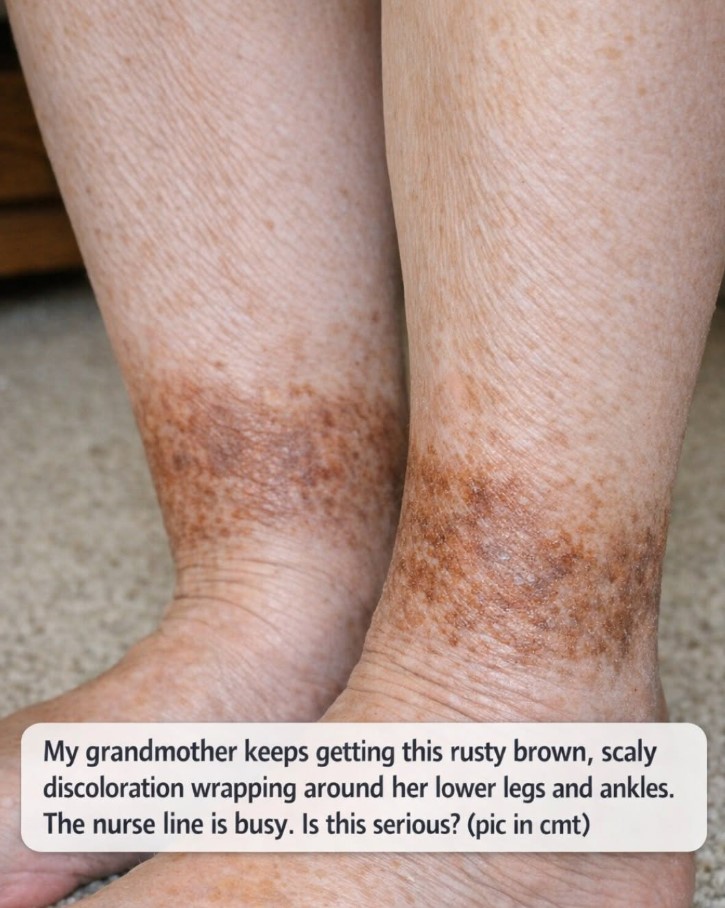
Seeing a rusty-brown, dry, or scaly discoloration spreading around an older person’s lower legs can be alarming, especially when it keeps coming back.
At first, it might look like nothing more than unusually dry skin. But when the discoloration is concentrated around the ankles and lower legs and is accompanied by swelling, itching, flaking, or changes in skin texture, there may be more going on beneath the surface.
One possible explanation is stasis dermatitis, a skin condition associated with problems returning blood from the legs back toward the heart. It is particularly common among older adults and people who experience chronic leg swelling or other circulation problems.
That doesn’t mean every brown or scaly patch is stasis dermatitis. Several other conditions can cause similar changes, which is why a medical examination is important.
The good news is that when the underlying cause is identified and treated appropriately, many people can manage the condition and reduce the risk of complications.
What Does Stasis Dermatitis Look Like?
Stasis dermatitis commonly affects the lower legs, especially around the ankles and shins.
The skin may develop a reddish-brown, rusty, or tea-stained appearance. Instead of forming one perfectly defined circle, the discoloration may spread around part or much of the lower leg.
The surface can become:
- Dry
- Flaky
- Itchy
- Scaly
- Thickened
- Shiny
- Firm or leathery
Some people also notice swelling, particularly later in the day.
For example, the legs may look relatively normal in the morning but become noticeably puffier by evening. Socks may leave deeper marks than usual, or the skin may feel tight after standing for long periods.
These details can be useful when describing the problem to a healthcare professional.
Why Does the Skin Turn Brown?
The discoloration isn’t simply a matter of the skin becoming dirty or dry.
Stasis dermatitis is often connected with chronic venous insufficiency, meaning the veins aren’t moving blood upward toward the heart as effectively as they should.
The veins in the legs contain small valves that help keep blood moving in the correct direction. When those valves become less effective, blood can begin pooling in the lower legs.
That increased pressure can cause fluid to move into surrounding tissue.
Inflammation follows, and tiny blood vessels may allow red blood cells to escape into the surrounding skin.
As those cells break down, they can leave behind an iron-containing pigment called hemosiderin, which contributes to the characteristic brown or rusty discoloration.
Meanwhile, persistent inflammation and swelling can cause the skin itself to become dry, irritated, thickened, and scaly.
Why Is It More Common in Older Adults?
Stasis dermatitis becomes more common with age because vein function can gradually change over time.
Several other factors can also increase the likelihood, including:
- Chronic leg swelling
- Varicose veins
- Previous blood clots
- Limited mobility
- Obesity
- Heart failure
- Previous leg injuries
- A history of vein surgery
Spending long periods sitting or standing can also contribute to symptoms.
The important point is that the skin changes may be a visible sign of an underlying circulation problem rather than simply an isolated skin issue.
Look for Swelling Around the Ankles
One useful clue is whether the discoloration is accompanied by swelling.
Pay attention to whether the ankles become puffier as the day progresses.
You might notice:
- Sock marks that remain for a while
- Tightness around the ankles
- Swelling after standing
- Heavy-feeling legs
- Visible varicose veins
- Skin that becomes increasingly irritated
These symptoms don’t prove that someone has stasis dermatitis, but they can provide useful information for a clinician.
If possible, take photographs of the legs in good natural light. Comparing photographs taken over several days or weeks can help show whether the affected area is spreading or changing.
Is It Just Dry Skin?
Sometimes dry skin really is just dry skin.
But persistent discoloration combined with swelling and scaling deserves more attention.
Ordinary dry skin generally doesn’t explain significant chronic swelling, reddish-brown staining around the ankles, or progressive changes in skin texture.
That’s why repeatedly applying moisturizer without investigating the cause may not be enough.
A clinician can look at the overall pattern and determine whether the problem appears related to venous circulation or whether another skin condition could be responsible.
Other Conditions Can Look Similar
Not every brown or red patch on the legs is caused by stasis dermatitis.
Several other conditions can produce redness, discoloration, scaling, or irritation.
These can include:
- Contact dermatitis
- Eczema
- Fungal infections
- Cellulitis
- Vasculitis
- Problems with arterial circulation
- A blood clot
The differences can sometimes be subtle, particularly during the early stages.
That’s one reason it is risky to diagnose the condition based solely on an internet photograph or description.
When Could It Be an Infection?
Cellulitis is one condition that deserves particular attention.
Unlike the gradual discoloration often associated with venous problems, cellulitis can develop more quickly and may cause increasing warmth, tenderness, redness, and swelling.
A rapidly changing area of redness—especially when accompanied by fever or significant pain—should not simply be assumed to be stasis dermatitis.
Other warning signs include drainage, pus, unpleasant odor, or an open wound.
These symptoms require prompt medical attention.
What About a Blood Clot?
A blood clot in a deep vein can also cause leg symptoms, but the pattern can be different.
One particularly important warning sign is sudden swelling affecting one leg much more than the other, especially when accompanied by new pain or tenderness in the calf.
If someone with concerning leg symptoms also develops chest pain, shortness of breath, sudden dizziness, or other symptoms suggesting a possible clot complication, emergency medical care is necessary.
Don’t wait for a routine appointment or a nurse line to become available in that situation.
When Should You Seek Urgent Care?
A gradual, stable discoloration isn’t necessarily an emergency.
However, certain changes should prompt same-day medical attention.
Seek urgent care if there is:
- Rapidly spreading redness
- Significant warmth
- New or severe pain
- Fever
- Pus or drainage
- A foul odor
- A new open sore
- Deep cracking or bleeding
- Sudden major swelling in one leg
A foot that becomes unusually pale, blue, or cold is another reason not to wait.
These signs can indicate infection, circulation problems, ulceration, or another condition that requires prompt assessment.
What If the Symptoms Have Been Developing Slowly?
If the discoloration has gradually developed over weeks or months, both legs are affected, and the person otherwise feels well, it may not require an emergency-room visit.
But that doesn’t mean it should be ignored.
A routine medical appointment within the next several days or couple of weeks can be appropriate depending on the symptoms.
If the skin is beginning to crack, the itching is severe, or the problem is interfering with sleep, arranging an appointment sooner is sensible.
Early attention can help prevent the skin from becoming increasingly fragile or developing ulcers.
What Can Be Done at Home While Waiting?
There are several relatively gentle measures that may help while waiting for medical evaluation.
Elevate the Legs
Raising the legs can help reduce fluid accumulation.
If possible, the legs can be elevated so that the ankles are above heart level for around 15 to 30 minutes at a time.
This can be done several times throughout the day if comfortable.
Simply placing the feet on a low footstool may not provide as much elevation as lying back and supporting the legs with pillows.
Moisturize Regularly
Dry, irritated skin benefits from consistent moisturization.
A bland, fragrance-free cream or ointment can help reduce dryness and scaling.
Thicker creams or ointments may work better than very light lotions.
Moisturizing shortly after bathing can also help retain moisture in the skin.
The goal is to protect the skin barrier and reduce cracking.
Avoid Very Hot Water
Long, hot baths or showers can make already-irritated skin even drier.
Using lukewarm water and keeping bathing relatively brief can be gentler on the skin.
Afterward, pat the legs dry rather than aggressively rubbing them.
Gentle Movement Can Help
If the person is able to walk safely, gentle movement can be beneficial.
The calf muscles help push venous blood upward toward the heart.
Long periods of sitting or standing without movement can contribute to pooling in the legs.
Even short, comfortable walks may be preferable to remaining completely still for long periods.
Of course, mobility recommendations should take into account the person’s overall health and ability to walk safely.
What About Compression Socks?
Compression therapy is commonly used for venous-related swelling and can be an important part of treatment.
However, compression isn’t appropriate for everyone.
People with significant problems affecting the arteries in their legs may be harmed by strong compression.
Warning signs of poor arterial circulation can include a cold foot, pain while walking, weak pulses, or ulcers on the toes.
Because of this, it is better not to automatically buy the strongest compression stockings available and begin using them without professional guidance.
A clinician can determine whether compression is appropriate and, when necessary, assess circulation before recommending it.
What Should You Avoid Putting on the Skin?
When the skin is irritated, it can be tempting to try every cream or household remedy available.
That can sometimes make matters worse.
Avoid harsh substances such as:
- Hydrogen peroxide
- Rubbing alcohol
- Strongly fragranced lotions
- Very hot water
- Irritating mentholated products
It’s also not a good idea to apply antibiotic ointment simply “just in case” unless a healthcare professional recommends it. Some topical antibiotics can themselves cause allergic skin reactions and make an existing rash more irritated.
Don’t Wrap the Legs Tightly Without Guidance
Another common mistake is tightly wrapping swollen legs with elastic bandages.
Improperly applied compression can create uneven pressure and cause additional problems.
If compression is needed, it’s better to learn the correct method from a qualified healthcare professional rather than improvising with household materials.
How Will a Doctor Diagnose the Problem?
A clinician will usually begin by examining the legs and asking questions about the history of the discoloration.
They may ask:
- When did it first appear?
- Is it getting worse?
- Are both legs affected?
- Does swelling increase during the day?
- Is there itching?
- Is there pain?
- Have there been previous blood clots?
- Are there varicose veins?
- Has there been a previous leg injury?
- Does the person have other circulation or heart problems?
The doctor may also check for ulcers, infection, swelling, and signs of reduced arterial circulation.
Depending on the findings, additional testing may be necessary.
Tests May Be Needed
If a blood clot is suspected, an ultrasound may be used to examine the veins.
If arterial circulation is a concern, a clinician may assess blood flow in the legs, potentially including an ankle-brachial index test.
If the appearance doesn’t fit a typical pattern, a dermatologist may be involved to investigate other causes of the skin changes.
The goal isn’t simply to identify the rash.
It’s to understand why the skin is changing.
How Is Stasis Dermatitis Treated?
Treatment depends on the underlying cause and the severity of the condition.
For stasis dermatitis, treatment may involve controlling swelling, protecting the skin, and improving venous circulation.
A clinician may recommend:
- Leg elevation
- Appropriate compression
- Regular moisturization
- Treatment for inflammation and itching
- Specialized wound care if ulcers develop
- Treatment for an infection if one is present
- Evaluation or treatment of underlying vein problems
In some cases, a topical corticosteroid may be prescribed for a limited period to reduce inflammation and itching.
If significant venous reflux is contributing to repeated symptoms, a vein specialist may also be consulted.
Why It’s Important Not to Ignore It
Even when stasis dermatitis isn’t an emergency, leaving it untreated for a long time can allow the skin to deteriorate.
Chronic inflammation can cause the skin to become:
- Thick
- Fragile
- Permanently discolored
- More prone to cracking
Small cracks can eventually develop into wounds, and wounds around the lower leg can sometimes become difficult-to-heal venous ulcers.
That’s why “not an emergency” should never be confused with “not important.”
A Simple Checklist for Today
If your grandmother is otherwise feeling well and there are no emergency warning signs, start by observing the legs carefully.
Look at both legs in good lighting.
Compare the amount of swelling.
Check whether one leg is substantially larger than the other.
Look for:
- Warmth
- Tenderness
- Open areas
- Cracks
- Drainage
- Increasing redness
- Changes in skin texture
Taking clear photographs can also help document how the condition changes over time.
Then, if comfortable and appropriate, elevate the legs, keep the skin moisturized with a bland product, and avoid scratching.
Most importantly, arrange a medical evaluation rather than trying to diagnose the condition at home.
So, Is the Rusty-Brown Skin Serious?
The short answer is: it can be important, but the appearance alone doesn’t tell you how serious it is.
A gradual rusty-brown, scaly pattern around the ankles and lower legs—particularly when accompanied by chronic swelling—is compatible with stasis dermatitis.
The condition is often manageable, but it can progress to skin breakdown and ulcers if the underlying circulation problem isn’t addressed.
At the same time, sudden redness, warmth, severe pain, fever, rapidly increasing swelling, open wounds, or symptoms such as chest pain or shortness of breath require much more urgent attention.
Final Thoughts
Seeing persistent brown, scaly discoloration around an older person’s ankles and lower legs can understandably be worrying.
One possible explanation is stasis dermatitis, which is often related to chronic venous insufficiency and the pooling of blood and fluid in the lower legs. The resulting inflammation can leave the skin dry, itchy, thickened, and stained a rusty or reddish-brown color.
But an important distinction remains: a description or photograph cannot confirm a diagnosis.
Other conditions can resemble stasis dermatitis, including infections, blood clots, eczema, fungal conditions, and problems with arterial circulation.
If the changes have developed gradually and the person feels well, arranging a medical appointment soon is a sensible next step. While waiting, gentle leg elevation, regular moisturizing, avoiding harsh products, and safe movement may help protect the skin.
But if the skin suddenly becomes much redder, warmer, more painful, or swollen—or if there is fever, drainage, an open wound, chest pain, shortness of breath, or a cold or blue foot—don’t wait for a routine appointment.
The most important thing is not to panic, but not to ignore persistent changes either. Getting the cause identified early can make treatment easier and may help prevent a manageable skin problem from becoming a much more serious one.