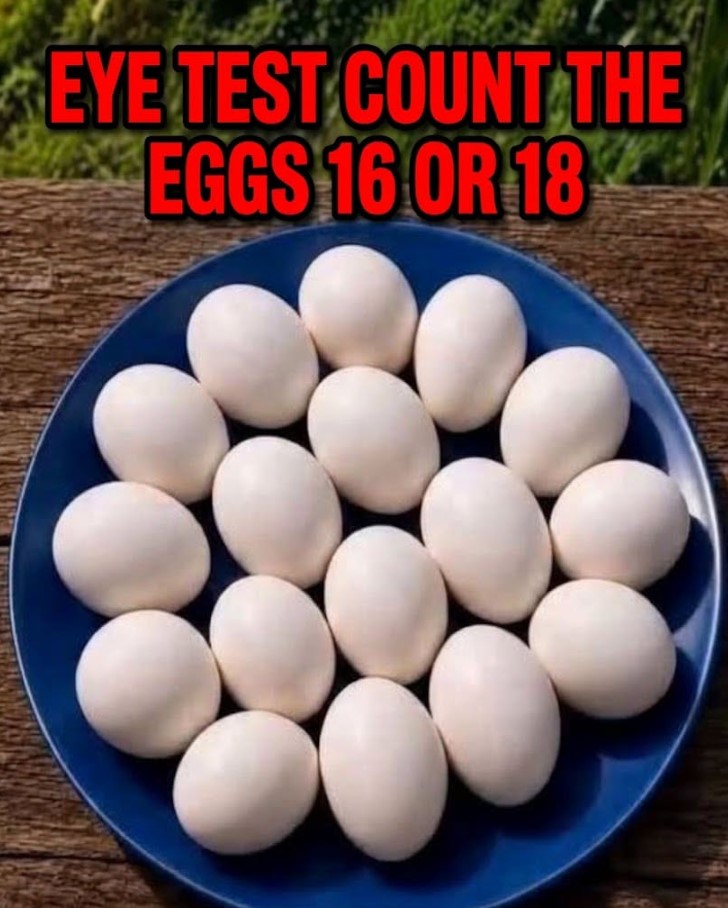
At first glance, this picture seems to present a very simple challenge. A blue plate is filled with eggs, and all you have to do is count them. The question sounds easy: Are there 16 or 18 eggs?
But don’t be too quick with your answer!
This little visual puzzle has confused many people because the eggs are arranged closely together in a circular pattern. Some appear to overlap, while others are tucked into the middle of the group. When you look at the entire plate at once, it is easy to lose track of which eggs you have already counted.
Many people immediately choose 16, while others are convinced that the answer must be 18. Surprisingly, neither answer is correct.
The actual number is 17 eggs.
Let’s take a closer look and discover how to count every egg without missing one or counting the same egg twice.
The Egg Counting Challenge
The picture shows a blue plate filled with eggs arranged in a compact group. The challenge asks viewers to examine the image carefully and decide whether they can find 16 or 18 eggs.
Before reading the explanation, imagine that you are looking at the plate yourself.
Would you count each egg individually, or would you try to estimate the total number by looking at the arrangement?
The second method may seem faster, but it is also where mistakes often happen. When objects are packed closely together, our eyes can easily jump from one shape to another.
The best strategy is to divide the picture into smaller sections and count each section systematically.
The Correct Answer: 17 Eggs
The plate contains exactly 17 eggs.
The easiest way to understand the answer is to separate the eggs into two groups:
- 13 eggs in the outer circle
- 4 eggs in the inner section
When we add these two groups together, we get:
13 + 4 = 17
Now let’s count them one by one.
Step 1: Count the 13 Eggs Around the Outside
Start at the very top of the plate and move clockwise, following the outer circle.
Try not to jump from one side to another. Moving in a single direction makes it easier to keep track of every egg.
Here is the complete count:
- The first egg is at the top center.
- The second egg is near the upper-right side.
- The third egg is slightly lower on the right.
- The fourth egg is around the middle-right section.
- The fifth egg is farther down on the lower-right side.
- The sixth egg is near the bottom-right area.
- The seventh egg is close to the lower-right edge.
- The eighth egg sits at the bottom center.
- The ninth egg is toward the bottom-left section.
- The tenth egg is along the lower-left edge.
- The eleventh egg is around the middle-left side.
- The twelfth egg is higher up on the left.
- The thirteenth egg is just before reaching the starting point at the top.
Once you complete the circle, you have counted 13 eggs.
Step 2: Find the 4 Eggs in the Middle
Now that the outer group is complete, move your attention to the center of the plate.
There are four additional eggs nestled inside the outer arrangement.
They are easier to overlook because they are surrounded by the other eggs and do not form a clearly separated circle.
Continue counting carefully:
- The fourteenth egg is in the upper-middle area.
- The fifteenth egg is slightly lower and to the right.
- The sixteenth egg is directly below that one, closer to the center.
- The seventeenth egg is in the lower-middle section.
That completes the count.
Step 3: Add the Two Groups Together
Now we simply combine the outer and inner groups.
| Egg group | Number |
|---|---|
| Outer circle | 13 |
| Inner section | 4 |
| Total | 17 |
The final calculation is:
13 + 4 = 17 eggs
So, although the challenge asks whether there are 16 or 18 eggs, the correct answer is actually 17.
Why Is This Puzzle So Easy to Get Wrong?
You might wonder how something as simple as counting eggs can become confusing. The answer has a lot to do with how we visually process groups of objects.
1. The Eggs Are Packed Closely Together
When objects are placed next to one another, their outlines can blend into a single visual pattern.
Instead of seeing 17 separate eggs, your eyes may initially register one large group. This makes it difficult to identify where one egg ends and another begins.
2. The Circular Arrangement Can Confuse Your Counting
The eggs around the outside form a rough circle. If you move your eyes randomly, you may accidentally count one egg twice or skip another entirely.
Following the outer edge in one direction helps prevent this problem.
3. The Middle Eggs Are Easy to Miss
Many people concentrate on the eggs around the outside because they are easier to follow.
However, the four eggs in the middle are just as important. Forgetting even one of them can lead to an incorrect answer.
4. The Two Suggested Answers Can Influence Your Judgment
The question specifically asks whether there are 16 or 18 eggs. This can make people feel that one of those two numbers must be correct.
But a good puzzle encourages us to examine the picture rather than simply accept the choices presented.
The correct total is 17, even though that number is not included in the question.
A Simple Method for Solving Similar Visual Puzzles
If you enjoy hidden-object challenges and counting games, a few simple habits can help you improve your accuracy.
Start from a clear point: Choose an object at the top, bottom, or corner of the image and begin there.
Follow one direction: Move clockwise or counterclockwise rather than jumping randomly around the picture.
Separate the groups: Look for objects around the outside and then examine the center.
Count slowly: Speed is not important. Accuracy matters much more.
Double-check the total: Once you finish, count each section again to make sure nothing was missed.
These techniques can be useful for many different visual puzzles, especially those involving overlapping shapes, crowded illustrations, or objects arranged in circles.
Conclusion
The Egg Count Challenge is a perfect example of how an ordinary-looking picture can turn into a surprisingly entertaining brain teaser. At first, the plate appears to contain either 16 or 18 eggs, and the crowded arrangement makes it easy to feel uncertain about the total.
However, once we slow down and divide the picture into smaller sections, the answer becomes clear. There are 13 eggs around the outside and another 4 eggs in the middle, giving us a final total of 17 eggs.
The most interesting part of this puzzle is that the answer is not particularly difficult to calculate. The real challenge is paying attention to every detail and avoiding the temptation to guess based on the overall appearance of the image.
It also reminds us that the choices presented in a question are not always the only possibilities. Sometimes, the correct answer is something we did not expect because we accepted the suggested options too quickly.
So, did you find all 17 eggs on your first attempt, or did you initially choose 16 or 18? Either way, this little challenge shows why taking a few extra seconds to observe carefully can make all the difference.
Share the puzzle with your family and friends and see who can discover the correct number without looking at the explanation. You might be surprised by how many people are convinced that the answer is 16 or 18 before finally discovering the missing number: 17!