Have you ever come across a simple-looking math puzzle that makes you stop and think twice? Some riddles are designed to test more than just our ability to calculate numbers. They challenge us to slow down, pay attention to mathematical rules, and avoid making quick assumptions.
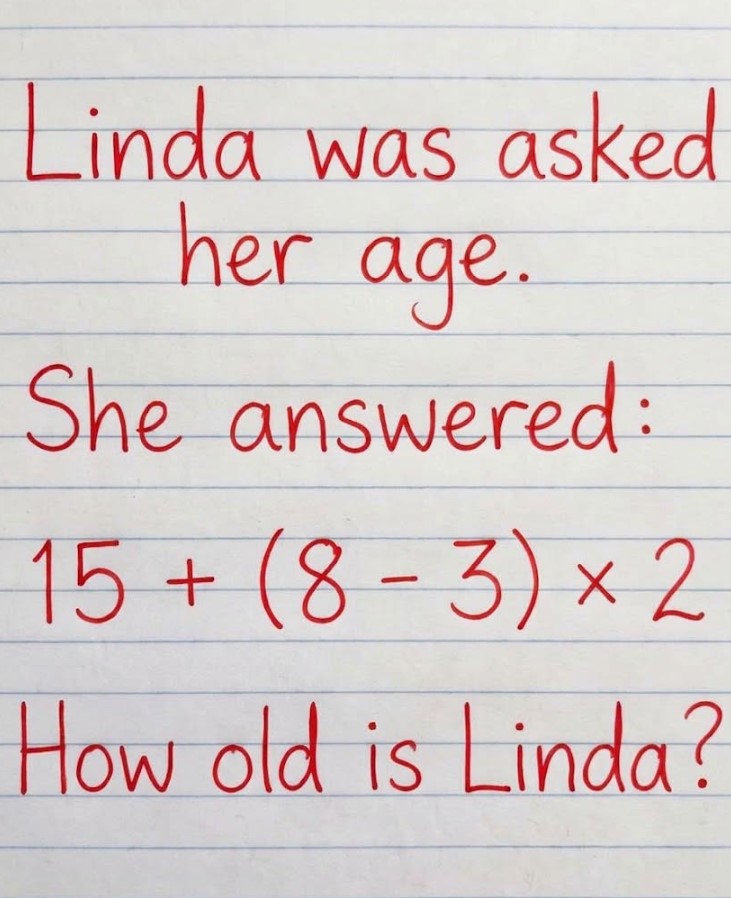
That is exactly what happens in this little brain teaser about Linda. When someone asks her how old she is, she doesn’t give a straightforward answer. Instead, she responds with a mathematical expression:
15 + (8 − 3) × 2
At first glance, the calculation may seem easy. However, the answer depends on following the correct order of operations. If you rush through the equation or solve it from left to right, you may end up with the wrong result.
So, can you work out Linda’s age? Let’s break down the puzzle step by step.
Take a Moment to Solve the Puzzle
Before looking at the answer, try solving the expression yourself:
15 + (8 − 3) × 2
What would you calculate first?
Some people may be tempted to start with the addition because 15 appears at the beginning of the expression. Others might simply work through the numbers from left to right.
However, mathematics follows a specific set of rules that tells us which operations must be completed first.
Understanding the Order of Operations
The key to solving Linda’s age puzzle is understanding the order of operations.
In mathematics, we cannot always perform calculations from left to right. Certain operations have priority over others, and following that priority ensures that everyone arrives at the same correct answer.
A common way to remember these rules is the acronym PEMDAS, which stands for:
- P – Parentheses: Calculate anything inside parentheses first.
- E – Exponents: Evaluate powers and roots.
- M – Multiplication: Perform multiplication.
- D – Division: Perform division.
- A – Addition: Perform addition.
- S – Subtraction: Perform subtraction.
Multiplication and division have equal priority and are handled from left to right. Addition and subtraction also have equal priority and are handled from left to right.
For Linda’s puzzle, we only need parentheses, multiplication, and addition.
Step 1: Solve the Parentheses
The original expression is:
15 + (8 − 3) × 2
According to the order of operations, anything inside parentheses must be calculated first.
We therefore begin with:
8 − 3 = 5
Now we replace the expression inside the parentheses with its result.
The equation becomes:
15 + 5 × 2
We have completed the first step, but we are not ready to add the numbers yet.
Step 2: Perform the Multiplication
After solving the parentheses, we are left with:
15 + 5 × 2
There are two operations in this expression: addition and multiplication.
According to PEMDAS, multiplication must be completed before addition.
So we calculate:
5 × 2 = 10
Replacing the multiplication with its result gives us:
15 + 10
The expression is now much easier to solve.
Step 3: Complete the Addition
We have reached the final step.
All that remains is to add 15 and 10 together:
15 + 10 = 25
And there we have it!
The correct answer to Linda’s age puzzle is 25 years old.
Why Do Some People Get This Puzzle Wrong?
Although the calculation is relatively short, it is easy to make a mistake when we overlook the order of operations.
One common error is solving the expression from left to right:
15 + (8 − 3) × 2
Someone might calculate 15 + 5 first, then multiply the result by 2. That would produce 40, but it would not follow the correct mathematical rules.
The multiplication must happen before the addition. That small detail completely changes the result.
Another reason people make mistakes is that they rush. When an equation looks simple, we sometimes assume we already know the answer and skip the rules that should guide us.
The best approach is to pause, identify the operations, and work through them in the correct order.
A Simple Tip for Solving Similar Math Puzzles
Whenever you encounter an expression containing several different operations, take a moment to identify what needs to be calculated first.
Start with parentheses, then handle exponents, multiplication and division, and finally addition and subtraction.
You can also rewrite the expression after each step. This makes it easier to follow your progress and reduces the chance of accidentally skipping an operation.
For example, Linda’s puzzle becomes much clearer when written one line at a time:
15 + (8 − 3) × 2
15 + 5 × 2
15 + 10
25
Each line shows exactly what changed, making the solution easy to understand and check.
Conclusion: So, How Old Is Linda?
After carefully following the order of operations, we can finally answer the question that started this little mathematical challenge.
Linda is 25 years old.
The solution is simple once we remember that parentheses come first, multiplication comes before addition, and the final addition comes last.
First, we subtract 3 from 8 to get 5. Then we multiply 5 by 2 to get 10. Finally, we add 10 to 15, giving us the answer of 25.
What makes this puzzle interesting is that it reminds us how easily a small mathematical detail can lead to a completely different result. The numbers themselves are not difficult, but the order in which we calculate them makes all the difference.
It is also a good reminder that solving a puzzle is not always about being the fastest person in the room. Sometimes, the smartest approach is simply to slow down, read carefully, and follow the rules.
So, if you answered 25 without looking at the explanation, congratulations! You understood the order of operations. And if you got a different answer at first, don’t worry. That is exactly why these little brain teasers are useful: they give us a fun way to practice basic mathematics and sharpen our attention to detail.