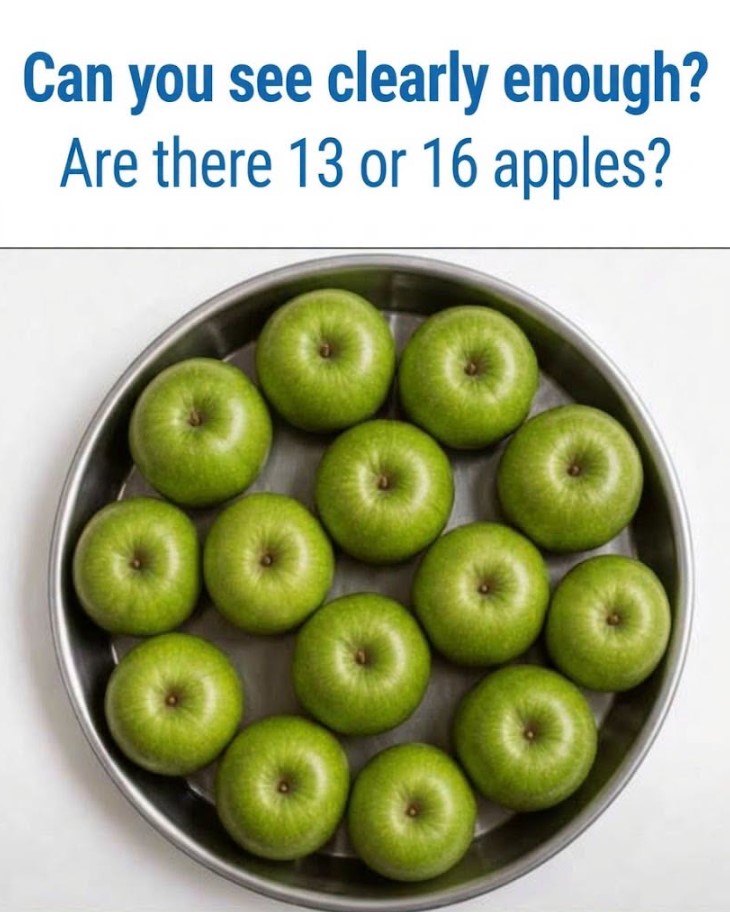
Sometimes, the simplest pictures can turn into surprisingly tricky challenges. A tray filled with red apples may not seem difficult to count at first, but when several objects are placed close together, our eyes can easily lose track of them.
That is exactly what makes this visual puzzle so interesting. At first glance, you might be confident that you can count every apple in just a few seconds. But once you look more carefully, you may begin to wonder whether you missed one or accidentally counted the same apple twice.
The challenge is simple: look at the picture of the round silver tray filled with red apples and decide how many there are. Are you seeing 13, 16, or perhaps another number?
Before revealing the answer, take a moment to examine the picture for yourself. Try not to rush. A careful count is more important than a quick guess.
Take a Closer Look at the Apples
When you first look at the tray, the apples may appear to form one crowded group. Their similar color and rounded shapes make it difficult to distinguish where one apple ends and another begins.
Instead of counting randomly, choose a starting point. You could begin at the top of the tray and move clockwise, or start on the left side and work your way around.
The important thing is to follow a consistent direction.
If two apples overlap, pay attention to their individual outlines. A small visible section of an apple can be easy to overlook, especially when another apple is covering part of it.
You can also use your finger to point at each apple as you count. This simple technique helps prevent you from skipping an apple or counting one twice.
Why Is This Picture So Confusing?
This type of visual challenge takes advantage of how we naturally process information.
When we see several similar objects grouped together, our brains often recognize the overall arrangement before identifying every individual object. We may understand that the tray contains a pile of apples without immediately noticing exactly how many are present.
There are several reasons why this can make counting difficult:
Similar colors: All the apples are red, so their boundaries may not stand out clearly.
Overlapping shapes: Some apples partially cover others, making it harder to identify each one.
Crowded arrangement: Because the apples are close together, it is easy to lose your place while counting.
Counting too quickly: When we rush, we may skip an object or accidentally count the same one more than once.
These small details can turn an ordinary counting exercise into an entertaining brain teaser.
The Correct Answer: 14 Apples
If you counted 13 or 16 apples, you are not alone. Those are two of the numbers that make this puzzle interesting.
However, the correct answer given in the original puzzle is 14 apples.
That means the tray contains neither 13 nor 16 apples. The correct total is right between the two suggested numbers.
The next time you examine a crowded picture like this, try counting slowly and separating the objects into smaller groups. Rather than looking at the entire tray as one large collection, focus on one section at a time.
Once you have counted one section, move to the next without returning to the previous area. This makes it easier to keep track of your progress.
Tips for Solving Similar Visual Counting Puzzles
Visual counting challenges are a fun way to practice concentration and attention to detail. Here are a few simple techniques that can help you solve them more accurately.
1. Choose a starting point. Begin at a clear position, such as the top, bottom, or left side of the picture.
2. Follow one direction. Move clockwise or from left to right. Avoid jumping randomly between objects.
3. Count in smaller groups. Divide a crowded arrangement into sections and count each section separately.
4. Look for hidden outlines. When objects overlap, search for the visible edges that distinguish one object from another.
5. Check your final count. Once you reach the end, repeat the process in the same direction to see whether you arrive at the same number.
These methods are useful not only for apple puzzles but also for pictures containing coins, flowers, animals, shapes, or other repeated objects.
Conclusion: Did You Find All 14 Apples?
Now that the answer has been revealed, we can finally settle the question: the tray contains 14 apples. Although the puzzle asks whether there are 13 or 16, neither of those numbers is correct. The actual answer is one that many people might overlook when they rely only on their first impression.
What makes this challenge particularly interesting is how such an ordinary picture can make us question what we see. Red apples arranged on a simple silver tray should be easy to count, yet their similar shapes, close arrangement, and overlapping edges can make the task surprisingly confusing. Sometimes, we become so focused on counting quickly that we fail to notice a small detail. Other times, we count one apple twice because we lose track of where we started.
This is a good reminder that careful observation matters. Instead of immediately choosing an answer, take a few seconds to examine the entire picture. Give yourself a clear starting point, move in one direction, and make sure every apple is counted only once. A calm and organized approach can make a big difference, even when the challenge appears simple.
And remember, getting the answer wrong on your first attempt does not mean you have poor eyesight or a lack of concentration. These puzzles are designed to make us look twice and question our assumptions. The enjoyment comes from the process of observing, counting, checking, and finally discovering the correct answer.
Perhaps you found all 14 apples immediately. Maybe you counted 13, then went back and discovered the extra one. Or perhaps you were convinced there were 16 until you took another look. Whatever happened, the important thing is that you gave your brain a little exercise and had some fun along the way.
Why not share this picture with a friend, a relative, or someone who enjoys a good brain teaser? Ask them to count the apples without telling them the answer. You may be surprised to discover that two people can look at exactly the same picture and come up with completely different numbers.
And when they finally discover that the answer is 14, you can ask them the same question again: did they really see all the apples, or did their eyes play a little trick on them?
Sometimes, the smallest challenges are the ones that make us stop, think, and smile. Keep observing, stay curious, and never underestimate the fun of a simple puzzle!