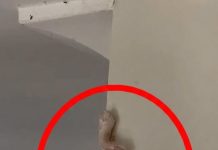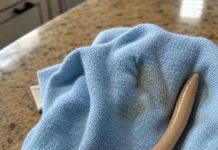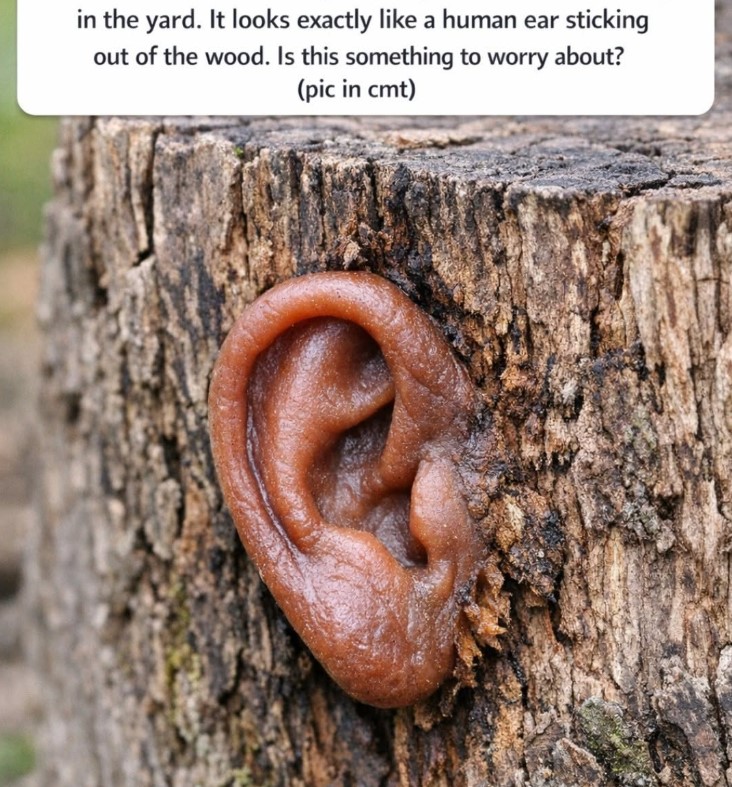
It was brown, softI was walking around the yard when I noticed something strange growing from an old tree stump.
At first, I th-looking, and strangely shaped.
And the more I looked at it, the more obvious the resemblance became.
It looked exactly like a human ear sticking out of the stump.
I had never seen anything quite like it before.
Was it some kind of plant? A strange insect nest? A piece of decaying wood? Or something that had been left behind by an animal?
The answer turned out to be much more natural—but no less fascinating.
It May Be a Fungus Called Wood Ear
The description of a brown, rubbery, ear-shaped growth attached to an old stump is a strong match for what is commonly called wood ear or jelly ear fungus.
Wood ear fungi belong to the Auricularia group and are known for their unusual appearance.
Unlike the classic mushroom shape most people imagine, these fungi can form thin, flexible structures that grow directly from dead or decaying wood.
Their fruiting bodies can be brown, reddish-brown, grayish, or nearly black, and they often have a soft, rubbery or gelatinous texture.
Most remarkably, they really can look like little ears growing from a tree.
That explains why the discovery can be so startling.
It isn’t your imagination.
The fungus actually has an ear-like shape.
Why Does It Look So Much Like an Ear?
The resemblance comes from the way the fungus grows.
The fruiting body often begins as a small cup-like structure. As it develops, the edges expand outward and become folded and wavy.
Eventually, the structure can form lobes that look surprisingly similar to the shape of a human ear.
The surface may also develop wrinkles and vein-like ridges, making the resemblance even stronger.
Depending on its age and how much moisture it contains, the fungus can look smooth, wrinkled, translucent, leathery, or almost black.
It’s one of those unusual examples of nature creating a shape that looks almost too familiar to be accidental.
Why Is It Growing on an Old Stump?
The location provides another major clue.
Wood ear fungi are commonly associated with dead and decaying wood.
An old stump is practically an invitation for decomposing fungi.
As wood ages, its structure gradually breaks down. Fungi help digest the tough materials in the wood and recycle those nutrients back into the surrounding ecosystem.
So if you see an ear-shaped fungus growing from a dead stump, it doesn’t necessarily mean something new and dangerous has attacked your yard.
It may simply mean that the stump is continuing its natural decomposition process.
The Fungus May Be Helping the Stump Disappear
A dead tree doesn’t simply vanish overnight.
The wood has to be broken down over time.
Fungi are an important part of that process.
Wood ear and other fungi that live on decaying wood act as decomposers. Their fungal networks spread through the wood and obtain nutrients by breaking down organic material.
Eventually, the stump becomes softer, weaker, and more integrated into the soil.
So that strange-looking “ear” could actually be evidence that nature’s recycling system is working exactly as it should.
Why Does It Feel Rubbery?
One of the easiest characteristics to notice with wood ear fungus is its texture.
Fresh specimens can feel surprisingly rubbery and flexible.
They aren’t necessarily soft like a piece of wet bread or mushy like rotting fruit.
Instead, they can have a firm, elastic quality.
This unusual texture is one reason the fungus can look so strange when you find it unexpectedly.
If you’ve never encountered one before, you might reasonably assume that somebody placed a piece of rubber or silicone on the stump.
But once you recognize the characteristic texture, the identity becomes much easier to understand.
Rain Can Make It Look Completely Different
Another fascinating characteristic is how much the fungus can change depending on moisture.
After rain or during humid weather, the fruiting bodies can become plumper and more flexible.
They may look almost gelatinous.
During dry conditions, they can shrink and become much darker and tougher.
A dried specimen may look dramatically different from the same fungus after rainfall.
This can make people wonder whether a new fungus appeared overnight.
In reality, the same fruiting body may simply have absorbed water and expanded again.
Is It Something Dangerous?
For most people, finding this kind of fungus growing on an old dead stump isn’t something that should cause immediate concern.
The fungus itself is part of the natural decomposition process.
The more important question is the condition and location of the stump.
If the stump is already dead and sits safely away from buildings, walkways, and play areas, there may be no urgent reason to remove it.
If the stump is unstable or positioned somewhere where it could become a hazard, removing or grinding the stump may be worthwhile.
In that situation, the fungus is more of a clue about the condition of the wood than the actual problem.
What If It Is Growing on a Living Tree?
This is where you should pay a little more attention.
A fungus growing on an obviously dead stump is one thing.
Finding unusual fungal growth on the trunk or major branches of a living tree can be more complicated.
Fungal fruiting bodies may sometimes indicate that decay is present in the wood.
That doesn’t automatically mean the tree is about to fall, but it can be worth having the tree assessed if you also notice cavities, large wounds, dead branches, extensive rot, or other signs of structural weakness.
The fungus itself isn’t necessarily the danger.
The condition of the tree underneath it is what matters.
Don’t Assume the Fungus Caused the Tree to Die
It’s easy to see fungus growing on a stump and conclude that the fungus killed the tree.
That’s not necessarily what happened.
Many fungi specialize in breaking down wood that is already dead or dying.
In those cases, the fungus is taking advantage of an existing source of food.
Think of it as a cleanup crew arriving after the main event.
The tree has died.
The wood remains.
Then fungi, insects, bacteria, and other organisms begin breaking it down.
The fungus is part of that larger ecological process.
Could It Be Something Other Than Wood Ear?
Yes.
Not every brown, jelly-like growth on wood is necessarily Auricularia.
There are several other fungi with unusual shapes and textures, and some can look superficially similar.
For example, other jelly fungi can form dark, irregular, gelatinous masses.
The exact species can depend on the type of tree, location, climate, and the detailed appearance of the fungus.
That’s why it is better to say the growth looks consistent with wood ear fungus rather than claiming that every photograph or description proves its identity.
If you want a confident identification, take several clear photographs from different angles and ask a local mushroom expert, naturalist, extension service, or knowledgeable mycologist.
What Should You Look For?
If you’re trying to determine whether the growth could be wood ear, look at several characteristics rather than just the shape.
A likely wood ear-type fungus may have:
- A brown or reddish-brown color
- An ear-like or cup-like shape
- A rubbery or gelatinous texture
- Wavy or folded edges
- A thin fruiting body
- Little or no obvious stem
- Growth directly from dead or decaying wood
The underside can also have wrinkles or vein-like structures rather than the familiar gills found on many common mushrooms.
The combination of these features is much more useful than the ear shape alone.
Should You Remove It?
If the fungus is growing on a harmless old stump in an out-of-the-way part of the yard, you don’t necessarily have to remove it.
You can simply leave it alone.
In fact, watching the fungus change after periods of rain can be surprisingly interesting.
It may expand.
It may become darker.
It may shrink during dry weather.
Then it may become plump again after the next rainfall.
You’re essentially watching decomposition happen in real time.
What If You Don’t Like the Appearance?
If the fungus is bothering you aesthetically, you can remove the visible fruiting bodies while wearing gardening gloves.
However, don’t expect that to permanently stop the fungus.
The visible “ears” are fruiting bodies produced by a larger fungal network inside the wood.
As long as the stump remains available as a food source, new fruiting bodies may eventually appear.
If you want to eliminate the source completely, the more effective solution is to deal with the stump itself.
Depending on its location, that might mean stump grinding or removal.
Should You Touch It?
There’s generally little reason to handle an unidentified wild fungus unnecessarily.
If you’re curious, taking photographs is usually the better option.
If you do need to handle it—for example, while clearing the stump—wear gardening gloves and wash your hands afterward.
And there is one especially important rule:
Don’t eat an unidentified wild fungus.
Even though certain wood ear species are edible and widely used as food, appearance alone isn’t enough to establish that a wild specimen is safe to consume.
Wood Ear Is Used as Food
This is one of the more surprising facts about these strange-looking fungi.
Wood ear fungi are used in various Asian cuisines.
They can be found dried or prepared in dishes such as soups, stir-fries, and other recipes.
Their unusual texture is one of their most recognizable culinary characteristics.
But this doesn’t mean that you should walk outside, pick the fungus from an old stump, and put it in your dinner.
Wild mushroom identification requires confidence and experience.
Some mushrooms have dangerous lookalikes, and incorrect identification can have serious consequences.
So if you’re interested in mushroom foraging, learn proper identification from reliable local experts before eating anything you find outdoors.
What About Children and Pets?
A strange mushroom growing in the garden can naturally attract attention from curious children or pets.
Because wild fungi can be difficult to identify, it’s best to prevent children and animals from chewing on them.
Dogs in particular may investigate unusual objects in the yard.
If you believe a child or pet has eaten an unidentified fungus, don’t wait for symptoms to appear. Contact an appropriate poison-control service, emergency medical service, or veterinarian for guidance and keep a photograph or sample available if it can be safely obtained.
When Should You Be Concerned About the Stump?
The fungus may not be the biggest issue.
The stump itself could become a problem if it is located somewhere people regularly walk or play.
Watch for signs such as:
- The stump becoming unstable
- Large sections collapsing
- Soft, rotten wood
- Large cavities
- Insect infestations
- Roots becoming exposed
- The stump interfering with mowing
- New fungal growth appearing on nearby living trees
If the stump is close to your house or another structure and appears unstable, professional advice may be worthwhile.
A Strange Discovery Can Be a Useful Clue
Finding the fungus can actually tell you something about what’s happening beneath the surface.
The visible fruiting body is only one part of the organism.
Much of the fungal network is hidden within the wood.
That means what you’re seeing on the outside is evidence of biological activity happening inside the stump.
The fungus is breaking down material that has become available.
In other words, the strange “ear” isn’t necessarily an invasion.
It can be a visible sign of decomposition.
Nature Can Produce Some Incredible Shapes
The resemblance to a human ear is what makes this discovery so memorable.
Nature is full of organisms that accidentally resemble familiar objects.
Some flowers look like animals.
Some insects resemble leaves.
Some fungi resemble brains, coral, shelves, or even ears.
Wood ear fungus is one of the best examples.
Once you know what it is, the strange shape becomes less frightening and much more fascinating.
What I Would Do If I Found One
If I discovered a growth like this in my own yard, I wouldn’t immediately reach for chemicals or start removing everything around it.
First, I’d take photographs.
I’d look at the stump and determine whether it was completely dead.
I’d check whether the fungus was growing from the stump itself or from a nearby living tree.
Then I’d leave it alone if there were no safety concerns.
If the stump was unstable or in a dangerous location, I’d address the stump rather than simply removing the visible fungus.
And if I wanted a precise identification, I’d ask someone experienced with local fungi.
Final Thoughts
That strange, rubbery brown object sticking out of an old stump may look unsettling at first, especially when it resembles a human ear so closely.
But if its shape, texture, and location match the typical characteristics, there’s a good chance you’re looking at some form of wood ear or jelly ear fungus. These fungi are well known for their ear-like fruiting bodies and their tendency to grow on dead or decaying wood.
In most cases, finding one on an old stump isn’t a reason to panic.
It may simply be nature’s way of recycling a piece of dead wood.
The important thing is to pay attention to the bigger picture. If the growth is on a dead stump that is safely out of the way, you can often leave it alone. If it is growing on a living tree or the tree shows signs of decay or structural weakness, getting professional advice may be sensible.
And although some wood ear fungi are edible, never assume an unidentified wild fungus is safe to eat just because it resembles a familiar species.
So the next time you spot something that looks like a tiny brown ear sticking out of a tree stump, don’t panic.
Take a closer look.
You may have stumbled upon one of nature’s strangest—and most fascinating—decomposers.