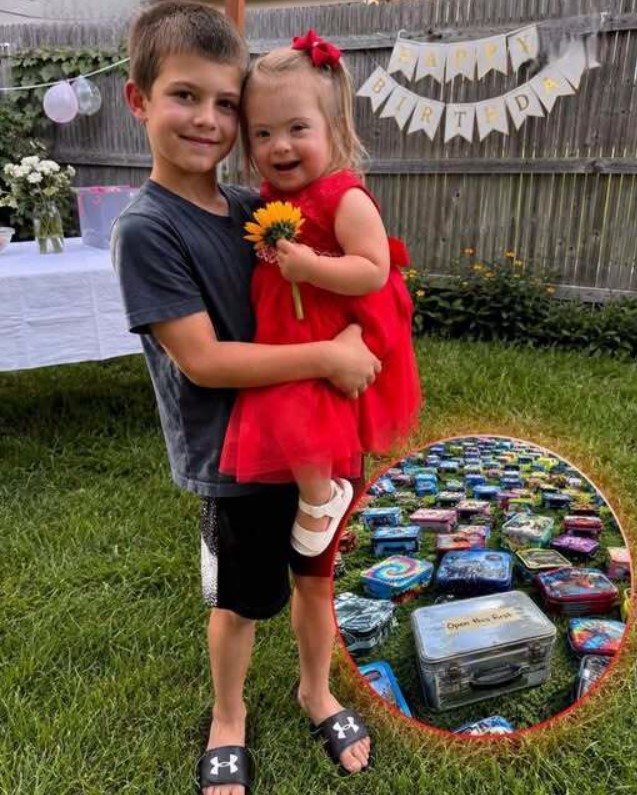
I never expected an ordinary act of kindness from my eight-year-old son to turn into something our entire neighborhood would remember.
Noah had always been a thoughtful child.
He noticed when someone was sitting alone.
He shared his toys without being asked.
And whenever he saw someone struggling, his first instinct was usually to find a way to help.
But one afternoon, I discovered that his kindness had gone much further than I realized.
He had stopped buying lunch at school.
Not because he disliked the food.
Not because he wasn’t hungry.
He had been saving his lunch money.
And he was saving every penny for a little girl who lived next door.
Her name was Lucy.
The Red Dress
Lucy was our neighbor’s daughter.
She was a cheerful little girl who loved music, colorful clothes, and anything that sparkled.
She also happened to have Down syndrome.
One day, Noah saw a bright red dress in a shop window.
He immediately thought of Lucy.
When he came home, he told me that he had found the perfect birthday present for her.
I assumed he was talking about a small toy or perhaps a card.
Instead, he had a very specific plan.
He wanted to buy her the red dress.
When I asked how he planned to pay for it, he proudly explained that he had been saving his lunch money.
That’s when I realized what he had been doing.
For days, Noah had been leaving the cafeteria without buying lunch.
He had been putting the money aside instead.
I was touched by his generosity, but I was also concerned.
No eight-year-old should be going hungry because he wants to buy a present for someone else.
We talked about it immediately.
I explained that helping other people is wonderful, but he should never sacrifice something as important as his own meals without telling us.
Eventually, we made sure he had the money he needed for the dress without skipping lunch.
Lucy’s Birthday
When Lucy’s birthday arrived, Noah couldn’t wait to give her the present.
Her family had organized a small backyard celebration.
There were balloons, snacks, music, and a handful of children running around the yard.
When Lucy’s mother opened the gift and showed her the red dress, Lucy’s face lit up.
She immediately wanted to put it on.
A few minutes later, she came outside wearing it.
Then she started spinning.
The red skirt moved around her as she laughed.
Noah laughed too.
He was absolutely delighted.
To him, the whole thing was simple.
He had seen something beautiful.
He thought Lucy would love it.
So he found a way to make her happy.
Not Everyone Understood
During the party, someone made an insensitive comment about the gift.
Noah’s grandmother questioned whether Lucy could really understand what a birthday present meant.
She seemed to think that because Lucy had Down syndrome, the gesture wouldn’t have the same meaning.
Noah didn’t understand why anyone would say that.
He simply replied:
“She understands when someone’s nice to her.”
His answer was simple.
But it said everything.
Lucy didn’t need to explain why she was happy.
She didn’t need to prove that she understood.
She was a child enjoying a birthday party and a beautiful new dress.
And Noah was simply happy that his gift had made her smile.
The Next Morning
I thought the story would end there.
It didn’t.
The following morning, I woke up and looked outside.
At first, I couldn’t understand what I was seeing.
Our front lawn was covered with lunchboxes.
There were dinosaur lunchboxes.
Superhero lunchboxes.
Sports-themed lunchboxes.
Colorful plastic boxes.
Metal lunch containers.
They stretched across the lawn almost all the way to the sidewalk.
For several seconds, I simply stood there staring.
Then Noah came running downstairs.
“Mom!”
He was just as confused as I was.
We went outside together.
In the middle of the lawn was an old metal lunchbox that looked completely different from the others.
A small note had been placed on top.
It said:
Open this first.
Noah reached down and picked it up.
Then he opened the lid.
And his expression changed immediately.
What Was Inside
There was a photograph.
It showed Noah leaving the school cafeteria.
Another photograph showed Lucy wearing the red dress.
Across the second photograph, someone had written a disturbing message:
Kindness has a price.
Beneath the photographs was something even more alarming.
A school master key.
And a list containing students’ names and home addresses.
My stomach dropped.
This wasn’t a harmless birthday surprise.
It wasn’t a neighborhood prank.
Someone had deliberately left those items where my son could find them.
I immediately told Noah to step away.
I called the police.
The Other Lunchboxes
While we waited for officers to arrive, I kept Noah away from the other lunchboxes.
I had no idea whether they were safe.
The police eventually closed off the area and carefully inspected each container.
What they discovered made the situation even stranger.
Most of the lunchboxes were completely harmless.
They contained sealed snacks, handwritten notes, small gifts, and donations.
They weren’t part of a threat.
They were part of a surprise.
Parents and teachers had heard about Noah giving up his lunch money for Lucy.
They had been so touched by his kindness that they decided to respond by helping him.
Some had contributed money to restore his school lunch account.
Others wanted to support Lucy’s family with expenses related to her developmental therapy.
The lawn had been filled with lunchboxes because the community wanted to teach Noah that kindness can come back to you in unexpected ways.
But one lunchbox was different.
The old metal box.
That one wasn’t part of the surprise.
Who Left the Threat?
Investigators began examining the evidence.
The photographs turned out to be particularly important.
They eventually connected them to a former cafeteria contractor.
The man had previously worked at the school.
Noah had seen something suspicious while he was at the cafeteria.
He had noticed the contractor removing money from a register.
Noah had mentioned what he saw to a teacher.
Then, as children often do, he moved on.
He didn’t realize that his observation had serious consequences for the adult involved.
The contractor was eventually dismissed.
Investigators believed he blamed Noah for what happened.
The Master Key
The presence of the master key made the situation much more serious.
It wasn’t something that should have been outside a secured school office.
The address list was also alarming.
It contained information about students and their homes.
Police treated the message as a potential threat rather than dismissing it as a strange prank.
They collected fingerprints.
They reviewed surveillance footage.
They examined digital records.
They began tracing exactly how the information had been obtained.
The Man Was Found
Eventually, investigators located the former contractor and questioned him.
Because the case was still being investigated, our family was advised not to publicly identify him or discuss certain details.
For me, the most important thing wasn’t revenge.
It was keeping Noah safe.
And it was making sure that no other child or family was put in danger because someone had decided to retaliate against an eight-year-old.
I Had to Talk to Noah
After everything that happened, I sat down with Noah.
He was frightened.
He wondered whether buying Lucy a birthday dress had somehow caused everything.
I wanted to make one thing absolutely clear.
“None of this happened because you were kind.”
The danger came from an adult who made a terrible decision.
Noah’s generosity wasn’t the problem.
The problem was someone choosing to respond to a situation with anger and retaliation.
I didn’t want my son to learn the wrong lesson from what happened.
I didn’t want him to think that helping people was dangerous.
Instead, I wanted him to understand that kindness is valuable—but children also need boundaries and adults who can help them stay safe.
His Lunches Were Important Too
There was another lesson we needed to address.
Noah had been so determined to help Lucy that he had stopped spending his lunch money on himself.
His intentions were beautiful.
But going hungry wasn’t the right way to be generous.
I explained that taking care of yourself doesn’t make your kindness less meaningful.
Children should never feel that they have to sacrifice food or basic needs to prove that they care about someone else.
So we came up with a better idea.
We created a small family giving jar.
Whenever Noah wanted to help someone, he could tell us about it.
We could talk about the best way to help and make sure he wasn’t putting himself at risk.
That way, his generosity could continue—but safely.
The Lunchboxes Came Inside
Once the police cleared the lawn, the colorful lunchboxes were brought inside.
Noah opened them one by one.
Many contained wonderful little messages.
Some parents had written notes telling him how much they admired his kindness.
Others had included snacks or small donations.
Some simply wanted him to know that his actions had inspired them.
The sight was incredibly moving.
One little boy had sacrificed his lunch money to make another child happy.
And without even knowing it, he had inspired an entire community.
Kindness Came Full Circle
The contrast between the lunchboxes was impossible to ignore.
Most of them represented kindness.
The battered metal box represented something much darker.
One group of adults had seen Noah’s generosity and decided to respond with generosity of their own.
Another adult had seen the same act and chosen anger.
That difference stayed with me.
The same act can be interpreted differently by different people.
But we don’t get to control how others behave.
We can only control what we teach our children and how we respond when something goes wrong.
Lucy Was Never a Charity Project
There was another important conversation our family had after the incident.
Lucy wasn’t a symbol.
She wasn’t someone who needed to be treated as helpless.
She was simply a little girl Noah cared about.
The red dress wasn’t a grand gesture designed to make her family look unfortunate.
It was a birthday present.
A child saw another child and thought:
“She would look beautiful in this.”
That’s all it needed to be.
Children with Down syndrome can experience happiness, excitement, disappointment, affection, preferences, and humor just like other children.
Their families should be listened to rather than having strangers assume what they need.
What the School Did
The school took the situation seriously.
Access procedures were reviewed.
Security controls were strengthened.
The way contractors could access school facilities was examined.
Parents were informed about what had happened without unnecessarily sharing photographs or personal information about the children.
No one wanted to create more fear than necessary.
The goal was to make sure the school became safer because of what had happened.
Noah Went Back to School
Eventually, Noah returned to school.
He was nervous at first.
I could see it in the way he held my hand a little tighter than usual.
But he wanted to go back.
He wanted to see his friends.
He wanted to eat lunch with them.
And most importantly, he didn’t want one frightening experience to change who he was.
His lunch account had been restored.
The school also made sure he had access to meals while everything was being sorted out.
That mattered to me.
No child should have to wonder whether they can afford to eat lunch.
He Still Wanted to Help People
I asked Noah whether everything that happened had changed his mind about helping others.
He thought about it for a moment.
Then he shook his head.
“No.”
I smiled.
“Why not?”
He shrugged.
“Because Lucy still liked the dress.”
That was Noah.
He wasn’t thinking about the investigation.
He wasn’t thinking about the police.
He wasn’t thinking about the frightening message.
He was thinking about a little girl spinning around in a red dress and laughing.
What I Learned as His Mother
As parents, we often tell children to be kind.
We teach them to share.
We teach them to help people who need it.
We tell them that generosity matters.
But there is another lesson we need to teach alongside kindness.
Boundaries matter too.
Children should know that they don’t have to go hungry to help someone.
They shouldn’t give strangers personal information.
They shouldn’t investigate frightening situations alone.
And when something feels wrong, they should tell a trusted adult immediately.
Kindness and safety aren’t opposites.
We can teach children both.
The Red Dress Stayed
Lucy continued wearing the red dress.
Every time I saw her in it, I remembered the reason Noah had wanted to buy it.
Not because of everything that happened afterward.
But because of the beginning.
A little boy saw something beautiful and thought another child deserved it.
That was the part I wanted him to remember.
Not the threat.
Not the fear.
Not the investigation.
The kindness.
The Lawn That Changed Everything
Even now, I sometimes think about that morning.
I walked outside expecting to see an ordinary lawn.
Instead, I found dozens of lunchboxes stretching toward the sidewalk.
At first, it looked strange.
Then it became one of the most meaningful sights I had ever seen.
Those lunchboxes represented a community saying:
We saw what your son did.
We noticed his kindness.
And we want to help.
The one dangerous box couldn’t erase the meaning of all the others.
If anything, it made their message even clearer.
One person’s cruelty does not cancel out the kindness of many others.
Final Thoughts
My eight-year-old son wanted nothing more than to make a little girl happy on her birthday.
He gave up his lunch money because he saw a red dress in a shop window and imagined how beautiful Lucy would look wearing it.
His decision taught me something I will never forget.
Children can have enormous hearts.
But they also need adults to protect those hearts.
Noah learned that kindness doesn’t mean sacrificing your own basic needs.
He learned that frightening situations should always be shared with trusted adults.
And he learned that courage isn’t only about doing something generous.
Sometimes courage means telling someone when something doesn’t feel right.
Our family also learned something from the lawn full of lunchboxes.
When people heard about Noah’s kindness, they had a choice.
They could ignore it.
Or they could respond.
Most chose to respond with kindness of their own.
Parents and teachers came together to restore Noah’s lunch account and support Lucy’s family. Their response showed Noah that generosity can spread from one person to another.
The battered metal lunchbox reminded us that not everyone responds to kindness with kindness.
But it didn’t get the final word.
The final word belonged to Noah.
He still wanted to help.
He still cared about Lucy.
And he still believed that being kind was worth it.
The red dress began with one little boy giving up his lunch money.
The lunchboxes that later covered our lawn showed him that kindness can travel much farther than we ever expect.
And that is the lesson I hope he carries with him for the rest of his life:
Be kind. Take care of yourself. Ask for help when something feels wrong. And never let someone else’s cruelty convince you that compassion isn’t worth it