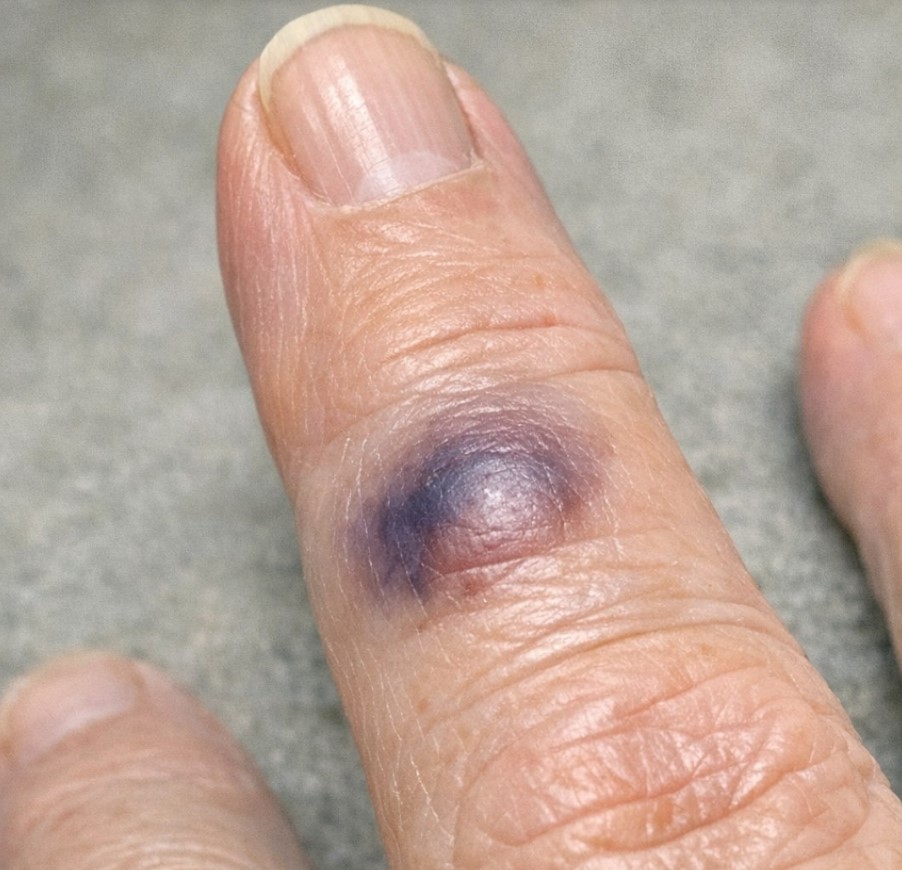
Finding a dark purple, swollen spot suddenly appearing on a finger can be unsettling, especially when there was no obvious accident or injury. In the picture, the area looks like a small, raised bruise beneath the skin, with a deep purple-blue color around the swelling.
If your mom says it stings but otherwise feels well, there are several possible explanations. One condition that can sometimes look surprisingly similar is Achenbach syndrome, a rare but usually harmless condition that can cause sudden pain, swelling, and bluish-purple discoloration of a finger. Still, a photograph cannot confirm the cause, so it’s important to pay attention to how the finger feels and whether anything changes.
What Could Cause a Sudden Purple Spot on a Finger?
A bruise forms when small blood vessels beneath the skin become damaged and leak a small amount of blood into the surrounding tissue. This can happen after an obvious impact, but sometimes the injury is so minor that a person doesn’t remember it happening.
The trapped blood can initially appear reddish or purple before gradually changing color as the body breaks it down.
The swelling in the picture may therefore represent a small collection of blood beneath the skin, sometimes called a hematoma.
However, when a purple patch appears suddenly without an obvious injury—particularly on a finger—another possibility is Achenbach syndrome.
What Is Achenbach Syndrome?
Achenbach syndrome is sometimes called paroxysmal finger hematoma. It typically appears suddenly, often affecting the palm-side of a finger.
Someone may notice a strange sensation first, such as:
- Stinging or burning
- Tingling
- Mild pain or tenderness
- A feeling of pressure
- Sudden swelling
Shortly afterward, part of the finger may become blue or purple.
The appearance can be dramatic, but the condition is generally considered benign and often resolves on its own.
One of the unusual features is that it can happen without a clear injury. A person may simply be going about an ordinary activity when the discoloration suddenly appears.
Why Does It Look So Dark?
The purple color can understandably make people nervous.
When blood collects beneath the skin, it can create a deep blue, purple, or almost black appearance depending on how much blood has accumulated and how deeply it is located.
Because the finger has relatively little soft tissue compared with other parts of the body, even a small amount of blood beneath the skin can create a noticeable bump or discoloration.
That doesn’t necessarily mean there is a dangerous amount of bleeding.
Still, the appearance alone isn’t enough to determine what is happening.
Could It Simply Be a Bruise?
Yes.
It’s possible to bruise a finger without remembering the exact moment it happened. A small bump against a countertop, pressure from carrying something, catching the finger on clothing, or another everyday event may be enough to break tiny blood vessels.
If your mom takes medications that increase bleeding or bruising, such as blood thinners, she may also bruise more easily.
If the area is localized, the finger remains warm and normally colored beyond the bruise, and she can move it normally, monitoring it while arranging appropriate medical advice may be reasonable.
What Should You Watch For?
The most important thing is not simply the color of the bruise but the condition and function of the entire finger.
Pay attention to whether your mom develops:
- Increasing or severe pain
- Rapidly worsening swelling
- Numbness or loss of sensation
- A cold finger
- Difficulty moving the finger
- Blue, gray, or black discoloration extending beyond the original area
- Significant weakness
- A finger that becomes pale or unusually cold compared with the others
These symptoms can indicate a problem that requires more urgent assessment.
A finger that suddenly becomes severely painful, cold, numb, or extensively discolored should not simply be assumed to have an ordinary bruise.
What Can She Do While Waiting?
If the clinic is closed and there are no concerning symptoms, avoid repeatedly pressing, squeezing, or massaging the swollen area.
Don’t try to puncture it or drain the discoloration yourself.
If there may have been a minor injury, protecting the finger and using a cold pack wrapped in cloth for short periods may help with swelling. Never place ice directly against the skin.
It can also be useful to take a photograph now. If the appearance changes, having a picture from the beginning can help a healthcare professional understand how quickly the discoloration developed.
Most importantly, watch how she feels rather than focusing only on how alarming the bruise looks.
When Should She Seek Urgent Care?
If the finger becomes cold, numb, severely painful, increasingly swollen, or difficult to move, it’s better to seek urgent medical attention rather than waiting for the regular clinic to reopen.
The same applies if the discoloration spreads dramatically or the entire finger begins turning blue, gray, or very pale.
If she has other unexplained bruising, unusual bleeding, or repeated episodes like this, she should also discuss the problem with a healthcare professional.
Even when the eventual explanation is harmless, unexplained or recurring symptoms deserve proper evaluation.
Could It Be Something More Serious?
There are several conditions that can cause changes in finger color or swelling, so it would be unsafe to diagnose the problem from a photograph alone.
Circulation problems, injuries, inflammation, infections, and other vascular conditions can sometimes produce discoloration or pain.
That’s why the surrounding symptoms matter.
A small, localized purple patch with mild discomfort and otherwise normal finger function can be reassuring, but a rapidly changing finger accompanied by significant pain or altered sensation deserves prompt attention.
Conclusion :
A sudden purple, slightly swollen area like the one shown doesn’t automatically mean something dangerous is happening. It could be an ordinary unnoticed bruise or something such as Achenbach syndrome, which can produce sudden purple discoloration and discomfort without an obvious injury.
However, the picture cannot establish the diagnosis.
For now, avoid squeezing or puncturing the area and keep an eye on its size, color, pain, temperature, sensation, and movement. If the finger remains warm and functional and the symptoms are mild, contacting the clinic when it reopens is a reasonable next step.
But if your mom develops severe or worsening pain, numbness, a cold finger, major swelling, difficulty moving it, or extensive blue/gray discoloration, don’t wait for the clinic—seek urgent medical evaluation.
Sometimes a frightening-looking bruise really is just a temporary collection of blood beneath the skin. The safest approach is to let the symptoms—not just the color—guide how urgently it needs to be checked.