
Some math problems look so easy that we feel confident we can solve them without writing anything down. But sometimes, the simplest calculations are the ones that catch us off guard.
A short addition puzzle has been challenging people because it seems to follow a predictable pattern. As the numbers are added one after another, many people begin to answer automatically instead of carefully checking each step.
The challenge is simple: start with 1,000, add a few numbers, and keep adding 1,000 along the way. At first glance, the answer may seem obvious, but there is a small detail that can easily lead to a mistake.
Before looking at the solution, take a moment to solve it yourself. Read the numbers slowly, calculate each addition, and see whether your final answer matches the correct result.
The Math Problem
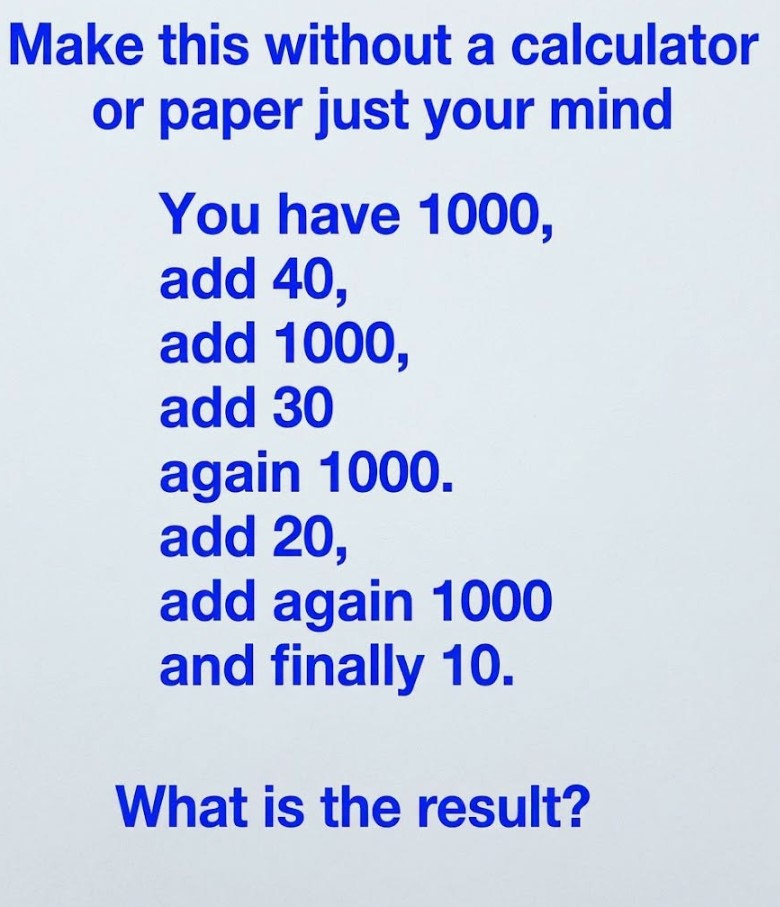
You have 1,000.
Add 40.
Add 1,000.
Add 30.
Again, add 1,000.
Add 20.
Again, add 1,000.
Add 10.
What is the final result?
Try solving the problem in your head before continuing. Many people quickly arrive at an answer of 5,000 because their minds follow the repeated pattern of adding 1,000.
However, the correct answer requires paying attention to every number, including the smaller amounts added between the thousands.
The Correct Answer: 4,100
If you answered 4,100, congratulations! You followed the entire calculation correctly.
If you answered 5,000, don’t worry. This is exactly why the puzzle is interesting. The repeated numbers can make it easy to lose track of the smaller additions.
Let’s break it down step by step.
Step-by-Step Explanation
The best way to solve this puzzle is to calculate each addition in the order it appears.
Step 1: Start with 1,000 and add 40.
1,000 + 40 = 1,040
Step 2: Add another 1,000.
1,040 + 1,000 = 2,040
Step 3: Add 30.
2,040 + 30 = 2,070
Step 4: Add another 1,000.
2,070 + 1,000 = 3,070
Step 5: Add 20.
3,070 + 20 = 3,090
Step 6: Add another 1,000.
3,090 + 1,000 = 4,090
Step 7: Finally, add 10.
4,090 + 10 = 4,100
That is the complete calculation. There are four additions of 1,000, which give us 4,000. The remaining numbers—40, 30, 20, and 10—add up to 100.
Therefore:
4,000 + 100 = 4,100
Why Do So Many People Get It Wrong?
The interesting part of this puzzle is not the difficulty of the arithmetic. Every addition is relatively simple. The challenge comes from how we process the information.
1. The Repeated Pattern Creates a Distraction
The number 1,000 appears four times, so the brain quickly recognizes a repeating sequence.
Once people notice this pattern, they may start anticipating the next result instead of carefully following the calculation. This can lead to an incorrect answer.
2. Mental Arithmetic Can Encourage Rushing
When a calculation looks easy, people often try to solve it as quickly as possible.
Instead of checking each result, they may jump from one number to another. A small mistake early in the process can then affect the final answer.
3. The Smaller Numbers Are Easy to Overlook
The numbers 40, 30, 20, and 10 may look insignificant next to 1,000.
However, together they make 100. They are an essential part of the calculation, and ignoring even one of them changes the final result.
4. Confidence Can Sometimes Work Against Us
When people believe a problem is easy, they may not feel the need to double-check their work.
This puzzle reminds us that confidence is not always the same as accuracy. Even basic calculations deserve a little attention.
A Simple Trick to Avoid This Mistake
If you find mental math challenging, try separating the large numbers from the smaller ones.
In this puzzle, there are four groups of 1,000:
1,000 × 4 = 4,000
Then add the remaining numbers:
40 + 30 + 20 + 10 = 100
Finally:
4,000 + 100 = 4,100
This approach makes the calculation easier because you can organize the numbers into two simple groups rather than adding everything in one long sequence.
It is also a useful technique for shopping calculations, budgeting, and everyday mental arithmetic.
Try Another Mental Math Challenge
Here is another quick problem to test your attention:
Start with 500.
Add 50.
Add 500.
Add 40.
Add 500.
Add 30.
Add 500.
Add 20.
What is the final result?
Take your time and follow the same method. First add the repeated numbers, then add the smaller amounts.
The answer is 2,140:
500 + 500 + 500 + 500 = 2,000
50 + 40 + 30 + 20 = 140
2,000 + 140 = 2,140.
Conclusion :
This simple problem is a great example of how an easy calculation can become surprisingly confusing when we rely too much on quick mental guesses. The numbers are not complicated, and there are no hidden mathematical rules. The only real challenge is paying attention to the order of the additions and remembering every number.
The correct answer is 4,100, because the four groups of 1,000 give us 4,000, while the remaining numbers add up to another 100. Once we separate the calculation into these two parts, the solution becomes clear.
What makes this puzzle enjoyable is that it encourages us to slow down and question our first answer. Instead of rushing toward a result that feels familiar, we can take a few seconds to check each step. That small habit can make a big difference, not only when solving puzzles but also when handling everyday calculations.
So, did you get 4,100 on your first attempt, or did your mind jump to 5,000? Either way, this challenge offers a useful reminder: sometimes, the easiest way to solve a difficult-looking problem is simply to slow down, stay focused, and let the numbers speak for themselves.