Some puzzles look incredibly easy until you take a closer look at the wording. This family riddle is a perfect example. At first, it seems like a simple counting exercise, but one small detail can easily lead you to the wrong answer.
The challenge is to calculate how many people belong to the Wang family based on a few short statements. You will need to pay attention to every family relationship and make sure you don’t count the same person more than once.
Here is the puzzle:
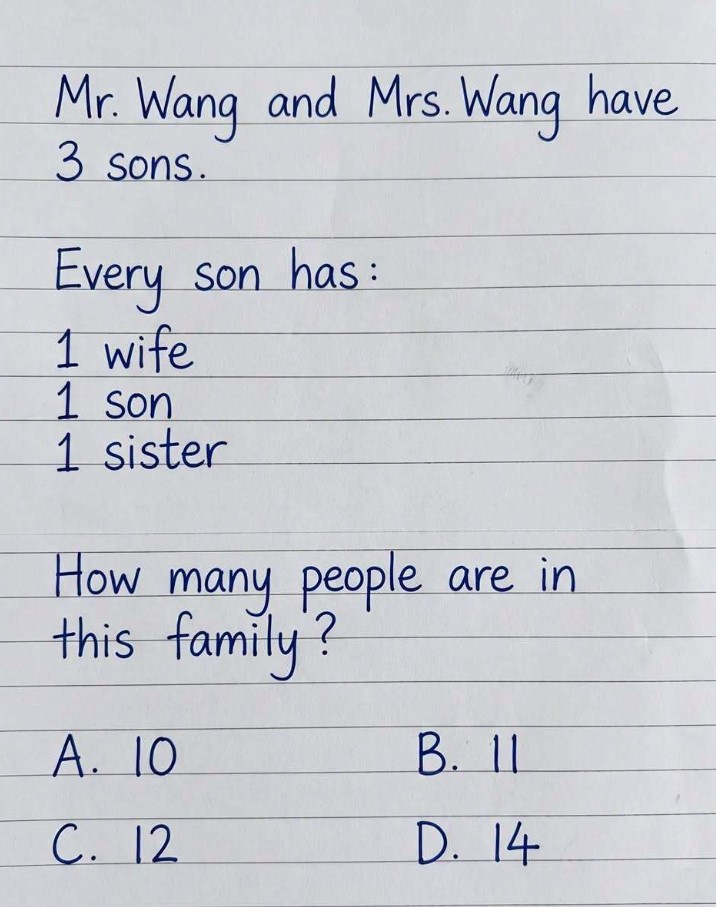
Mr. Wang and Mrs. Wang have 3 sons. Every son has 1 wife, 1 son, and 1 sister. How many people are there in the family altogether?
Choose your answer carefully. Some people may arrive at 11, while others might think the answer is 14. But only one answer correctly follows the wording of the riddle.
Before looking at the explanation, take a moment to work it out yourself.
Start by Counting the Parents
The first step is the easiest.
Mr. Wang and Mrs. Wang are the parents, so we begin with two people.
They have three sons, which means we need to add three more.
So far, the family contains:
- Mr. Wang
- Mrs. Wang
- Their first son
- Their second son
- Their third son
That gives us a total of five people.
Add the Three Wives
The puzzle tells us that every son has one wife.
Since there are three sons, each one has a wife of his own.
That means we add three more people to the family.
Our calculation is now:
2 parents + 3 sons + 3 wives = 8 people.
At this point, we have counted the original couple, their three sons, and the three daughters-in-law.
But we are not finished yet.
Count the Grandchildren
The next detail says that every son has one son.
Because there are three sons, each has one child who is also a boy.
That gives us three grandchildren.
We add these three boys to our previous total:
8 + 3 = 11 people.
This is where many people stop and choose 11 as their answer. However, there is still one important detail in the puzzle that we haven’t included.
The Tricky Part: Every Son Has One Sister
Now comes the detail that makes this puzzle interesting.
The statement says that every son has one sister.
Some people may interpret this as meaning that each of the three brothers has a different sister. If that were true, we would need to add three girls.
But read the wording carefully.
The puzzle never says that each brother has a separate sister. It only says that every son has one sister.
All three brothers can have the same sister.
Imagine Mr. and Mrs. Wang have four children: three boys and one girl. Each of the boys has one sister, but she is the same girl in all three cases.
Therefore, we only need to add one more person, not three.
Our total becomes:
11 + 1 = 12 people.
The Correct Answer: 12 People
The correct answer is C. 12 people.
Let’s review the complete family so there is no confusion:
- Mr. Wang and Mrs. Wang: 2 people
- Their three sons: 3 people
- The three wives: 3 people
- The three grandsons: 3 people
- One shared sister: 1 person
The final calculation is:
2 + 3 + 3 + 3 + 1 = 12
That gives us twelve people altogether.
Why Do So Many People Get This Puzzle Wrong?
The difficulty isn’t really about mathematics. The addition itself is very simple. The real challenge is understanding how the family members are related.
When people read that every son has one sister, they may automatically assume that three separate sisters must be added to the total. However, there is no reason to make that assumption.
In an ordinary family, three brothers can easily share one sister. Each brother has a sister, but that doesn’t mean each one has a different sister.
Another common mistake is stopping at 11 after counting the parents, sons, wives, and grandchildren. That total is almost correct, but it leaves out the sister.
The best way to solve this kind of riddle is to think about the actual people involved rather than simply adding every number mentioned in the question.
Conclusion
This family puzzle is a great reminder that understanding a question is sometimes more important than being quick with calculations. At first glance, the riddle appears to require nothing more than adding parents, children, wives, and grandchildren. However, the final detail about the sister changes everything.
The secret is recognizing that the three brothers do not need three different sisters. They can all share one sister, and that single person satisfies the statement that every son has a sister. Once you understand this relationship, the answer becomes much easier to find.
So, the correct answer is 12 people, made up of two parents, three sons, three wives, three grandsons, and one sister.
If you answered 11, you were very close but forgot to include the sister. If you answered 14, you probably counted three separate sisters instead of one shared sister.
The next time you come across a family riddle, remember to read every sentence carefully. Small details can completely change the answer, and sometimes the smartest solution is simply to avoid counting the same person twice!