
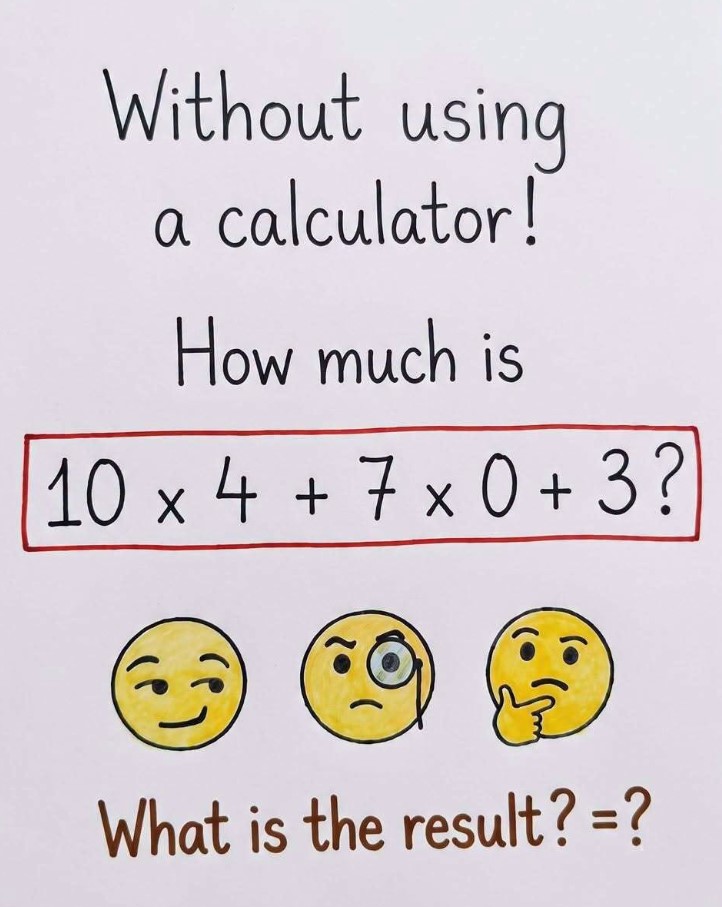
Have you ever looked at a simple math problem and felt completely confident about the answer, only to discover that you made a mistake? It happens more often than you might think! Some mathematical puzzles look incredibly easy, but one small detail can make people rush to the wrong conclusion.
Today’s challenge is a perfect example. It doesn’t require advanced mathematics, complicated formulas, or even a calculator. All you need are basic arithmetic skills and a good understanding of the order in which mathematical operations should be performed.
Take a close look at this equation:
10 × 4 + 7 × 0 + 3 = ?
At first glance, the problem seems straightforward. However, the zero in the middle may confuse you. Some people immediately focus on it and assume that multiplying by zero somehow makes the entire expression equal zero.
Others may look at the equation too quickly and add the numbers in the wrong order.
Before reading the explanation, try solving it yourself. Take a moment, think carefully, and see whether you can find the correct answer without reaching for your calculator.
Why Is This Simple Math Puzzle So Tricky?
The difficulty comes from a common mistake: performing calculations in the wrong order.
When an equation contains several operations, you cannot always solve it simply by moving from left to right. Mathematics follows specific rules that tell us which operations must be completed first.
This is known as the Order of Operations.
You may remember learning these rules in school under the names PEMDAS or BODMAS. They help us solve mathematical expressions consistently and avoid incorrect results.
In this particular puzzle, multiplication must be completed before addition.
That means we cannot simply add every number from left to right and then multiply. We must identify the multiplication expressions first.
Understanding the Order of Operations
Before solving the puzzle, let’s quickly review the basic rules.
The order of operations generally follows these steps:
- Parentheses: Complete calculations inside parentheses first.
- Exponents: Calculate powers and roots.
- Multiplication and Division: Perform these operations from left to right.
- Addition and Subtraction: Complete these operations from left to right.
For this puzzle, there are no parentheses or exponents. We only need to deal with multiplication and addition.
The most important thing to remember is that multiplication comes before addition.
Once all multiplication operations have been completed, we can finish the remaining addition.
Step-by-Step Solution
Let’s break down the equation carefully.
Original equation:
10 × 4 + 7 × 0 + 3
Step 1: Solve the First Multiplication
Start with the first multiplication expression:
10 × 4 = 40
Ten multiplied by four equals forty.
We can now replace the first multiplication with 40.
Step 2: Solve the Second Multiplication
Next, calculate the second multiplication:
7 × 0 = 0
Remember this important mathematical rule: any number multiplied by zero always equals zero.
It doesn’t matter whether you multiply zero by 7, 20, 100, or even a million. The result will always be zero.
Step 3: Rewrite the Equation
Now that both multiplication operations are finished, the original expression becomes:
40 + 0 + 3
Notice how much simpler the equation looks now.
We no longer have any multiplication to perform. All that remains is addition.
Step 4: Complete the Addition
Start from the left and work your way across:
40 + 0 = 40
Then add the final number:
40 + 3 = 43
And that’s it!
The Correct Answer Is 43!
is the correct answer to this mathematical challenge.
The complete calculation is:
10 × 4 + 7 × 0 + 3
= 40 + 0 + 3
= 40 + 3
= 43
If you found 43 without using a calculator, congratulations! You remembered the order of operations and applied it correctly.
If you got a different answer, don’t worry. This is exactly why these little math challenges are so interesting. They remind us that even basic arithmetic requires attention to detail.
Common Mistakes People Make
There are a few reasons why someone might arrive at an incorrect answer.
Mistake 1: Thinking the entire expression becomes zero
Some people see the multiplication by zero and immediately assume that everything equals zero.
However, the zero only affects the expression 7 × 0. It does not change the other parts of the equation.
The result of that multiplication is simply added to the other numbers.
Mistake 2: Calculating from left to right without following the rules
Another common mistake is treating every operation as if it has equal priority.
For example, someone might calculate 10 × 4 correctly, but then continue without checking which operations need to be completed first.
Remember that multiplication and division take priority over addition and subtraction.
Mistake 3: Rushing through the calculation
When an equation looks easy, people sometimes answer too quickly. They may recognize the numbers but fail to examine the mathematical symbols carefully.
Taking a few extra seconds can prevent unnecessary mistakes.
How to Improve Your Mental Math Skills
You don’t need a calculator for every mathematical problem. Practicing simple equations can help you become more comfortable with numbers and improve your confidence.
Here are a few useful habits:
- Practice a little every day: Solve a few short equations whenever you have free time.
- Remember the order of operations: Understanding the rules is more useful than memorizing individual answers.
- Break complicated expressions into smaller steps: Solving one operation at a time makes calculations easier.
- Double-check your work: A quick review can help you catch mistakes.
- Avoid rushing: Accuracy is more important than answering in a few seconds.
You can also challenge friends and family members with similar equations. It is a fun way to practice mental math and see who remembers the basic rules best.
Conclusion
This simple math puzzle proves that even an equation made up of familiar numbers can become confusing when we don’t pay attention to the rules. The presence of zero makes the challenge especially interesting because many people immediately focus on it and forget that it only affects the multiplication directly connected to it.
The secret to finding the correct answer is understanding the order of operations. Multiplication must be completed before addition, so we first calculate 10 × 4 and 7 × 0. Once those two operations are finished, the equation becomes 40 + 0 + 3, which gives us 43.
The correct answer is therefore 43, and no calculator is needed!
Whether you solved it correctly on your first attempt or needed to read the explanation, this challenge is a useful reminder that careful thinking is often more important than speed. Sometimes, the smallest mathematical details make the biggest difference.
Why not share this equation with your friends or family and see whether they can solve it without a calculator? You might be surprised by how many different answers people suggest before remembering the simple rules they learned at school!