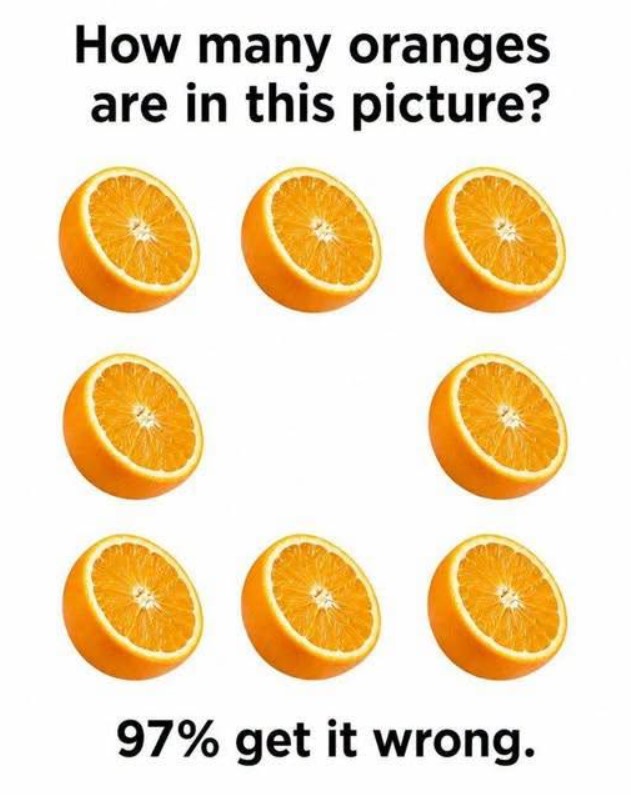
At first glance, this looks like one of those picture puzzles that should take only a few seconds to solve. The oranges are arranged in a simple pattern, there are no complicated shapes or hidden objects, and the question seems straightforward: How many oranges are really in the picture?
Most people immediately begin counting what they can see. There are three pieces across the top, two in the middle, and three along the bottom. Add them together and the obvious answer appears to be eight.
But before you lock in your answer, take another look.
There is a small detail that changes the entire puzzle. The objects shown in the image are not whole oranges. Each one is a half of an orange, with the cut side facing upward. That means the puzzle is asking you to think about the difference between counting visible pieces and counting the whole fruits those pieces came from.
The Obvious Answer: Eight
Let’s start with the answer that most people will probably give.
The picture contains three orange halves in the top row. Beneath them, there are two more pieces in the middle row. Finally, the bottom row contains another three.
That gives us:
3 + 2 + 3 = 8
So there are clearly eight visible orange pieces in the image. If the question were asking, “How many orange pieces can you see?” then there would be no real trick at all. The answer would simply be eight.
You can count them from top to bottom and arrive at the same result every time.
This is why the puzzle can be so convincing at first. Your brain naturally identifies each visible orange shape as an individual object and counts each one separately.
But Are They Actually Eight Oranges?
This is where the wording becomes important.
Look carefully at every piece. None of the oranges shown is complete. Each one has been sliced in half, exposing the juicy interior of the fruit.
So, technically, what you are looking at is not eight complete oranges. You are looking at eight orange halves.
If two halves make one complete orange, then eight halves represent:
8 ÷ 2 = 4 whole oranges
That gives us a second possible answer: four oranges.
This is the clever part of the puzzle. The image gives you eight visible pieces, but those pieces represent only four complete fruits.
So Which Answer Is Correct?
The answer depends on exactly how you interpret the question.
If you are counting the objects that are visibly shown, the answer is:
8 orange halves
If you are counting the whole oranges represented by those halves, the answer is:
4 whole oranges
That means someone who answers eight isn’t necessarily wrong. They are counting the visible pieces. Someone who answers four has noticed that each visible piece is only half of a fruit.
The wording, “How many oranges are in this picture?” creates the ambiguity. A half orange can still be casually described as an orange, but if the question is asking about whole fruits, then two halves should be combined into one.
Why So Many People Get Tricked
These puzzles work because people tend to solve them quickly.
When you see a simple image and a question asking for a count, your brain usually switches into counting mode. You scan the picture, identify the repeated objects, and add them together.
In this case, that process gives you eight almost instantly.
The problem is that you may never stop to examine what each object actually represents.
The puzzle isn’t testing advanced mathematics. There is no difficult calculation involved. Instead, it tests observation, attention to detail, and interpretation.
The most important step is simply slowing down enough to ask yourself:
“Am I counting whole oranges, or am I counting orange halves?”
Once you notice that every piece has been cut in half, the second answer becomes obvious.
A Simple Way to Look at It
Imagine that you had eight actual orange halves sitting on a kitchen table.
If someone asked you how many pieces of orange you had, you would say eight pieces.
But if someone asked you how many whole oranges those pieces came from, you would say four oranges.
The same principle applies to this image.
There are eight separate pieces visible, but because each piece represents half of a fruit, they correspond to four complete oranges.
This is why describing the image as containing eight orange halves representing four whole oranges is probably the clearest way to explain the puzzle.
The Arrangement Makes It Even Easier to Miss
The positioning of the pieces also encourages a quick answer.
They are arranged neatly in three rows:
- Top row: 3 orange halves
- Middle row: 2 orange halves
- Bottom row: 3 orange halves
The balanced arrangement makes it natural to count each piece individually. Once you get the number eight, you may feel confident that you’ve solved the puzzle.
But the arrangement is really just a distraction from the more important detail: every visible fruit is only half of an orange.
That is what separates a quick count from a careful observation.
What Would Be the Best Answer?
If you want to be completely precise, the best response would be:
There are 8 orange halves in the picture, representing 4 whole oranges.
This answer accounts for both interpretations and removes the ambiguity.
If the puzzle expects a single number based on the whole fruits, then 4 is the intended answer.
If it is asking how many visible orange pieces appear in the image, then 8 is correct.
So don’t feel bad if you initially chose eight. The picture is designed to make that the natural first response.
The Real Lesson Behind the Puzzle
What makes this puzzle interesting isn’t really the oranges. It is the way a simple question can lead us toward an automatic answer.
We often assume that the first answer that comes to mind must be the correct one, especially when the task looks easy. But sometimes the smallest visual detail changes the meaning of the entire problem.
Here, the difference between eight pieces and four whole fruits is easy to overlook.
The puzzle reminds us that careful observation can be more important than speed. Before answering a visual question, it can be worthwhile to look at the objects themselves rather than simply counting their shapes.
A few extra seconds of attention can completely change your answer.
Final Answer :
So, how many oranges are really in the picture?
There are eight visible orange halves, arranged as three on the top row, two in the middle, and three on the bottom. But because every piece is only half of an orange, those eight halves represent four whole oranges.
That is the little trick hidden in the puzzle.
If you answered 8, you counted the visible pieces correctly. If you answered 4, you recognized that the pieces are halves and calculated the number of complete fruits.
The most accurate answer is therefore four whole oranges, shown as eight halves.
The next time you come across a seemingly easy picture puzzle, don’t rush to count. Take a moment to examine exactly what you’re looking at. Sometimes the answer isn’t hidden somewhere in the picture—it is hidden in the way the question is worded.