Finding a new lump on someone’s back can be frightening, especially when it appears suddenly and you don’t immediately know what it is. The worry can become even greater when the emergency room has a long waiting time and you’re left wondering whether the bump can safely wait to be evaluated.
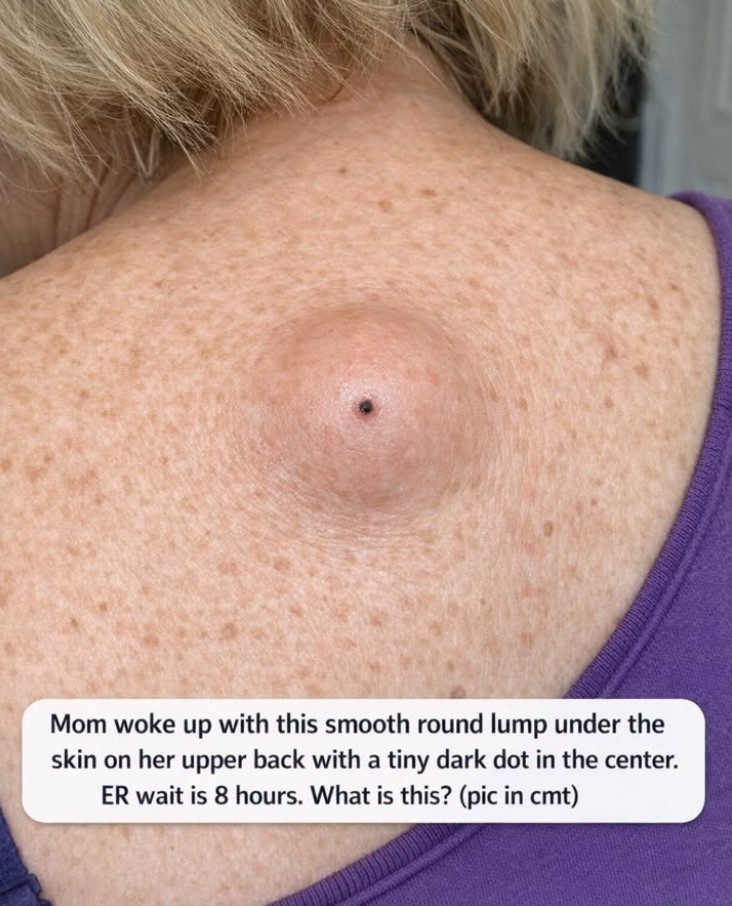
In this situation, the lump was described as smooth, round, and located underneath the skin of the upper back, with a tiny dark dot in the center. That particular combination can be characteristic of an epidermoid cyst, a common type of cyst that can develop beneath the skin. Epidermoid cysts are often slow-growing and painless, and they commonly occur on areas such as the face, neck, and trunk. A small dark central opening, sometimes resembling a blackhead, can be one of their recognizable features.
However, an important point is that a description alone cannot confirm the diagnosis.
A new lump can have several possible causes, and the appearance, size, firmness, tenderness, growth rate, skin changes, and other symptoms all matter. A healthcare professional may be able to identify an epidermoid cyst simply by examining it, but other testing may sometimes be needed depending on how the lump looks or behaves.
So what could this particular bump be, and what should you do while waiting to be seen?
The Tiny Dark Dot Is an Important Clue
One of the most distinctive features described in this situation is the tiny dark dot in the center of the lump.
An epidermoid cyst can have a small central opening, sometimes called a punctum. From the outside, this can look like a tiny blackhead or dark spot sitting in the middle of an otherwise smooth, rounded bump.
That happens because the cyst has an opening connecting toward the skin surface. The cyst itself forms underneath the skin, while keratin gradually accumulates inside.
Mayo Clinic lists a small, round bump beneath the skin and a tiny blackhead plugging the central opening among the typical signs of an epidermoid cyst.
This is why the dark dot can be useful information when describing the lump to a healthcare professional.
Still, it should not be treated as proof that the lump is definitely a cyst. Several different skin conditions can look similar, particularly when viewed without a physical examination.
What Is an Epidermoid Cyst?
An epidermoid cyst is a small sac that develops beneath the skin.
The outer layer of skin normally sheds cells continuously. In some cases, cells that should have moved toward the surface instead become trapped deeper in the skin. Those cells can form the wall of a cyst and produce keratin, a protein that gradually accumulates inside it.
The material inside an epidermoid cyst is often thick and whitish rather than liquid.
This explains why some people notice a thick, sometimes unpleasant-smelling substance if a cyst eventually opens and drains.
Although these cysts can look concerning, many are harmless and don’t require immediate treatment if they remain small, stable, and painless.
Why Does It Appear on the Upper Back?
The trunk is one of the areas where epidermoid cysts commonly occur.
The upper back has numerous hair follicles and skin structures that can become involved in the development of these cysts. An epidermoid cyst can sometimes follow irritation or an injury involving the skin or a hair follicle, although many people cannot identify any particular event that caused theirs.
That means the person may wake up and suddenly notice the bump even though the cyst itself may have been developing gradually.
In other words, noticing it for the first time does not necessarily mean the cyst formed overnight.
It may simply have reached a size that made it easier to feel or see.
Why Does It Feel Smooth and Round?
The description of a smooth, rounded lump under the skin is also compatible with the typical appearance of an epidermoid cyst.
Many epidermoid cysts feel like a small, firm or rubbery bump beneath the skin. The skin over the cyst may look relatively normal, particularly when there is no inflammation or infection.
Some remain unchanged for long periods.
Others gradually become larger.
Some can become irritated after repeated friction, pressure, scratching, or accidental bumps.
The texture and mobility of a lump can provide useful information to a clinician, but they aren’t enough to establish a diagnosis at home.
Could It Really Have Appeared Overnight?
This is one of the most confusing parts of discovering a lump.
Someone may go to sleep without noticing anything and wake up convinced that the lump appeared during the night.
That does not necessarily mean the underlying growth developed within a few hours.
An epidermoid cyst can grow slowly and remain unnoticed until it becomes large enough to feel. If the person sleeps on the area, changes position, or happens to touch the spot in the morning, they may suddenly become aware of it.
Inflammation can also make a previously unnoticed cyst become more prominent.
That is why the timing of discovery and the actual age of the lump are not always the same thing.
Is an Epidermoid Cyst Usually Dangerous?
Most epidermoid cysts are not dangerous.
They are often slow-growing and painless, and many do not require treatment unless they become bothersome, inflamed, infected, rupture, or repeatedly get irritated.
That is reassuring, but it does not mean every new lump should automatically be assumed to be an epidermoid cyst.
A healthcare professional should evaluate an unfamiliar or changing lump, particularly if it has unusual features.
The safest approach is to focus on the actual symptoms rather than trying to identify the condition solely from its appearance.
Signs That May Suggest Inflammation or Infection
An uncomplicated cyst may not cause much discomfort.
The situation changes if inflammation or infection develops.
Watch for:
- Increasing redness around the lump
- Warmth of the surrounding skin
- Increasing swelling
- Significant tenderness
- Worsening pain
- Pus or drainage
- A bad smell from an opening in the skin
- Fever or feeling generally unwell
- Redness spreading outward
These changes are more concerning than a small, stable, painless bump.
Mayo Clinic notes that epidermoid cysts can become inflamed, painful, or infected, and a ruptured cyst can lead to a boil-like infection requiring prompt medical attention.
What If the Emergency Room Has an Eight-Hour Wait?
An eight-hour emergency department wait can make an unfamiliar lump feel much more frightening.
However, the length of an emergency-room wait does not tell you whether the lump itself is dangerous. Emergency departments prioritize patients according to urgency, so the waiting time may change depending on the severity of other cases arriving at the same time.
If the lump is small, painless, unchanged, and the person otherwise feels well, a routine medical or dermatology appointment may be more appropriate than waiting many hours in an emergency department.
That decision depends on the person’s symptoms and overall situation, though.
If there are concerning symptoms such as rapidly worsening pain, significant spreading redness, fever, severe swelling, or other serious symptoms, medical evaluation should not be delayed simply because the lump resembles a cyst.
When a Lump Should Be Evaluated Promptly
A healthcare professional should evaluate a lump sooner if it:
- Grows rapidly
- Becomes increasingly painful
- Becomes red or hot
- Starts draining
- Breaks open
- Appears infected
- Keeps returning
- Is unusually hard or fixed
- Is accompanied by other concerning symptoms
- Is causing significant discomfort
Mayo Clinic specifically recommends medical evaluation for an epidermoid-type cyst that grows or multiplies rapidly, breaks open, becomes painful or infected, or is repeatedly irritated.
What Should You Do While Waiting?
If the person is otherwise well and the bump does not have alarming symptoms, the most important thing is to avoid irritating it.
Keep the area clean.
Don’t repeatedly press on it just to see whether it is still there.
Don’t try to puncture it with a needle.
And don’t attempt to squeeze it out.
Even when a cyst contains material that looks as though it could be removed by pressing, squeezing can irritate the surrounding tissue and increase the risk of inflammation, rupture, scarring, or infection.
Mayo Clinic specifically advises against squeezing an epidermoid cyst yourself.
Why You Shouldn’t Pop the Lump
A common reaction to a bump with a visible dark dot is to treat it like a large blackhead.
That can be a mistake.
The dark opening is not necessarily a simple blackhead that can safely be squeezed.
An epidermoid cyst has a sac beneath the skin. Removing some of the material from the opening does not necessarily remove the cyst wall.
If the cyst ruptures underneath the skin, its contents can trigger inflammation and cause the area to become painful and swollen.
A clinician can determine whether drainage or complete removal is appropriate.
How Doctors Diagnose an Epidermoid Cyst
In many cases, a healthcare professional can identify an epidermoid cyst by examining the skin and feeling the lump.
The clinician may ask:
- When was the lump first noticed?
- Has it changed in size?
- Is it painful?
- Has it ever drained?
- Is the surrounding skin red?
- Has there been fever?
- Has the person had similar lumps before?
- Was there any recent injury or irritation to the skin?
Mayo Clinic notes that a healthcare professional will often be able to diagnose an epidermoid cyst by examining the affected skin, although additional examination or testing may sometimes be appropriate.
Does It Always Need to Be Removed?
No.
A cyst that is not painful, infected, or particularly bothersome can sometimes simply be monitored.
Some people choose removal because the lump is uncomfortable, gets repeatedly bumped, becomes irritated by clothing, or is cosmetically bothersome.
Other people choose removal because they have experienced repeated inflammation or because they want to reduce the chance of the cyst returning after drainage.
The appropriate option depends on the individual cyst and the person’s preferences after discussing the situation with a healthcare professional.
Drainage Versus Complete Removal
If an epidermoid cyst becomes inflamed or infected, treatment may involve addressing the inflammation first.
One option doctors may use is incision and drainage, in which a small opening is made and the contents are released. This can relieve symptoms, but the cyst may return because the cyst wall remains.
Another option is minor surgery to remove the entire cyst.
Removing the complete cyst can reduce the chance of it growing back, although any procedure can leave a scar.
If the cyst is significantly inflamed, a clinician may delay complete removal until the inflammation has settled.
Could It Be Something Other Than an Epidermoid Cyst?
Yes.
This is an important point when discussing any new lump.
A smooth lump beneath the skin can have several possible causes, including other types of cysts, benign growths, inflamed hair follicles, lipomas, or other skin conditions.
The tiny central dark dot makes an epidermoid cyst an important possibility, but it doesn’t make the diagnosis certain.
A clinician needs to consider the lump’s location, size, texture, mobility, appearance, rate of growth, and associated symptoms.
That is why an online description or photograph should never be considered a substitute for an examination when a new lump is concerning.
Could It Be Cancer?
Most lumps that resemble common benign skin cysts are not cancerous.
However, it is not appropriate to diagnose or rule out cancer from a description alone.
A lump that is rapidly changing, unusually hard, persistent, associated with concerning skin changes, or otherwise atypical should be assessed by a healthcare professional.
The important thing is not to panic simply because a lump has appeared.
At the same time, it is equally important not to dismiss a changing lump without having it evaluated.
What About a Lipoma?
Another common cause of a soft lump beneath the skin is a lipoma.
Lipomas are benign growths made primarily of fatty tissue. They often feel soft and may move slightly beneath the skin.
Unlike the classic description of an epidermoid cyst, a lipoma does not typically have a central dark punctum.
That doesn’t mean the presence or absence of a dot can diagnose the lump by itself, but it helps explain why doctors consider several possibilities when examining a new bump.
What About a Boil or Abscess?
An abscess can also produce a raised lump, but it often behaves differently.
An abscess may become increasingly painful, warm, red, swollen, and tender. It may eventually produce pus.
A cyst can also become infected and develop similar symptoms, which is one reason it can be difficult to distinguish the two without an examination.
If the lump becomes rapidly more painful or the surrounding redness starts spreading, medical evaluation becomes more important.
What If the Lump Suddenly Opens?
If a cyst opens on its own, avoid squeezing it further.
Keep the area clean and cover it with a clean dressing if it is draining.
Watch carefully for increasing redness, swelling, pain, warmth, pus, fever, or other signs of infection.
A ruptured cyst can become inflamed or infected, so it should not simply be ignored because some material has drained out.
Why the Location on the Upper Back Matters
The upper back is a common location for several types of skin lumps.
It is also an area that can experience pressure from sleeping, backpacks, clothing, chairs, and other sources of friction.
A cyst that is painless when first noticed can become irritated simply because of where it is located.
If the lump repeatedly gets rubbed or bumped, discussing removal with a healthcare professional may make sense even if it is otherwise harmless.
What Not to Put on It
There is usually no reason to experiment with harsh household chemicals, strong acids, essential oils, or aggressive acne treatments on an unidentified lump.
The skin over a cyst can become irritated, and damaging the surface may make evaluation more difficult.
The goal while waiting for medical assessment should be simple:
Keep the area clean, avoid squeezing or puncturing it, and monitor for changes.
Could a Warm Compress Help?
For some uncomplicated cysts, a warm, moist cloth may help encourage drainage and healing, but it should not be used as a substitute for medical evaluation when there are signs of infection or significant worsening.
Mayo Clinic includes a warm, moist cloth among measures that may help a cyst drain and heal, while also advising people not to squeeze the cyst themselves.
If warmth makes the area more painful or the lump is rapidly worsening, medical advice is more appropriate than continued home treatment.
What Information Should You Give the Doctor?
When the appointment happens, it can help to provide a simple timeline.
For example:
- When the lump was first noticed
- Whether it was painful initially
- Whether it has increased in size
- Whether the skin changed color
- Whether there is a central dark spot
- Whether anything has drained from it
- Whether there is redness or warmth
- Whether there has been fever
- Whether similar lumps have occurred before
Taking a photograph when the lump is first noticed can also be useful if its appearance changes before the appointment.
A New Lump Doesn’t Always Mean an Emergency
Discovering something unfamiliar on the body can make the mind jump immediately to the worst possibility.
But a new lump does not automatically mean an emergency.
A classic epidermoid cyst can be relatively harmless and may not require immediate treatment if it is small, painless, stable, and not infected.
The more useful question is not simply, “What is this lump?”
It is:
What symptoms are happening along with the lump?
A painless bump with normal-looking surrounding skin is a very different situation from a rapidly expanding, intensely painful, red, hot lump accompanied by fever.
That distinction is important when deciding how urgently medical care is needed.
When Emergency Care Is More Appropriate
Although a simple skin cyst is generally not an emergency, seek urgent medical attention if the person develops serious symptoms or appears significantly unwell.
Examples include:
- Severe or rapidly worsening pain
- Rapidly expanding swelling
- Significant spreading redness
- High fever or severe chills
- Confusion or fainting
- Difficulty breathing
- Severe weakness
- New neurological symptoms
- Severe unexplained back or neck pain
The presence of these symptoms changes the situation and should not be attributed automatically to a simple cyst.
For severe or sudden symptoms, emergency medical services or an appropriate emergency department should be used rather than waiting for a routine appointment.
The Most Likely Explanation From the Description
Based solely on the description of a smooth, round lump beneath the skin with a tiny dark central dot, an epidermoid cyst is one reasonable possibility.
The central punctum is particularly characteristic, and epidermoid cysts commonly occur on the trunk.
But that is different from saying that the lump has definitely been diagnosed.
The safest conclusion is that the appearance is compatible with an epidermoid cyst, while an in-person healthcare professional should confirm what it actually is.
Conclusion :
A smooth, round lump beneath the skin of the upper back with a tiny dark dot in the center can certainly look alarming, especially when it is discovered unexpectedly. However, that particular combination of features is commonly associated with an epidermoid cyst, a type of cyst that develops beneath the skin and can contain keratin. These cysts often occur on the trunk and may have a small central opening that looks like a blackhead.
The reassuring part is that many epidermoid cysts are harmless, slow-growing, and painless. They may not require immediate treatment if they remain stable and don’t become inflamed or infected.
At the same time, it is important not to diagnose a new lump based only on its appearance. Other skin growths and conditions can look similar, and a healthcare professional can usually determine what the lump is by examining it.
While waiting to be evaluated, the safest approach is to leave the lump alone. Don’t squeeze it, puncture it, or try to force anything out of the central opening. Doing so can irritate the cyst, cause it to rupture beneath the skin, increase inflammation, and potentially raise the risk of infection.
Pay particular attention to changes. Increasing pain, redness, warmth, swelling, drainage, fever, rapid growth, or a sudden change in the appearance of the lump are reasons to seek medical advice more promptly.
If the lump remains small, painless, and otherwise unchanged, an appropriate healthcare professional may determine that it can simply be monitored or treated electively. If treatment is necessary, options can include drainage or minor surgical removal, depending on the circumstances. Complete removal of the cyst can reduce recurrence, although it can leave a scar.
Most importantly, an unfamiliar lump deserves attention without automatically assuming the worst. The central dark dot may provide a useful clue, but the final diagnosis should come from a healthcare professional who can actually examine the skin and the lump.
If your mother develops severe pain, rapidly spreading redness or swelling, fever, significant weakness, confusion, trouble breathing, or another serious symptom, don’t rely on an eight-hour wait or an online explanation—seek appropriate urgent medical care.