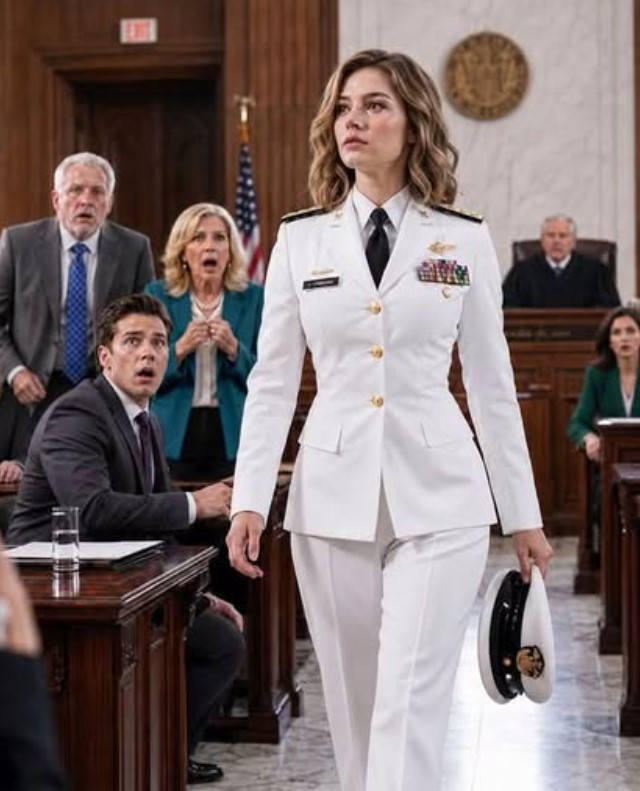
The judge stared at me.
“What did your grandfather leave behind, Commander?”
For several seconds, I couldn’t answer.
Not because I didn’t know.
Because saying it aloud would make everything that had happened over the last twelve years feel painfully real.
I looked across the courtroom.
Luke was standing beside his attorney, his face drained of color. My mother had both hands pressed against her mouth. My father sat completely still, staring at me as though he were seeing his daughter for the first time.
I took a slow breath.
“My grandfather left a controlling interest in a land preservation trust.”
Luke’s attorney frowned.
The prosecutor didn’t react.
He already knew.
“The trust contains property and financial assets,” I continued, “but that’s not what makes it important.”
The judge leaned forward.
“What does?”
I swallowed.
“It contains records.”
The courtroom became completely silent.
“Records of land purchases. Political donations. Private contracts. Payments made through companies that officially disappeared years ago.”
My father’s face turned white.
Luke stared at me.
The prosecutor asked quietly, “How extensive are these records?”
“Twenty-seven years.”
My mother’s eyes filled with tears.
She shook her head.
“No.”
I looked at her.
She whispered it again.
“No, Catherine.”
I almost felt sorry for her.
Almost.
Because I knew what she was remembering.
The expensive dinners.
The businessmen who came to our house.
The envelopes my father never explained.
The sudden renovations.
The vacations that were supposedly business trips.
The meetings Luke attended long before he was old enough to understand what they were really about.
My grandfather had known.
He had been documenting everything.
And he hadn’t been doing it for Luke.
He had been waiting for me.
The prosecutor walked toward the evidence table and picked up a sealed envelope.
“Commander, do you recognize this?”
My heart stopped.
The envelope was yellowed with age.
Across the front, written in familiar handwriting, were five words:
To Catherine. Open only when they come for you.
My grandfather’s handwriting.
I had seen it thousands of times.
I nodded.
“Yes.”
The clerk brought the envelope to me.
My fingers trembled as I broke the seal.
Inside was a single letter.
I unfolded it slowly.
There were only a few paragraphs, but the first sentence made my stomach tighten.
If you are reading this, Catherine, your brother has finally made his move.
I stopped breathing for a moment.
Luke whispered from the defense table.
“That’s impossible.”
I looked at him.
“You haven’t heard the rest.”
The judge allowed me to continue.
I read on.
My grandfather had discovered years earlier that Luke was secretly moving family assets into shell companies.
At first, he thought Luke was simply greedy.
Then he discovered something far worse.
Luke wasn’t working alone.
There were people outside our family who wanted control of the marshland.
They knew the property would become enormously valuable as federal environmental and flood-control projects expanded throughout the region.
My grandfather refused to sell.
So they needed another way.
They needed someone with a legitimate veteran-owned identity.
Someone whose military record could help qualify companies for federal contracts.
Someone whose background could survive a government verification process.
That person was me.
But there was one problem.
I actually existed.
And I had a real military career.
So they needed to create another version of me.
A disgraced version.
A vanished version.
A version nobody would think to search for.
My supposed military failure had never been the crime.
It had been the cover story.
For twelve years, my family had been telling people that I had failed in the Navy.
In reality, I had been serving.
While they were telling the world I had disappeared, someone was using my identity to make millions.
My entire life had become camouflage.
When I finished reading, the courtroom remained silent.
Then the prosecutor spoke.
“Commander, there is one more page.”
I looked down.
He was right.
There was another page folded behind the letter.
I turned it over.
My grandfather had written one final message.
And Catherine, if they ever convince you that your family abandoned you because you weren’t enough, remember this: sometimes people reject the truth because the truth would force them to admit what they have become.
I couldn’t breathe.
I lowered the letter.
My father was crying.
Not quietly.
Not with dignity.
He covered his face with both hands.
“Catherine…”
I looked at him.
He slowly stood.
“I was wrong.”
The courtroom remained silent.
“I should have believed you.”
I stared at the man who had once been the most important person in my life.
“You had twelve years to believe me.”
He nodded.
“I know.”
“No,” I said softly. “You don’t.”
His eyes met mine.
“You didn’t just believe Luke. You helped him.”
My father’s face collapsed.
“I thought I was protecting the family.”
I shook my head.
“You were protecting the story.”
He couldn’t answer.
Then my mother stood.
She looked older than she had when the hearing began.
“I knew something was wrong,” she whispered.
I stared at her.
She continued.
“I knew some of the documents didn’t look right. I knew Luke was moving money. But every time I questioned him, he told me you were unstable. He said you hated us.”
My voice was barely audible.
“And you believed him.”
She nodded.
“Yes.”
Then she said the words I had waited twelve years to hear.
“I am sorry.”
For years, I had imagined what it would feel like to hear those words.
I thought they would heal something inside me.
They didn’t.
And strangely, I was grateful.
Because I finally understood that forgiveness didn’t mean pretending the past had never happened.
Luke remained standing.
He looked at my parents.
Then at me.
Then toward the judge.
For the first time that morning, there was no performance left.
No confident smile.
No charming expression.
No carefully constructed story.
Just a frightened man realizing that every lie he had built was collapsing around him.
The prosecutor approached him.
“Mr. Sterling, you should probably speak with your attorney.”
Luke gave a bitter laugh.
“You think this is about me?”
The prosecutor stopped.
Luke looked directly at me.
“You still don’t understand.”
A cold feeling moved through me.
“What don’t I understand?”
He looked toward my father.
“Ask him.”
My father’s expression changed.
Luke smiled.
It was the first genuine smile I’d seen from him that morning.
“The trust wasn’t my idea.”
Everyone froze.
The prosecutor stepped closer.
“Whose idea was it?”
Luke looked at my father.
Dad said nothing.
Luke answered for him.
“His.”
My heart dropped.
“No.”
Dad immediately shook his head.
“Catherine, listen to me.”
But I couldn’t.
The prosecutor turned toward him.
“Mr. Sterling, did you participate in the creation of Vance Shield Recovery?”
Dad said nothing.
“Did you authorize the use of your daughter’s identity?”
Silence.
“Did you know she was still serving in the Navy?”
My father’s shoulders dropped.
“Yes.”
The word barely escaped his mouth.
My mother looked at him as though she had never seen him before.
I couldn’t move.
My own father had known.
All those years.
He knew I was still serving.
He knew the discharge papers were false.
He knew Luke was using my name.
And he had still allowed me to become the family disgrace.
“Why?” I whispered.
Dad looked at me.
“Because your grandfather chose you.”
I didn’t understand.
“He left everything to you,” Dad said. “Not Luke. Not me. You.”
Luke’s face twisted with anger.
“He always loved her more.”
Dad shook his head.
“No. He trusted her more.”
The courtroom went silent.
Dad continued.
“He knew what you were capable of.”
Luke exploded.
“You’re blaming me now?”
“You threatened me!” Dad shouted. “You threatened your mother. You told us you’d destroy everything if I didn’t help you.”
Luke went pale.
And suddenly, the pieces fit.
My father’s guilt had never been the same as Luke’s ambition.
Dad had been weak.
Luke had been willing.
And I had been the person they both needed gone.
The trial continued for months.
The evidence from my grandfather’s trust led investigators into other companies, other accounts, and other people.
The federal case became much larger than Vance Shield Recovery.
Luke eventually pleaded guilty.
My father entered a cooperation agreement.
My mother testified.
None of them received the future they had spent years trying to protect.
The marshland was placed under federal preservation oversight.
Investigators recovered much of the stolen money.
The false veteran certifications were dismantled.
And, officially, my name was cleared.
But that wasn’t the ending I remembered most.
That happened six months later.
I returned to my parents’ house.
Not because they asked me to.
Because I wanted to.
The house looked smaller than I remembered.
The hallway seemed narrower.
The kitchen where I had once stood at nineteen, holding my enlistment papers while arguing with my father, suddenly felt like a room from someone else’s childhood.
Dad was sitting at the table.
He looked much older.
Mom brought tea.
Nobody spoke for a long time.
Then Dad pushed something across the table.
My old enlistment photograph.
I picked it up.
“You kept this?”
He nodded.
“I never threw it away.”
I studied the photograph.
A nineteen-year-old girl stared back at me.
She looked confident.
Stronger than she felt.
Completely unaware of how much her life was about to change.
Dad’s voice was quiet.
“I was proud of you.”
I looked at him.
“You never said that.”
“I know.”
“And when I came home?”
He closed his eyes.
“I was afraid.”
“Of Luke?”
He nodded.
“And of losing everything.”
I placed the photograph on the table.
“You lost me instead.”
Tears ran down his face.
“I know.”
This time, I believed him.
But believing someone’s regret isn’t the same as restoring the past.
My mother reached across the table and took my hand.
I let her hold it for a few seconds.
Then I gently pulled away.
“I don’t know if I can be your daughter the way I was before.”
She nodded through her tears.
“I understand.”
“I don’t hate you.”
Mom cried harder.
“But I don’t owe you my life just because you finally believe it was real.”
She nodded again.
“I know.”
I walked toward the door.
Before I left, Dad called my name.
“Catherine.”
I turned.
He looked at me.
“I should have believed you.”
This time, I smiled.
Not because those words fixed anything.
They didn’t.
But because they no longer had the power to hurt me.
“I know.”
Then I walked outside.
The morning air was cold.
I stood beside my car and looked back at the house where I had once begged to belong.
And I realized something.
For twelve years, I had believed my family had buried me.
They hadn’t.
They had buried a version of me they needed to exist.
The weak daughter.
The disgraced sailor.
The failure.
The woman who supposedly couldn’t finish what she started.
But that woman had never existed.
I had.
I was still here.
And I had never needed their permission to become who I was.
My grandfather had understood that long before I did.
As I drove away, my phone rang.
It was the prosecutor.
I answered.
“Commander Sterling.”
“Yes?”
“We found one more document in the trust.”
I pulled the car to the side of the road.
“What document?”
There was a pause.
“Your grandfather’s final instructions.”
My heart began beating faster.
“What do they say?”
His voice softened.
“He anticipated that your family might try to take everything from you.”
I waited.
“And he left you one final gift.”
“What?”
“A letter.”
I closed my eyes.
“What’s in it?”
The prosecutor gave a quiet laugh.
“You’ll have to open it yourself.”
That evening, I sat alone at my kitchen table and opened the final envelope.
Inside was another photograph.
It showed my grandfather standing beside the marshland when I was a little girl.
I turned it over.
On the back, he had written:
You were never meant to inherit this land.
I frowned.
Then I noticed another sentence beneath it.
You were meant to decide what it became.
I stared at those words for a long time.
Then I finally understood.
The inheritance wasn’t the land.
It wasn’t the money.
It wasn’t even the trust.
It was the choice.
My grandfather had left me the one thing my family had spent years trying to take away.
The right to decide my own life.
I folded the letter.
Outside, the sun was setting over the water.
For the first time in twelve years, I didn’t feel like someone who had survived being erased.
I felt like someone who had finally stopped asking to be remembered.
I had served my country.
I had survived betrayal.
I had walked into a federal courtroom wearing the uniform they said I had disgraced.
And I had walked out knowing the truth.
My family had tried to bury my name.
The government had put it on the record.
And in the end, that was enough.
Because sometimes justice isn’t watching the people who hurt you fall.
Sometimes justice is realizing they no longer have the power to decide who you are.