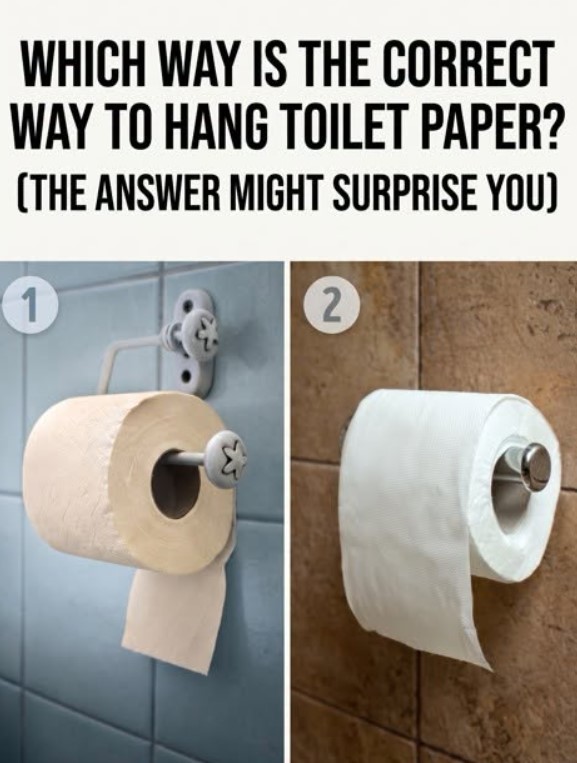
Have you ever walked into a bathroom, noticed the toilet paper roll facing the wrong direction, and felt the urge to turn it around? If so, you are certainly not alone. Few everyday household habits create as much friendly disagreement as the simple question of how toilet paper should hang.
Some people insist that the loose end must fall over the top of the roll, facing outward. Others prefer it hanging underneath, closer to the wall. Each side has its own arguments, and these small differences can become surprisingly important when people share a bathroom.
For some households, the debate is mostly about appearance. Others believe one position is more convenient, easier to use, or more hygienic. Pet owners may even have a practical reason for choosing one direction over the other.
But is there really a correct way to hang toilet paper? Interestingly, an invention from the nineteenth century provides a clue that may surprise you.
The answer involves a historical patent, a few practical considerations, and the realization that the best arrangement can depend on your bathroom and daily habits. Before you change the direction of your toilet paper roll, let’s examine both methods and discover which one has the strongest argument in its favor.
The Two Ways to Hang Toilet Paper
There are two common ways to position a toilet paper roll. Although both allow you to pull off sheets when needed, they differ in how the loose end hangs.
1. The Over-the-Top Method
The over-the-top method places the loose end in front of the roll, allowing the paper to fall toward you rather than toward the wall.
This is the arrangement many people recognize as the traditional way to hang toilet paper. It makes the loose end easy to see and usually allows you to grab a sheet without reaching behind the roll.
One advantage is convenience. When the paper hangs over the front, you can often pull it down with a simple movement. You do not need to search for the loose end or move the roll around to find where the next sheet begins.
Another advantage is visibility. If the bathroom is dimly lit or you are in a hurry, the hanging edge is generally easier to locate.
The over-the-top method can also help keep your fingers farther away from the wall behind the toilet paper holder. Depending on the holder’s design, this may reduce unnecessary contact with surrounding surfaces.
For people who appreciate an organized bathroom, this position can also create a neat appearance, especially when the loose end is folded cleanly against the front of the roll.
However, there is one potential disadvantage: if you have a curious cat or a young child who enjoys pulling at loose paper, the exposed end may be easier to reach.
2. The Under-the-Roll Method
The under-the-roll method positions the loose end behind the roll, closer to the wall.
People who prefer this arrangement often say it looks tidier or less noticeable. Because the loose end is tucked behind the roll, the front of the bathroom fixture can appear more compact and orderly.
This position may also be useful in households where pets frequently unroll toilet paper. Depending on the animal and the holder, placing the loose end underneath can make it less accessible to a casual paw swipe.
Another reason people choose this method is habit. If they grew up in a household where toilet paper was always installed this way, the arrangement may feel completely natural.
Nevertheless, the under-the-roll position has a few disadvantages. The loose end can be harder to locate, particularly if the paper sits close to the wall. You may need to reach behind the roll or rotate it slightly before finding the edge.
It can also be less convenient when the holder is mounted in a tight space.
Despite these differences, the under-the-roll method still performs its basic function. It allows you to dispense toilet paper, and many people prefer it for perfectly reasonable personal reasons.
Is There an Officially Correct Way to Hang Toilet Paper?
This is where the story becomes interesting.
In 1891, American inventor Seth Wheeler received a patent for an improved roll of perforated paper intended for toilet use. The patent, commonly identified as U.S. Patent No. 465,588, includes illustrations showing the paper passing over the top of the roll.
This historical detail has become one of the most frequently cited arguments in favor of the over-the-top method.
The illustration suggests that Wheeler presented his particular roll design with the loose end hanging over the front. For people who enjoy settling household debates with historical evidence, it provides a compelling talking point.
However, there is an important distinction: the patent focused on the construction and perforation of the paper roll, including how individual sheets could be separated easily. It was not a formal declaration that every household must hang toilet paper in one particular direction.
In addition, historical research into Wheeler’s other patents shows that his designs did not all depict the roll in the same orientation. This makes it difficult to claim that his work established an absolute rule for every toilet paper holder.
So, what can we conclude?
The over-the-top position has a recognizable historical reference in the 1891 patent, but there is no universal household law requiring everyone to use that arrangement.
If someone in your family insists that the patent settles the argument, you now have an interesting historical fact to share. Just remember that a patent drawing and a universal rule are two different things.
Which Method Is More Hygienic?
Hygiene is another reason people argue about the direction of a toilet paper roll.
Supporters of the over-the-top method often point out that the loose end hangs away from the wall. Depending on the holder’s position, this can make it easier to grasp the paper without brushing your fingers against nearby surfaces.
Bathroom walls, shelves, and toilet fixtures can collect dust, moisture, and other residue. Reducing unnecessary contact with these surfaces is a sensible habit.
The under-the-roll position, on the other hand, can place the loose end closer to the wall. On some holders, this may make it more difficult to reach the paper without touching the surrounding area.
However, the direction of the roll alone does not determine whether a bathroom is hygienic. Toilet paper can be handled during use, and the holder itself may also be touched frequently.
What matters more is maintaining good bathroom hygiene.
Here are a few practical habits to follow:
- Wash your hands thoroughly with soap and water after using the bathroom.
- Clean the toilet paper holder and nearby surfaces regularly.
- Avoid touching the loose end unnecessarily.
- Keep the bathroom well ventilated to help manage moisture.
- Lower the toilet lid before flushing, if your toilet has one.
- Replace an empty roll promptly and avoid placing fresh toilet paper on dirty surfaces.
These habits are more useful than assuming that one roll direction automatically makes a bathroom clean.
The over-the-top position may offer a small convenience advantage in some bathrooms, but it should not be treated as a substitute for proper cleaning and handwashing.
Why the Over-the-Top Method Is Often Preferred
Although both methods work, the over-the-top arrangement has several practical advantages that help explain its popularity.
The Loose End Is Easier to Find
When the paper hangs in front of the roll, the edge is visible. You can usually identify it immediately instead of searching behind the roll.
This may seem like a small detail, but it makes everyday use more convenient.
Pulling the Paper Can Be Easier
The loose end is positioned toward the user, which often allows for a more natural downward pulling motion.
Depending on the holder and the perforations, this may make it easier to tear off the desired amount without accidentally unrolling too much.
It Can Reduce Contact With the Wall
With the paper hanging forward, your hand may have less reason to reach behind the roll or brush against the wall.
The benefit depends on the distance between the holder and the wall, so it will not be identical in every bathroom.
It Can Look Neat and Intentional
Some people prefer the appearance of a visible, neatly hanging edge. In guest bathrooms, hotels, and carefully arranged spaces, the over-the-top position can create a familiar, finished look.
Of course, appearance is subjective. Someone who prefers a more discreet arrangement may find the under-the-roll method more attractive.
Why Some People Prefer the Under-the-Roll Method
The under-the-roll position also has its supporters, and their reasons are not necessarily wrong.
It Can Look More Discreet
Because the loose end hangs behind the roll, less paper is visible from the front. Some people find this arrangement more understated.
It May Help With Curious Pets
Cats can be fascinated by a dangling strip of toilet paper. In some cases, placing the loose end underneath makes it less accessible to a casual swipe.
This is not a guaranteed solution. A determined pet may still reach the paper, turn the roll, or pull at it from another angle.
If your cat regularly unrolls toilet paper, a covered holder or another pet-resistant storage solution may be more effective.
It May Suit Certain Bathroom Layouts
The placement of the toilet paper holder can influence which direction feels more comfortable.
In a narrow bathroom, or where the holder is positioned unusually close to another fixture, one orientation may be easier to reach than the other.
The most practical choice is the one that allows everyone using the bathroom to access the paper comfortably.
Does the Direction Affect How Much Toilet Paper You Use?
Some people believe hanging toilet paper in one direction helps prevent waste, but there is no simple rule that applies to every person or holder.
The amount of paper used depends on several factors, including personal habits, sheet size, perforation quality, and how easily the roll turns.
If a roll spins freely, a quick pull may release more paper than intended. This can happen with either orientation, depending on the holder’s design and the way the paper is pulled.
If you frequently find long strips of paper hanging from the roll, consider checking whether the holder has a loose spindle or rotates too freely.
You can also encourage everyone in the household to tear off only what they need.
Ultimately, sensible use and a properly functioning holder are more important than the direction of the loose end.
How to Hang Toilet Paper Correctly
If you decide to use the over-the-top method, installing the roll is straightforward.
- Remove the empty cardboard tube from the holder.
- Take a fresh toilet paper roll and identify the loose end.
- Place the roll on the holder so the loose end hangs over the front, facing outward.
- Make sure the roll rotates freely without rubbing against the wall or nearby fixtures.
- Pull down a small section of paper and check that it tears easily along the perforations.
If your holder uses a spring-loaded spindle, compress the spindle gently and position it securely between the brackets.
For wall-mounted holders with a fixed bar, slide the roll into place according to the holder’s design.
If you prefer the under-the-roll method, simply reverse the direction so the loose end falls behind the roll.
The most important thing is to ensure the roll is secure, easy to reach, and comfortable for everyone who uses the bathroom.
What About Hotels and Guest Bathrooms?
The direction of toilet paper can be especially noticeable in hotels, guest bathrooms, and other shared spaces.
Many people associate the over-the-top method with a neat, familiar presentation. Some housekeeping routines also involve folding the final sheet into a small triangle to make the roll look freshly arranged.
This is mainly a presentation detail. A neatly folded edge can signal that someone has tidied the bathroom, but it does not independently prove that the room has been thoroughly cleaned.
If you are preparing a bathroom for guests, the more important priorities are to provide a fresh roll, clean the holder and surrounding surfaces, and make sure the paper is easy to reach.
You can then choose whichever orientation creates the appearance you prefer.
Frequently Asked Questions
Is hanging toilet paper over the top officially correct?
The 1891 patent illustration by Seth Wheeler shows the paper hanging over the front of the roll. This supports the over-the-top arrangement as the orientation shown in that particular design, but it does not establish a universal rule for every bathroom.
Which way is easier to use?
Many people find the over-the-top method easier because the loose end is visible and simple to grab. However, the best arrangement can depend on the holder, its position, and your personal preference.
Is the under-the-roll method unhygienic?
Not automatically. Both methods can be used hygienically. Regularly cleaning the bathroom, minimizing unnecessary contact with surfaces, and washing your hands properly are more important than the roll’s orientation.
Can hanging toilet paper underneath help stop cats from unrolling it?
It may make the loose end less accessible to some cats, but it is not guaranteed to prevent the behavior. A covered toilet paper holder may be a better option for persistent paper pullers.
Does the over-the-top method save toilet paper?
Not necessarily. Paper use depends more on individual habits, the holder’s design, and how easily the roll turns than on the direction alone.
Should everyone in the house use the same direction?
Using one consistent arrangement can prevent small disagreements and make the bathroom look more organized. However, there is no reason to treat the choice as a serious household rule.
Conclusion :
The question of which way to hang toilet paper may seem trivial, but it has inspired friendly arguments in homes for generations. Some people prefer the loose end hanging over the front because it is easy to see and grab, while others favor the under-the-roll position because it looks more discreet or may help keep curious pets from reaching the paper.
If you are looking for a historical argument in favor of one side, the 1891 patent associated with Seth Wheeler provides an interesting clue: its illustration shows the paper hanging over the top of the roll. However, that historical detail does not establish an absolute rule for every household.
The over-the-top method has practical advantages, particularly when it comes to visibility and convenience. Still, the under-the-roll method remains a reasonable choice for people who prefer its appearance or find it better suited to their bathroom.
In the end, the best approach is the one that works for your space and the people who use it. Keep the holder clean, make sure the roll is easy to reach, and remember that good hygiene depends on much more than which way the paper hangs.
Now that you know the history behind this familiar household debate, take a look at your own toilet paper holder. Is your roll hanging over or under? And more importantly, are you ready to defend your choice the next time someone turns it around?