Coming home to an empty house after dark is a normal part of everyday life for many people. You unlock the door, step inside, and instinctively reach for the nearest light switch. It seems like the most natural thing in the world.
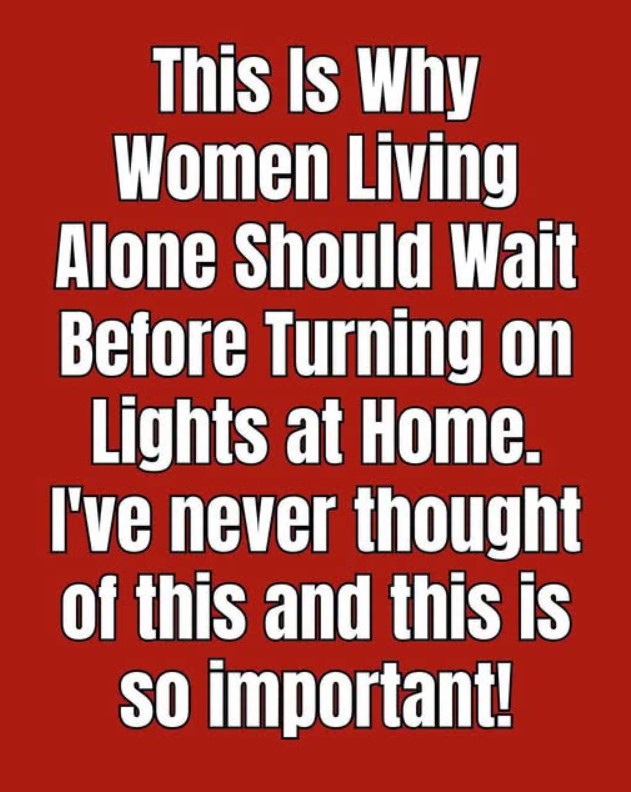
But there is an interesting home-security habit worth knowing: if you live alone, you may want to think about your lighting routine rather than automatically turning on every light the moment you arrive.
The idea isn’t that turning on a light is dangerous. In fact, if you need light to move safely through your home, you should absolutely turn it on. The concern is more subtle. Predictable lighting patterns can sometimes reveal information about when someone is home and how they move around their property.
That doesn’t mean you should become suspicious of every noise outside or assume that someone is watching your house. Most people aren’t. Instead, this is about adopting a few simple habits that make your home less predictable from the outside while keeping your own safety as the top priority.
Why Your Evening Lighting Routine Matters
Think about what happens when you come home at approximately the same time every evening.
Perhaps you arrive around 6:30 p.m., switch on the hallway light, turn on the kitchen light while preparing dinner, then switch on the living-room lamp before settling down for the evening.
If someone outside could see your windows clearly and happened to observe the property regularly, repeated patterns could potentially tell them something about the household.
A predictable lighting routine might indicate:
- When someone usually arrives home
- Which parts of the house are being used
- Whether the property appears occupied
- When the household becomes quiet
- When someone may be preparing for bed
- Whether a normal routine has suddenly changed
Again, this doesn’t mean someone is necessarily monitoring your movements. The important principle is simply that your home can communicate information through visible patterns.
Home security is often about reducing unnecessary predictability rather than trying to make your home completely invisible.
Don’t Take the “Wait” Advice Too Literally
The title of this advice can make it sound as though someone living alone should enter a dark house and deliberately avoid turning on the lights.
That is not what you should do.
If you need the lights on to see where you’re going, turn them on.
Walking through a dark house can create unnecessary hazards. You could trip over a shoe, stumble on a staircase, bump into furniture, or accidentally step on a pet.
Your immediate physical safety is much more important than maintaining a perfectly unpredictable lighting pattern.
The smarter approach is to think about your lighting habits before and after you arrive home rather than deliberately putting yourself in danger.
If you arrive at night and need to turn on the entryway light immediately, there is nothing wrong with doing so.
The Goal Is to Make Your Home Look Naturally Occupied
Instead of keeping your house dark for a long period, consider creating a more natural and varied lighting pattern.
Smart bulbs, timers, and programmable lighting can make this much easier.
For example, rather than having every light inside your home switch on simultaneously at exactly the same time every evening, you might arrange for different lights to operate at slightly different times.
A possible setup could include:
- A living-room lamp switching on around sunset
- An entryway light coming on later
- A kitchen light being used only when needed
- An upstairs light turning on at another time
- Exterior lighting activating when movement is detected
The objective isn’t to create an elaborate fake occupancy system. It is simply to avoid making the property’s visible routine unnecessarily repetitive.
Modern smart lighting can make this particularly convenient because many systems allow schedules to be created in advance.
Timers Can Be Useful When You’re Away
Lighting schedules can be particularly helpful when you’re traveling.
A completely dark home for several nights can sometimes appear different from the normal pattern of an occupied property, particularly if the house usually has visible evening activity.
Timers can make selected lights turn on and off automatically, creating a more natural appearance.
However, there is no need to turn every light on for hours. That can waste electricity and create an obviously artificial pattern.
A better approach is to use a small number of lights at different times and vary the schedule when practical.
The goal is subtlety and convenience—not an attempt to fool everyone who passes by your house.
Look Around Before Entering Your Home
One of the more practical habits for people who live alone is to pay attention to their surroundings before walking through the front door.
As you approach your home, take a quick look at the property.
You don’t need to inspect every window or become nervous about ordinary activity. Simply notice whether anything looks obviously different from what you normally expect.
For example, you might notice:
- A door that appears to be open
- Broken glass near an entrance
- Signs of damage around a lock
- An unfamiliar vehicle that seems out of place
- A gate that has been left open
- Outdoor lights behaving differently
- Something unusual around a window or entry point
The purpose is awareness, not paranoia.
When you know what your home normally looks like, unusual changes are easier to recognize.
What If Something Looks Wrong?
This is where personal safety becomes more important than any lighting strategy.
If you arrive home and notice something genuinely suspicious—such as a damaged door, broken window, or clear indication that someone may have entered—don’t walk inside simply to investigate.
Move somewhere safe and contact an appropriate person or local emergency services if necessary.
You don’t need to prove that something is wrong before taking reasonable precautions.
The same principle applies if you believe someone may be inside your home. Avoid entering or searching the property yourself simply because you are curious about what happened.
Your goal should always be to put distance between yourself and a potentially dangerous situation.
Exterior Lighting Can Improve Visibility
Interior lighting is only one part of home security.
Good outdoor lighting can make entrances, walkways, and other areas around the property easier to see.
Motion-activated lights can be particularly convenient because they illuminate an area when movement is detected.
Potentially useful locations include:
- Front entrances
- Back doors
- Garages
- Side entrances
- Driveways
- Dark pathways
- Areas around gates
Outdoor lighting isn’t a guarantee of security, and it shouldn’t be treated as a replacement for locks, alarms, cameras, or other appropriate measures.
Its biggest benefit is visibility. When an entrance or walkway is well illuminated, it can be easier for you to see what is happening around the property.
Don’t Forget Your Curtains and Blinds
Windows can provide light from inside the home, but they can also allow people outside to see into certain rooms.
This is why curtains and blinds are another simple part of an overall privacy routine.
At night, interior lights can make windows especially revealing because the contrast between the illuminated room and the dark exterior can make it easier to see inside.
Using curtains or blinds appropriately can reduce unnecessary visibility into your home.
You don’t have to keep every window covered constantly. Instead, think about which rooms are visible from outside and whether you are comfortable with what someone could potentially see.
This is especially important in bedrooms, bathrooms, home offices, and other areas where privacy matters.
Don’t Create a Perfectly Predictable Routine
One of the broader lessons here is that routines can sometimes reveal more information than people realize.
If everything happens at exactly the same time every day, your routine can become very predictable.
This applies not only to lights but also to other visible habits.
For example, if the same outdoor light switches on at precisely 7:00 p.m., the same curtains open and close at identical times, and the same room is illuminated every evening, the overall pattern may become noticeable.
You don’t need to constantly change your life to prevent this.
Instead, small variations can be enough. Smart lighting schedules can help because they allow you to adjust timing without requiring extra effort every evening.
Consider Smart Home Technology
For people who live alone, smart-home technology can provide additional convenience.
Depending on the system you choose, you may be able to control:
- Interior lights
- Outdoor lights
- Door locks
- Security cameras
- Motion sensors
- Door and window sensors
- Alarm systems
The advantage is that you can manage many of these devices remotely.
For example, if you forgot to turn on a light before leaving for a trip, you may be able to activate it from your phone.
However, convenience should always be balanced with digital security. Use strong, unique passwords for your accounts, enable multi-factor authentication when available, and keep connected devices updated.
A smart home is only as secure as the accounts and devices controlling it.
Don’t Make Your Home Look Abandoned
While excessive lighting isn’t necessary, completely neglecting the exterior can create its own problems.
Overgrown plants, broken outdoor lights, newspapers accumulating near the entrance, or other obvious signs of neglect can make a property appear unoccupied.
Keeping the outside of your home reasonably maintained is therefore useful for both everyday comfort and general security.
Make sure outdoor lights work, entrances are visible, and locks and doors are in good condition.
Simple maintenance can go a long way.
Your Safety Comes Before Every Rule
It’s important not to let home-security advice become a source of unnecessary fear.
Living alone does not mean that you should constantly assume someone is following you or watching your house.
Most people go about their daily lives without encountering serious security problems.
The purpose of habits such as checking your surroundings, using outdoor lighting, managing curtains, and varying predictable lighting schedules is simply to give you greater awareness and control.
And if a security tip ever conflicts with immediate physical safety, choose physical safety.
If you need to turn on a light because you cannot safely navigate your home without it, turn it on.
If something looks suspicious outside, don’t investigate just because you feel you should follow a particular rule.
Good security practices should make you feel more confident—not more frightened.
A Simple Evening Routine
If you want to incorporate these ideas into your daily life, there is no need to make things complicated.
When approaching your home at night, briefly look around for anything obviously unusual.
Once inside, turn on whatever lights you need to move around safely.
Use curtains or blinds where appropriate to protect nighttime privacy.
Consider using timers or smart bulbs for selected lights so that your home doesn’t always follow exactly the same visible pattern.
Check that outdoor lights are working, particularly around entrances and dark pathways.
And if you ever notice signs of forced entry or believe someone could be inside, don’t investigate alone. Move to a safe location and seek appropriate assistance.
These are simple habits, but together they can provide a sensible layer of awareness.
Final Thoughts
The advice to “wait before turning on the lights” is really less about the light switch itself and more about predictability, privacy, and awareness.
You shouldn’t walk through a dark house just to make your routine less obvious. Your safety comes first. Instead, think about how your home appears from the outside and whether your everyday habits unnecessarily reveal when you’re home, when you leave, or which rooms you’re using.
Using a mixture of timed lights, motion-activated outdoor lighting, curtains or blinds, sensible home maintenance, and basic awareness can create a more balanced approach.
Living alone can be peaceful, independent, and enjoyable. A few practical precautions can help you preserve that sense of comfort without turning your home into a source of anxiety.
The most important takeaway is simple: don’t be predictable when you don’t need to be, but never sacrifice your immediate safety to follow a security tip. A well-lit path, an alert mindset, and a few smart habits are far more valuable than sitting in the dark waiting for the “right” moment to switch on a lamp.