Have you ever looked at a picture and suddenly noticed a face, a person, or a hidden object that you hadn’t seen at first? Optical illusions have a special way of capturing our attention. They encourage us to slow down, look more carefully, and question what our eyes are telling us.
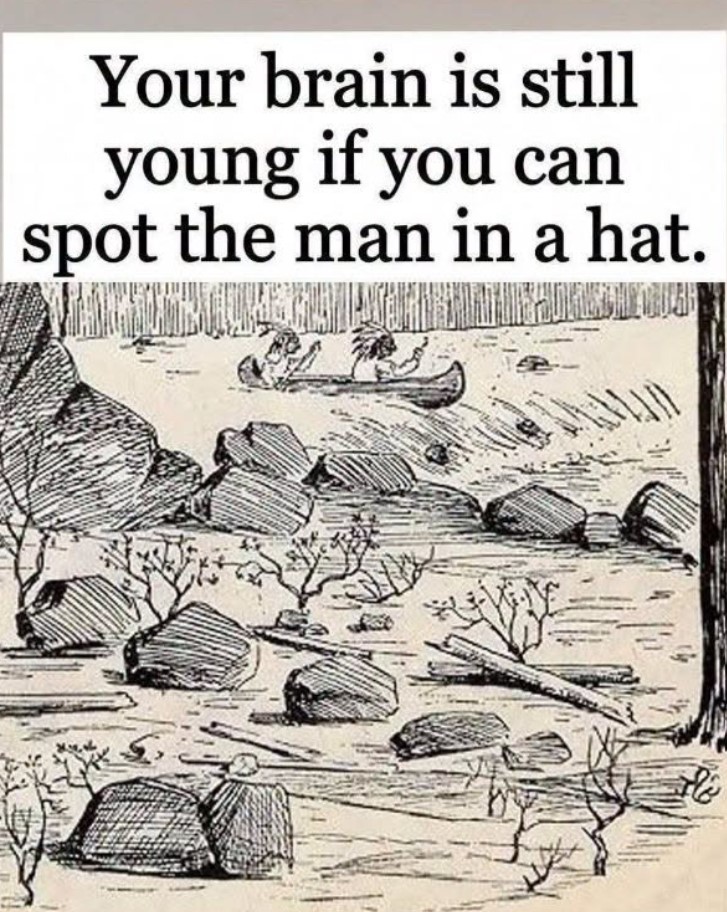
One popular type of visual puzzle asks viewers to find a man wearing a hat hidden somewhere within a complicated image. At first glance, the picture may appear to show an ordinary scene, a collection of shapes, or a confusing arrangement of lines. But after examining the details, you may suddenly recognize the hidden figure.
Challenges like this are popular online because they are simple, entertaining, and surprisingly engaging. They invite people of different ages to test their observation skills and compare how quickly they notice the hidden image.
The title of this puzzle suggests that spotting the man proves your brain is still young. Although that makes an appealing challenge, there is an important distinction: finding a hidden figure can demonstrate visual attention and pattern recognition, but it cannot determine your brain’s biological age or establish whether your cognitive abilities are declining.
Still, the puzzle offers an enjoyable opportunity to explore how the brain interprets visual information and why some people notice hidden details faster than others.
What Is the Hidden Man in a Hat Puzzle?
The hidden-man puzzle is a type of visual perception challenge. The viewer is presented with an image containing numerous details, and the goal is to identify a particular figure concealed within the larger composition.
Depending on the design, the man may be formed by shadows, overlapping outlines, background shapes, or features that initially appear to belong to something else.
The difficulty comes from the way the image is organized. Your eyes receive visual information, but your brain must interpret that information and decide which details belong together.
At first, you might focus on the most obvious objects in the picture. The hidden man may remain unnoticed because your attention has already settled on another interpretation of the scene.
Then, after changing your viewing angle or concentrating on a different section, the figure may suddenly become recognizable.
That moment of discovery is one reason optical illusions and hidden-picture puzzles are so satisfying. The image has not changed, but your interpretation of it has.
Why Can the Man Be Difficult to Find?
The human brain is constantly working to organize visual information. When you look at a busy picture, you do not consciously analyze every line, shadow, and shape individually. Instead, your visual system attempts to identify meaningful patterns as efficiently as possible.
This ability is useful in everyday life. It helps you recognize familiar faces, identify objects in crowded spaces, and understand what is happening around you.
However, the same process can make hidden-picture puzzles challenging.
If a shape initially resembles a tree branch, a patch of shadow, or part of a wall, your brain may interpret it that way before you realize it contributes to the outline of a human face.
Several factors can influence how quickly you spot the figure:
- Visual attention: You may notice the man faster if your attention reaches the relevant part of the image.
- Pattern recognition: Experience recognizing faces and familiar shapes can influence how you interpret ambiguous details.
- Contrast and lighting: Some outlines become easier to recognize when you adjust the brightness of your screen or view the image under different lighting.
- Patience: Spending a little more time examining the picture may reveal details that were initially overlooked.
- Expectations: Knowing that a man wearing a hat is hidden in the picture gives your brain a specific target to search for.
None of these factors alone determines intelligence or brain age. They simply help explain why a visual puzzle may be easy for one person and difficult for another.
What Does Your Brain Actually Do When You Look at an Optical Illusion?
Vision involves much more than receiving an image through your eyes.
Light enters the eyes and is converted into signals that travel through the visual system. The brain processes these signals and combines them with information about shapes, colors, contrast, movement, and familiar objects.
Your brain also uses context and previous experience to interpret what you see.
Imagine looking at a collection of dark lines. Initially, they may appear to be random marks. But once you recognize the outline of a face, those same lines suddenly seem to form a nose, forehead, eyes, and hat.
This experience illustrates how perception depends on the organization and interpretation of visual information.
Researchers study visual illusions because they can reveal how different perceptual processes operate. Some illusions cause objects to appear larger or smaller than they really are. Others make stationary patterns seem to move or encourage viewers to see faces in ordinary objects.
Scientific research also shows that age-related changes in visual perception are not uniform. A 2024 study published in Scientific Reports examined several size illusions in adults aged 20 to 85 and found different age-related patterns depending on the illusion being tested. This suggests that there is no single rule describing how aging affects every aspect of visual perception. <Cite refs={[“turn788739search1″,”turn788739search2”]}/>
A hidden-man puzzle is therefore an interesting demonstration of perception, but it is not a comprehensive test of how well the brain functions.
Does Finding the Man Mean Your Brain Is Young?
This is where the puzzle’s catchy title needs some explanation.
Finding the man may require concentration, visual discrimination, and pattern recognition. However, there is no reliable scientific basis for claiming that someone has a younger brain simply because they solve this particular puzzle.
A person in their twenties might take several minutes to identify the figure, while someone in their seventies might notice it immediately. That difference would not establish that the older person has a younger brain.
Many factors affect performance, including eyesight, familiarity with optical illusions, image quality, attention, fatigue, and individual differences in perception.
Even researchers who study visual illusions do not treat all illusions as interchangeable measurements of cognitive ability. Studies have found that susceptibility to different illusions can change in different ways with age. <Cite refs={[“turn788739search1″,”turn788739search3”]}/>
In other words, solving the puzzle can be a small test of observation, but it cannot tell you your biological brain age, diagnose a neurological condition, or rule out cognitive difficulties.
It is best to approach the challenge as entertainment rather than a medical assessment.
Why Do Some People Spot Hidden Images Faster Than Others?
People differ in how they direct their attention and organize visual information. These differences are normal and do not necessarily indicate that one person’s brain is healthier or more intelligent than another’s.
Someone who enjoys puzzles may already be accustomed to scanning an image for unusual outlines. That experience can make similar challenges easier.
Other people may focus first on the overall scene instead of its smaller details. They might need additional time to notice that several apparently unrelated shapes form a recognizable figure.
Visual acuity can also play a role. If the image is small, blurry, or displayed on a low-quality screen, subtle details may be difficult to distinguish.
Lighting matters as well. Reflections on a phone screen or low contrast between the figure and its surroundings can make the puzzle harder.
Sometimes, taking a short break helps. Looking away and returning to the image may encourage you to notice a different arrangement of shapes.
The key point is that speed is not the same as overall cognitive ability. A single visual puzzle measures only a narrow aspect of performance under particular conditions.
How to Improve Your Chances of Finding the Man in a Hat
If you want to solve the puzzle, try approaching it systematically rather than staring at the entire picture without a plan.
1. Begin by Looking at the Whole Image
Spend a few seconds examining the picture as a whole.
Notice the dominant shapes, areas of light and darkness, and any unusual outlines. Avoid immediately deciding what every section represents.
Sometimes, the hidden figure becomes easier to recognize when you stop concentrating on the most obvious objects.
2. Divide the Picture Into Smaller Sections
Mentally divide the image into sections and examine each one carefully.
Start at the top, then move toward the center and bottom. You can also scan from left to right.
This approach helps prevent your attention from jumping randomly between different parts of the picture.
3. Look for the Outline of a Face
Instead of searching for an entire person, concentrate on features that might form a human face.
Look for a forehead, nose, chin, or the curved outline of a cheek. The hat may appear as a dark shape or a narrow outline above the head.
You may recognize one feature before seeing the complete figure.
4. Pay Attention to Negative Space
Negative space refers to the empty area surrounding an object.
In some optical illusions, the hidden figure is easier to recognize by examining the shape of the space around it rather than focusing on the lines themselves.
Look at gaps between objects, unusual curves, and areas where shadows create a face-like silhouette.
5. Adjust Your Viewing Distance
If the image is on a phone, try holding it a little farther away. If you are using a computer, take a small step back from the screen.
A different viewing distance can change how separate details combine into a larger shape.
You can also zoom in if the image contains fine details, although excessive zooming may make it harder to see the overall composition.
6. Give Yourself Time
Do not assume you have failed if the man does not appear immediately.
Some hidden-picture puzzles are deliberately designed to misdirect attention. Taking a short break and returning with fresh eyes may help you recognize a pattern you missed earlier.
And if you still cannot find him, that does not say anything negative about your intelligence or the health of your brain.
Can Optical Illusions Help Keep Your Mind Active?
Puzzles, games, reading, and other mentally engaging activities can provide enjoyable opportunities to practice particular skills.
Hidden-picture challenges encourage you to focus on visual details, compare shapes, and reconsider an initial interpretation. Other puzzles may involve memory, language, reasoning, or problem-solving.
These activities can be a pleasant part of an active lifestyle, especially when they are enjoyable enough to encourage regular participation.
However, it is important not to overstate their benefits. Completing one optical illusion does not prove that your brain is young, and solving visual puzzles alone has not been established as a way to prevent dementia.
Research into cognitive training and brain health is complex. Improvements on a practiced task do not automatically translate into improvements across every area of thinking or memory.
For general brain health, it is more useful to consider the broader picture. Regular physical activity, adequate sleep, social connection, and managing relevant health conditions all matter. Activities that challenge the mind can be included as one enjoyable part of that wider approach.
The best reason to solve a hidden-picture puzzle is that it stimulates curiosity and gives you an opportunity to enjoy a small mental challenge.
Other Fun Ways to Challenge Your Observation Skills
If you enjoy searching for the man in a hat, there are many other visual challenges worth trying.
Find the hidden animal: These pictures conceal an animal among leaves, branches, rocks, or other shapes. They encourage you to look beyond the obvious scene.
Spot the difference: Two nearly identical images contain a few small changes. Your task is to identify each difference.
Find the missing object: A busy illustration contains an object that blends into the background, requiring careful scanning.
Recognize the ambiguous image: Some pictures can be interpreted in two different ways. You may initially see one object and later recognize another.
Complete the pattern: These puzzles ask you to identify a repeated visual arrangement or determine which shape belongs next.
Each activity focuses on slightly different skills. Some emphasize visual attention, while others involve reasoning, memory, or recognizing patterns.
You do not need to finish every challenge quickly. Taking time to observe and enjoy the process is perfectly fine.
When Should You Be Concerned About Changes in Memory or Thinking?
An optical illusion should never be used to judge whether someone’s memory or thinking abilities are healthy.
Failing to find the man in a hat is not a warning sign of dementia. Likewise, spotting him immediately does not rule out a cognitive problem.
Normal thinking abilities can vary from day to day. Poor sleep, stress, distractions, tiredness, and vision difficulties may affect concentration.
If you or someone close to you experiences persistent or worsening changes in memory, language, judgment, or the ability to manage familiar daily activities, it is sensible to speak with a healthcare professional.
A professional can consider the person’s symptoms, medical history, medications, vision, sleep, and other possible explanations. A single online puzzle cannot provide that assessment.
The important distinction is between struggling with one challenging image and experiencing a continuing change in everyday functioning.
There is no need to worry simply because a visual puzzle takes longer than expected.
Conclusion: Enjoy the Challenge, but Do Not Judge Your Brain by One Picture
The hidden man in a hat puzzle is a fun way to explore how your brain interprets visual information. It encourages you to slow down, focus on details, recognize patterns, and look at familiar shapes from a different perspective.
If you find the man quickly, enjoy the satisfaction of solving the challenge. If it takes longer, give yourself time to examine the image from another angle.
Your result does not determine your intelligence, reveal your biological brain age, or establish whether your brain is healthy. Visual perception is complex, and a single puzzle cannot measure all the different abilities involved in thinking and memory.
What makes these challenges worthwhile is the curiosity they inspire. They remind us that our first impression of an image is not always the only possible interpretation and that looking more carefully can reveal something we initially overlooked.
So take another look at the picture, enjoy the search, and challenge yourself without unnecessary pressure.
After all, the goal is not to prove that your brain is younger than someone else’s. It is to stay curious, enjoy learning, and appreciate the fascinating ways the human mind makes sense of the world.