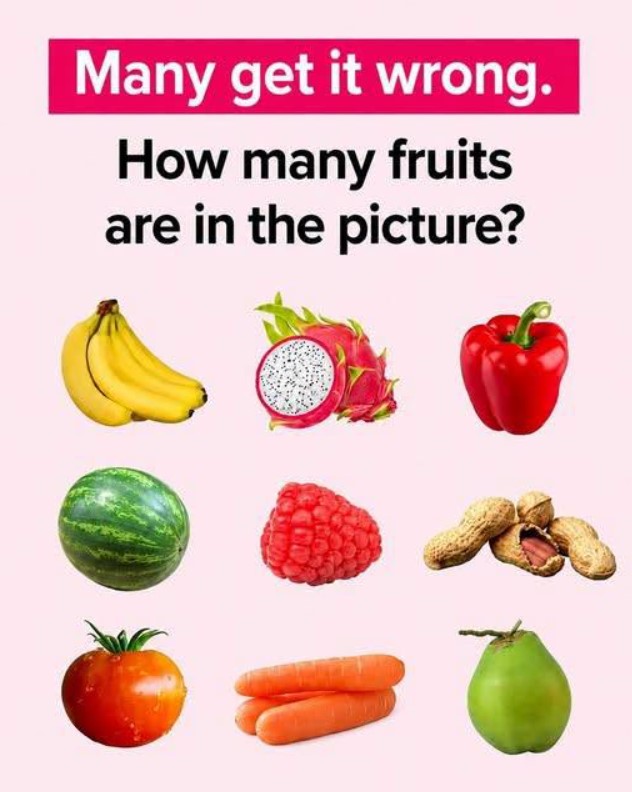
At first glance, this looks like a simple counting puzzle. You see a collection of colorful foods arranged together, and the question seems straightforward: How many fruits can you find?
But this puzzle has a clever little twist.
Not everything in the picture belongs to the category you might expect. Some foods are commonly called vegetables even though botanically they are fruits, while other items may look fruit-like but don’t actually qualify as fruits at all.
That means you can’t solve this challenge simply by counting the foods that look sweet or colorful. You have to think about how each food is classified botanically.
The original puzzle includes bananas, dragon fruit, a red bell pepper, watermelon, raspberry, peanuts, tomato, carrots, and a green coconut. According to the puzzle’s botanical classification, the correct answer is seven fruits.
But which seven count—and which two should you leave out?
Let’s take a closer look.
Can You Find All the Fruits?
Before reading the answer, take another look at the picture and try to count the fruits yourself.
Don’t worry about whether a food is usually considered a fruit or vegetable in the kitchen.
Instead, ask yourself a different question:
Does this part of the plant meet the botanical definition of a fruit?
That small change in perspective makes the puzzle much more interesting.
You may immediately recognize the banana and watermelon as fruits. The dragon fruit and raspberry are also fairly obvious.
But then things become less straightforward.
What about the red bell pepper?
What about the tomato?
And what about the coconut?
Meanwhile, the peanuts and carrots are sitting right alongside everything else, waiting to make you second-guess your answer.
The First Easy Answer: Bananas
Let’s begin with one of the easiest items.
Bananas are fruits.
There isn’t much controversy here. The banana develops from the flower of the banana plant and contains seeds, even though the cultivated bananas we commonly eat have very small, undeveloped seeds.
So if you spotted the bananas right away, you were on the right track.
Make sure to include them in your final count.
Dragon Fruit Definitely Counts
Next, we have the dragon fruit.
Its bright appearance might make it stand out from the other foods in the picture, but its botanical classification is straightforward.
Dragon fruit develops from the flower of its plant and contains numerous small seeds inside its flesh.
That means it qualifies as a fruit.
So far, our list is growing.
Banana + dragon fruit = 2 fruits.
But the puzzle is only beginning to get interesting.
The Bell Pepper Trick
Now we reach one of the foods that can easily fool you.
The red bell pepper is commonly treated as a vegetable.
We chop it into salads, add it to stir-fries, roast it with other vegetables, or use it in savory dishes.
From a culinary perspective, calling it a vegetable makes perfect sense.
Botanically, however, the story is different.
A bell pepper develops from the flower of the pepper plant and contains seeds. That means it meets the botanical definition of a fruit.
So the red bell pepper does count.
This is one of the main traps in the puzzle because many people automatically exclude anything they associate with savory cooking.
Our count is now:
3 fruits.
Watermelon Is an Easy One
The watermelon probably won’t cause too much confusion.
It is widely recognized as a fruit and develops from the flowering part of its plant.
The juicy flesh and seeds make its fruit classification relatively easy to understand.
So add the watermelon to the list.
4 fruits.
At this point, you might think you’ve already figured out the puzzle.
But there are still a few surprising items to examine.
Don’t Forget the Raspberry
The raspberry is another fruit that belongs in the count.
Raspberries look quite different from fruits such as bananas and watermelons. Instead of having one obvious piece of flesh surrounding a large central seed, raspberries consist of many tiny segments called drupelets.
Each drupelet contains a seed.
So despite their unusual structure, raspberries are fruits and should be included.
That brings us to:
5 fruits.
Here Comes the Peanut Trap
Now look at the peanuts.
This is where the puzzle tries to catch you.
Peanuts are often grouped with other plant foods and can appear alongside fruits and vegetables in food illustrations.
But botanically, peanuts are legumes, not fruits.
Peanuts develop underground, inside pods. The part we eat is the seed contained within the pod.
Because of this, peanuts should not be included in the fruit count.
So if you counted the peanuts, take them back off your list.
This is a good reminder that visual appearance isn’t enough for this puzzle.
The Tomato Is a Fruit
Now we arrive at perhaps the most famous botanical surprise.
The tomato is a fruit.
In everyday cooking, tomatoes are overwhelmingly treated like vegetables.
We put them into salads.
We use them in sauces.
We add them to sandwiches.
We cook them with onions and peppers.
And we rarely think of eating a tomato as eating a piece of fruit.
But botanical classification is based on how the plant develops rather than how we use the food in the kitchen.
A tomato develops from the flower of the tomato plant and contains seeds.
Therefore, botanically speaking, the tomato is a fruit.
So don’t make the mistake of leaving it out.
Our count is now:
6 fruits.
What About the Carrots?
The carrots are another item that should not be counted.
Unlike a tomato or pepper, a carrot isn’t the fruit produced by the plant.
The part we normally eat is the plant’s root.
That makes carrots a root vegetable rather than a botanical fruit.
So even though carrots are colorful and appear right next to several genuine fruits, they don’t belong in the final total.
That leaves us with one final item to investigate.
The Coconut Surprise
The green coconut may not look like the other fruits in the picture, but it absolutely counts.
Botanically, a coconut is a fruit.
More specifically, it is a type of fruit known as a drupe.
This is another example of why appearances can be misleading.
Many people associate coconuts with tropical drinks, coconut milk, desserts, and other foods rather than thinking about their botanical classification.
But for this puzzle, the coconut belongs on the list.
And with that, we have our final answer.
The Answer: Seven Fruits
Let’s put everything together.
The seven fruits in the picture are:
- Banana
- Dragon fruit
- Red bell pepper
- Watermelon
- Raspberry
- Tomato
- Coconut
The two foods that do not count are:
- Peanuts — legumes
- Carrots — roots
So the correct answer is:
7 Fruits
The original puzzle confirms the same seven-item list and identifies the peanuts and carrots as the two foods that shouldn’t be counted.
Why This Puzzle Is More Difficult Than It Looks
The challenge isn’t really about counting.
It’s about classification.
If you simply look at the image and ask, “Which foods do I normally call fruits?” you might leave out the bell pepper and tomato.
If you count everything that comes from a plant, you’ll probably include the carrot and peanut.
Neither approach works.
The puzzle requires you to switch from everyday food terminology to botanical classification.
That’s what makes it such a clever challenge.
Culinary Classification vs. Botanical Classification
One of the biggest sources of confusion is that the word “vegetable” is used differently in everyday life than the word “fruit” is used in botany.
In the kitchen, foods are often classified according to how they’re prepared and eaten.
A tomato can be considered a vegetable because it’s commonly used in savory dishes.
A bell pepper is treated the same way.
Carrots are vegetables because they’re edible roots.
Peanuts are commonly discussed alongside nuts, although botanically they are legumes.
Botany uses a different system.
A botanical fruit generally develops from the flower of a plant and contains seeds.
That’s why tomatoes and peppers qualify even though they don’t feel like “fruits” when you’re preparing dinner.
Why Tomatoes Cause So Much Confusion
The tomato deserves special attention because it has been at the center of the fruit-versus-vegetable debate for generations.
Most people don’t eat tomatoes in the same situations where they eat apples, oranges, or grapes.
Instead, tomatoes are often cooked, sliced into sandwiches, added to salads, or turned into sauces.
So our everyday language naturally places them in the vegetable category.
But botanical classification doesn’t care whether something tastes sweet or savory.
It looks at the plant’s structure and how the food develops.
That’s why the tomato qualifies as a fruit.
Sweetness Doesn’t Determine Whether Something Is a Fruit
Another common misconception is that fruits have to be sweet.
That’s simply not true.
A fruit doesn’t become a fruit because it tastes sugary.
And a food doesn’t become a vegetable because it tastes savory.
The botanical classification is based on the part of the plant and how it develops.
This explains why a bell pepper can be a fruit even though it may be used in a savory dinner, while a carrot is a root rather than a fruit.
The flavor has nothing to do with the basic botanical definition.
Why Peanuts Don’t Count
Peanuts are particularly interesting because their name and appearance can make classification confusing.
Despite being commonly grouped with nuts in everyday language, peanuts are legumes.
They belong to the same broad plant family as foods such as beans and peas.
The peanut plant produces pods underground, and the edible portion inside the pod is the seed.
That is fundamentally different from the way a botanical fruit develops from a flower.
So when this puzzle asks you to count fruits, peanuts have to stay out.
A Fun Way to Challenge Friends
This picture can make a great little challenge for friends or family.
Show someone the image and ask:
“How many fruits can you find?”
Don’t give them any hints.
Give them 30 seconds or one minute to make their count.
Then ask them to name every item they included.
You’ll probably get some interesting answers.
Someone may count the tomato but leave out the pepper.
Another person may count both but also include the peanuts.
Someone else may confidently say there are only four or five.
Then reveal the botanical explanation.
The disagreement itself is part of what makes the puzzle fun.
How to Solve Similar Food Puzzles
If you encounter another puzzle asking you to identify fruits, vegetables, nuts, or other foods, don’t rely entirely on appearance.
Instead, ask:
Where does the edible part come from?
Is it developing from a flower?
Is it a root?
Is it a leaf?
Is it a stem?
Is it a seed?
Is it a legume pod?
This approach can help you understand the classification instead of simply memorizing individual examples.
Don’t Let the Picture Fool You
The cleverest puzzles often take advantage of assumptions we make automatically.
We see a tomato and think “vegetable.”
We see a pepper and think “vegetable.”
We see a peanut and think “nut.”
We see a coconut and think “tropical food.”
But the puzzle isn’t asking what category each food occupies in the grocery store or kitchen.
It’s asking which foods are botanically fruits.
Once you understand that rule, the answer becomes much easier.
Final Challenge
Before finishing, try to name the seven fruits without looking back.
Can you remember all of them?
Banana.
Dragon fruit.
Bell pepper.
Watermelon.
Raspberry.
Tomato.
Coconut.
And the two foods that don’t belong?
Peanuts and carrots.
If you got all seven, you solved the puzzle correctly.
Conclusion :
The “How Many Fruits Are in the Picture?” challenge is much more than a simple counting game. It uses familiar foods to test whether you can distinguish between the way we classify foods in everyday cooking and the way botanists classify them.
The final answer is seven fruits: the banana, dragon fruit, red bell pepper, watermelon, raspberry, tomato, and coconut. The peanuts don’t count because they are legumes, while the carrots don’t count because the edible portion is a root.
Perhaps the biggest lesson is that appearances—and even everyday language—can be misleading. A tomato may look and behave like a vegetable in your kitchen, but botanically it is a fruit. The same is true of the bell pepper. Meanwhile, something that seems like it might belong in the fruit category can turn out to be something entirely different.
That’s what makes this picture so entertaining. It starts as a simple question about counting, but the moment you begin examining each food carefully, it turns into a miniature lesson in botany.
So the next time someone asks you how many fruits are in the picture, don’t just count the foods that look fruity.
Think like a botanist—and remember the answer is seven.