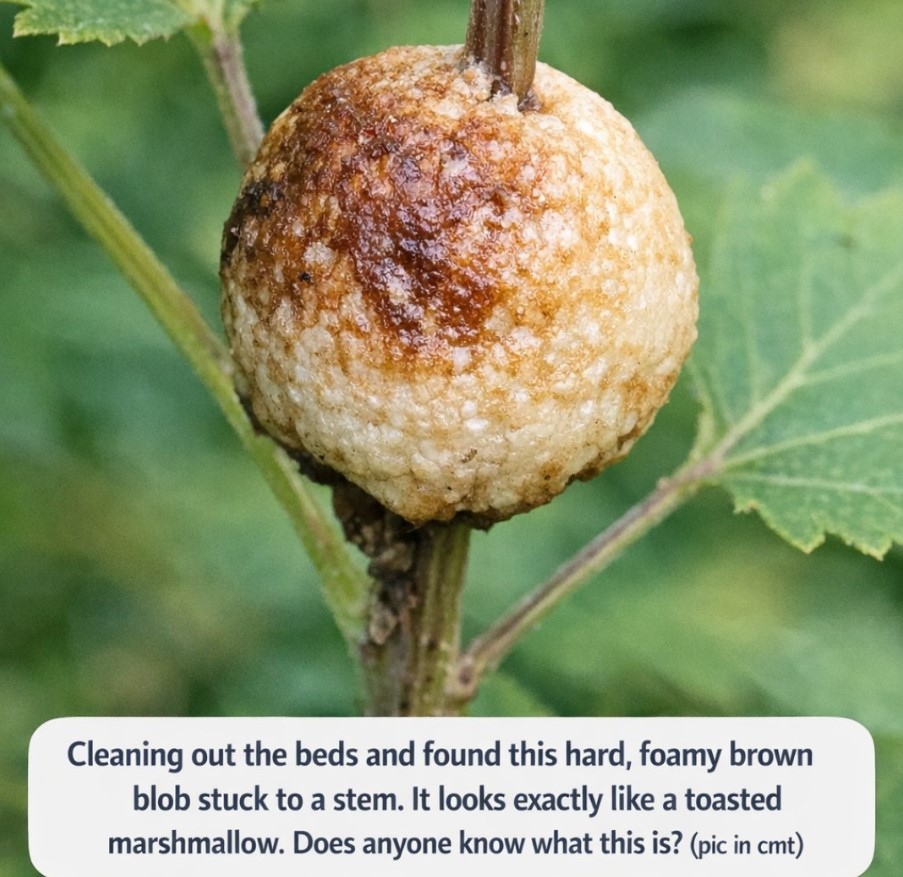
Cleaning out garden beds can uncover all kinds of surprises. Hidden beneath leaves, tangled among old stems, and tucked against branches, you may find things you never noticed during the growing season. But few discoveries are quite as strange as a hard, brown, foamy blob attached firmly to a plant stem.
At first glance, it can look almost like a toasted marshmallow that somehow landed on the plant and hardened there. You might even wonder whether it is a fungus, an insect nest, a strange plant growth, or something that needs to be removed immediately.
If the object is firm, tan or brown, foam-like, and attached to a stem or twig, however, there is a very good chance that you’ve discovered a praying mantis egg case, scientifically called an ootheca. University of Maryland Extension describes these egg cases as hardened, straw-colored, foam-like masses attached to stems and twigs, containing anywhere from dozens to hundreds of eggs.
So before you scrape that mysterious “marshmallow” away, take a closer look. You may have found one of the most fascinating little structures in the garden.
What Is That Brown Foamy Object?
The unusual blob is most likely a praying mantis ootheca, or egg case.
A female praying mantis produces a special frothy secretion when laying her eggs. She deposits the eggs into this material, which gradually hardens into a protective case. Scientific descriptions explain that the ootheca is formed from frothy secretions that harden after being produced, creating a durable structure around the developing eggs.
Once hardened, the egg case can look remarkably unlike an ordinary insect egg mass. Instead of seeing individual eggs, you see one compact brown or tan structure that resembles dried foam or a piece of lightweight insulation.
That’s actually the clever part.
The hardened foam acts as protection for the eggs while they develop.
Why Does It Look Like a Toasted Marshmallow?
The comparison to a toasted marshmallow isn’t as strange as it sounds.
A praying mantis ootheca can have a rough, bubbly, hardened surface that looks almost like expanding spray foam. Depending on the species and age of the egg case, its color can range from pale tan to brown or russet.
When freshly produced, the material is much softer and more foam-like. As it is exposed to air, it hardens and becomes increasingly protective.
Over time, weathering can make the structure darker and tougher, which is why an old egg case discovered during garden cleanup can look like a little piece of brown dried foam stuck to a stem.
What’s Inside the Egg Case?
The really fascinating part is what’s hidden inside.
The brown exterior isn’t just a random shell. It protects a large number of developing mantis eggs.
Depending on the species, an ootheca can contain dozens to hundreds of eggs. University of Maryland Extension notes that mantis egg cases can contain dozens to hundreds of eggs that overwinter inside their protective walls and hatch when conditions become favorable.
That means the little object you discovered could potentially represent an entire future generation of praying mantises.
It’s essentially a tiny natural nursery attached to your plant.
Why Did the Mantis Put It on the Stem?
The female mantis needs a stable place to attach her egg case.
Stems and twigs are excellent locations because they provide a firm surface above the ground. Mantis egg cases can also be attached to branches, fences, rocks, buildings, and other structures depending on the species and environment.
The location doesn’t mean the plant has an infestation.
The stem is simply serving as a convenient support.
So if you discover one attached to a shrub or perennial during your garden cleanup, the plant itself isn’t necessarily being harmed.
Is It a Mantis Egg Case or Something Else?
Although the appearance strongly suggests a mantis ootheca, identification should always take the entire situation into account.
A typical mantis egg case is:
- Hard rather than soft
- Tan, beige, brown, or straw-colored
- Foamy or slightly spongy in appearance
- Firmly attached to a stem, twig, branch, or other surface
- Usually elongated, rounded, or somewhat irregular depending on the species
- Made from a hardened protective material
University extension sources specifically describe mantis oothecae as hard, foam-like masses attached to stems and twigs.
If your mystery object matches those characteristics, a mantis egg case is a strong possibility.
Different Mantis Species Have Different Egg Cases
Not every mantis ootheca looks exactly the same.
Species vary in the shape, size, color, and texture of their egg cases. For example, the University of Maryland Extension notes that the egg case of the native Carolina mantid is longer and narrower than that of the Chinese mantid.
The Illinois Extension also notes that Chinese mantis egg cases can be larger and foam-like, while Carolina mantis oothecae tend to have a somewhat different shape.
So don’t worry if the object you’ve found doesn’t look exactly like a photograph you’ve seen online.
The basic characteristics matter more than having a perfect match.
What Happens to the Egg Case During Winter?
One of the reasons the structure is so tough is that it has to protect the eggs through changing outdoor conditions.
Mantis egg cases can remain attached to plants and other surfaces through cold weather. Their hardened, foam-like construction provides protection for the developing eggs.
This is why gardeners often discover them while cleaning up beds during fall, winter, or early spring.
The adult mantises may no longer be visible, but their reproductive legacy remains attached to the garden.
When Will the Baby Mantises Hatch?
When temperatures become favorable, the eggs inside the ootheca can hatch.
In many temperate regions, this occurs during spring as temperatures rise. The exact timing varies according to species and local conditions.
New Jersey State Park Service explains that mantis egg cases harden after being produced and that, as temperatures warm, the case can absorb moisture and become softer before young mantises emerge.
The emergence can be an impressive sight if you’re lucky enough to witness it.
Tiny mantis nymphs can appear from the egg case and quickly disperse into the surrounding vegetation.
What Do Baby Mantises Look Like?
Newly hatched mantises don’t look like completely different insects.
They resemble miniature versions of adult mantises, although they are extremely small and lack fully developed wings. University of Maryland Extension notes that immature mantises resemble adults but are smaller and wingless.
They begin life ready to hunt appropriately sized prey.
As they grow, they shed their outer exoskeleton multiple times before reaching adulthood.
Will Hundreds of Baby Mantises Really Come Out?
Potentially, yes.
The exact number depends on the species and individual egg case, but some oothecae contain dozens or even hundreds of developing eggs.
That doesn’t mean hundreds of adult mantises will eventually take over your garden.
Many young mantises don’t survive to adulthood. They face predators, weather, food shortages, competition, and even one another.
Praying mantises are predators from an early stage, and young mantises may prey on other small insects—including, in some circumstances, other young mantises.
Should You Leave the Egg Case Alone?
In most cases, yes.
If you’ve identified the object as a mantis ootheca and it isn’t creating a problem, there is usually no reason to remove it.
Destroying it could eliminate the developing eggs inside.
Instead, consider leaving it in place and allowing nature to take its course.
New Jersey State Park Service specifically encourages gardeners to leave recognizable mantis egg cases in place during garden cleanup.
Your mysterious brown blob may actually be one of the most interesting things in the entire flower bed.
Is It Good to Have Mantises in the Garden?
Praying mantises are predators, so they can contribute to the natural balance of insects in a garden.
They hunt a variety of insects and other small arthropods. This can include insects that gardeners consider pests.
Illinois Extension describes mantises as predators that help feed on insects in the garden ecosystem.
However, it’s important to understand that mantises aren’t selective pest-control specialists.
They don’t know the difference between an aphid you dislike and a beneficial insect you want to protect.
They may consume pollinators and other insects as well as plant pests.
For that reason, it’s best to think of them as one part of a diverse ecosystem rather than as a guaranteed biological pest-control solution.
Could the Egg Case Hurt the Plant?
Generally, the presence of a mantis egg case isn’t a sign that the plant is being eaten or infected.
The female uses the stem as a place to attach the ootheca.
The egg case isn’t feeding on the plant the way a parasitic organism would.
If the stem is healthy and the plant is growing normally, there’s generally no reason to remove the ootheca simply because it’s attached there.
What If You’re Cleaning Up the Garden?
This is when it is particularly easy to accidentally destroy a mantis egg case.
Garden cleanup often involves cutting back old stems, removing dead vegetation, pulling weeds, and clearing away debris.
Before cutting an old stem, take a moment to inspect it.
Look for unusual:
- Brown foam-like masses
- Hardened insect structures
- Egg clusters
- Cocoons
- Webbing
- Other unusual attachments
Not every strange object needs to be removed.
A few seconds of inspection could save an entire generation of beneficial wildlife.
Don’t Confuse It With Spittlebug Foam
Another common garden discovery is a frothy mass produced by spittlebugs.
Spittlebug masses are usually much softer, wetter, and more obviously foamy than a hardened mantis egg case.
The University of Maryland description of a mantis ootheca emphasizes that the egg case becomes a hardened, foam-like structure.
So if the object you found is hard and brown rather than wet and bubbly, a mantis ootheca is a more likely explanation.
Could It Be a Fungus?
Some fungal growths can certainly appear strange, but the combination of a hard, brown, foam-like structure firmly attached to a stem is particularly characteristic of mantis egg cases.
Still, if the object is soft, slimy, rapidly changing, or appears to be growing directly from plant tissue, another explanation may be possible.
A clear photograph showing the object, the stem, and its surroundings can be very helpful when asking a local extension office or entomologist for identification.
What If You Accidentally Remove It?
Don’t panic.
Garden cleanup is full of surprises, and many people have removed an unfamiliar object before realizing what it was.
If the ootheca remains intact and you discover that it is a mantis egg case, careful relocation may sometimes be possible. Illinois Extension recommends that when an egg case has to be removed from a wall or another unsuitable surface, it should be transferred to a sheltered location rather than simply placed on the ground.
If you’re unsure how to move one without damaging it, getting advice from a local extension service or entomology resource is preferable to experimenting.
Should You Bring It Inside?
Generally, there is no reason to bring a naturally occurring mantis egg case indoors.
The egg case is adapted to outdoor conditions, and the seasonal environment plays a role in its development.
Bringing it indoors can create an unexpected situation when dozens or hundreds of tiny mantises eventually emerge.
If you’ve found an ootheca in your garden, leaving it outdoors in an appropriate location is usually the simplest option.
What Happens After the Eggs Hatch?
Once the young mantises emerge, they begin dispersing.
They need food, shelter, and enough space to survive.
The tiny nymphs start hunting small prey and continue growing through a series of molts. With each molt, they become larger and more capable predators.
Over time, the surviving individuals mature into adult mantises.
Eventually, the cycle begins again when females produce their own oothecae.
Why Finding One Can Be a Good Sign
Discovering a mantis egg case means that a mantis successfully reproduced somewhere in or around your garden.
That’s a fascinating indication that your outdoor space is supporting wildlife.
A garden isn’t simply a collection of plants. It is a living community involving insects, spiders, birds, microorganisms, and countless other organisms.
Finding an ootheca is a small reminder of how much activity can be happening around you even when you aren’t looking.
A Better Approach to Garden Cleanup
Instead of clearing everything as quickly as possible, consider taking a slower approach.
Before cutting back old plants, inspect the stems.
Before throwing away dried branches, look for egg cases.
Before spraying an unfamiliar insect, try to identify it.
Before scraping off an unusual structure, take a photograph and investigate.
This approach can help you avoid destroying beneficial insects and can make your garden much more interesting.
You might discover that what looks like a problem is actually part of the solution.
What to Do If You Find One
If the mystery object matches a mantis ootheca, the simplest approach is:
- Leave it in place if possible.
- Avoid crushing or scraping it.
- Don’t spray insecticide directly on it.
- Protect the stem during pruning and cleanup.
- Watch for hatchlings when the weather warms.
- Enjoy the fact that your garden has become part of the mantis life cycle.
The University of Maryland Extension and New Jersey State Park Service both identify these hardened, foam-like structures as praying mantis egg cases and emphasize their role in protecting the developing eggs.
Frequently Asked Questions
Is the brown foamy blob a praying mantis egg case?
If it is hard, brown or straw-colored, foam-like, and attached to a stem or twig, a praying mantis ootheca is a strong possibility.
Is a mantis egg case harmful?
The egg case itself isn’t a plant disease. It is a protective structure containing developing mantis eggs.
Should I remove it?
If it isn’t causing a problem, leaving it undisturbed is generally the best choice.
How many eggs are inside?
The number varies, but mantis oothecae can contain dozens to hundreds of eggs.
When will the eggs hatch?
In temperate climates, hatching commonly occurs as temperatures warm in spring, although timing varies by species and location.
Will the baby mantises damage my plants?
Mantises are predators rather than plant-eaters. They hunt other insects rather than feeding directly on your plants.
Are mantises good insects?
They are fascinating generalist predators and can contribute to garden biodiversity, although they also eat beneficial insects, including some pollinators.
Conclusion :
That strange hard, foamy brown blob that looks like a toasted marshmallow may turn out to be something far more interesting than garden debris. If it is firmly attached to a stem or twig and has the characteristic hardened, foam-like appearance, you’ve likely discovered a praying mantis egg case, or ootheca.
The unusual structure is actually a carefully constructed protective nursery. A female mantis creates it from a frothy secretion that hardens around her eggs, protecting them from the outdoor environment while they develop. Depending on the species, a single case can contain dozens or even hundreds of eggs.
As the weather warms, tiny mantis nymphs can emerge and begin their lives as predators in the garden. They will grow, molt, hunt, and eventually mature into adults that continue the life cycle.
So the next time you’re cleaning out your flower beds and see something that looks like a piece of toasted marshmallow glued to a stem, don’t scrape it off immediately. Pause, take a closer look, and consider leaving it where it is.
What initially looks strange or unwanted may actually be a tiny natural nursery preparing to release the next generation of praying mantises.
Sometimes the most unusual discoveries in a garden are also the most fascinating—and this little brown “marshmallow” is a perfect example.