At first glance, this looks like a simple counting challenge. You look at the picture, count the sea creatures, and give your answer. Easy, right?
Not quite.
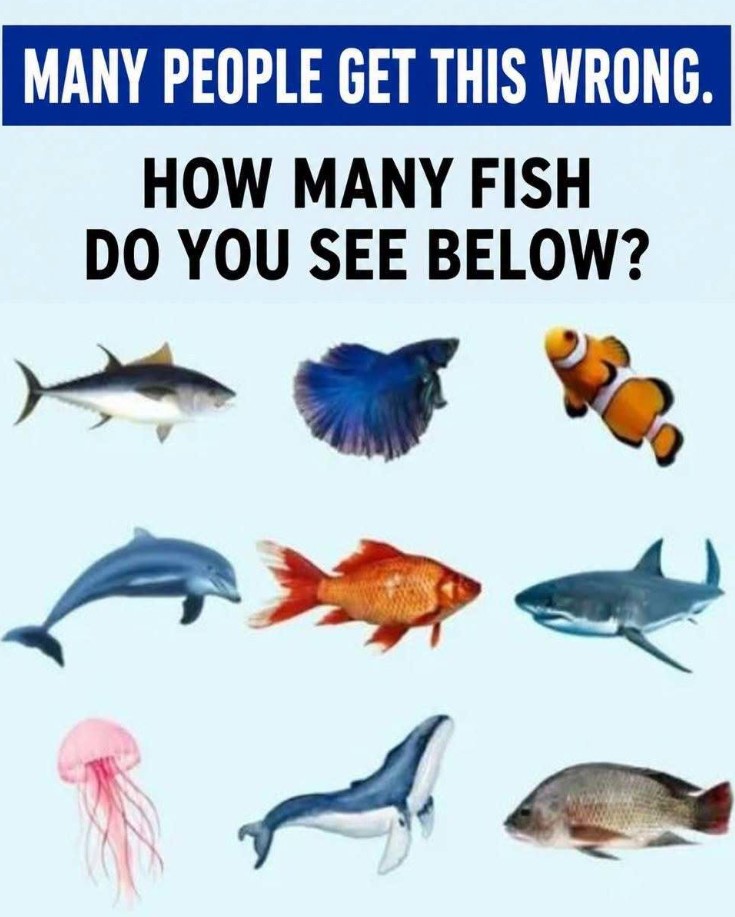
The image shows nine different sea creatures, but the question doesn’t ask how many creatures you see. It asks a much more specific question:
How many fish do you see below?
That’s where the trick comes in.
Some of the animals pictured look like fish, live in the water, or even have the word “fish” in their names. But scientifically, not everything swimming around in the ocean is actually a fish.
So before you give your answer, take another careful look at the image.
There are several obvious fish, but there is also a dolphin and a jellyfish. Neither one belongs to the fish group. Dolphins are mammals that breathe air through lungs, while jellyfish are invertebrates belonging to the phylum Cnidaria.
That small distinction completely changes the answer.
Take a Good Look Before Answering
The picture contains nine animals arranged in three rows.
At the top, you can see:
- A tuna-like fish
- A blue betta fish
- A clownfish
The middle row contains:
- A dolphin
- A goldfish
- A shark
And the bottom row shows:
- A jellyfish
- Another shark
- A larger fish
At first, it is tempting to simply count all nine.
After all, every animal shown is associated with aquatic life, and most have the familiar appearance we associate with creatures living underwater.
But this is exactly what makes the puzzle effective.
It tests whether you’re actually reading the question or simply counting everything that looks like it belongs in the ocean.
So, How Many Fish Are There?
The correct answer is:
7 FISH
There are seven actual fish in the image.
The two creatures that should not be counted are the dolphin and the jellyfish.
That leaves seven.
Let’s go through the image carefully so you can see exactly how the answer is reached.
Fish Number 1: The Tuna
The first creature in the upper-left corner is a tuna-like fish.
This one is an easy addition to the total.
It has the characteristics we normally associate with fish, including a streamlined body and fins. Tuna are marine fish and are among the fastest-swimming fish in the ocean.
So:
Fish count: 1
Fish Number 2: The Betta Fish
Next to the tuna is a colorful blue betta fish.
Betta fish are freshwater fish commonly kept in aquariums. Their flowing fins can make them look almost like underwater decorations, but there is no trick here.
It is definitely a fish.
That brings the count to:
Fish count: 2
Fish Number 3: The Clownfish
The orange-and-white creature in the upper-right corner is a clownfish.
This is another straightforward answer.
Clownfish, also called anemonefish, are genuine fish belonging to the damselfish family.
So we can add another one.
Fish count: 3
The First Trick: The Dolphin
Now we reach the middle-left of the picture.
At first glance, the dolphin may seem like an obvious fish because it lives in the ocean and has a streamlined body, fins, and a tail.
But a dolphin is not a fish.
Dolphins are marine mammals. They breathe air with lungs, are warm-blooded, give birth to live young, and feed their young with milk.
This is an important distinction.
A creature doesn’t become a fish simply because it lives underwater.
So the dolphin does not increase our fish count.
Fish count: still 3
Fish Number 4: The Goldfish
Next to the dolphin is a familiar orange goldfish.
This one definitely counts.
Goldfish are bony fish, and their appearance leaves little room for doubt.
Add it to the total:
Fish count: 4
Fish Number 5: The Shark
On the right side of the middle row is a shark.
Some people may hesitate here because sharks look very different from common bony fish such as goldfish or tuna.
But sharks are absolutely fish.
They belong to the group of cartilaginous fish, meaning their skeletons are primarily made of cartilage rather than bone. Educational marine resources classify sharks alongside other fish such as rays and clownfish.
So the shark counts.
Fish count: 5
The Second Trick: The Jellyfish
Now look at the lower-left corner.
There’s a pink jellyfish.
This is probably the creature that causes many people to make an incorrect count.
Its name literally contains the word “fish.”
But a jellyfish isn’t a fish at all.
Jellyfish are cnidarians, a group of animals that also includes sea anemones and corals. They don’t have the characteristics that define fish.
So despite its name, the jellyfish must be excluded.
Fish count: still 5
This is one of the main tricks of the puzzle.
The word “fish” in an animal’s common name doesn’t necessarily mean the animal is scientifically classified as a fish.
Fish Number 6: The Lower-Middle Shark
Moving toward the bottom center of the image, we see another shark.
It has a distinctive body shape and prominent fins.
Just like the first shark, this animal is a genuine fish.
So we add another:
Fish count: 6
Fish Number 7: The Bottom-Right Fish
Finally, look at the lower-right corner.
The last animal is another conventional fish with a broad body and fins.
There is no trick here either.
It counts as the seventh fish.
Final fish count: 7
Why So Many People Answer 9
Now it’s easy to understand why the puzzle claims that many people get it wrong.
There are nine animals visible.
If someone simply looks at the picture and counts every animal, the answer will be nine.
But that’s not what the question asks.
It asks specifically for the number of fish.
The two exceptions are:
- The dolphin — a mammal.
- The jellyfish — an invertebrate, not a fish.
Therefore:
9 total creatures − 2 non-fish = 7 fish
The Difference Between Living in Water and Being a Fish
This puzzle highlights a common misunderstanding about animal classification.
People often use habitat as their main clue.
If an animal lives in the ocean, they may automatically think it’s a fish.
But biological classification doesn’t work that way.
Whales, dolphins, seals, and sea turtles all spend much of their lives in the water, but they aren’t fish.
Likewise, jellyfish live in marine environments but belong to an entirely different animal group.
Fish are generally aquatic vertebrates that breathe through gills throughout their lives. Sharks and rays are fish even though their skeletons differ from those of bony fish.
So the most reliable way to solve a puzzle like this is to look beyond appearance and habitat.
Why the Dolphin Is Such a Good Distraction
The dolphin is especially effective because it looks remarkably fish-like.
Its streamlined body allows it to move efficiently through water. It has a dorsal fin and flippers, and its tail helps propel it forward.
If you weren’t thinking carefully, there would be nothing strange about calling it a fish.
But dolphins have several defining mammalian characteristics.
They breathe atmospheric oxygen using lungs rather than extracting oxygen from water through gills. They also give birth to live young and nurse their babies with milk.
That’s why the dolphin belongs with mammals, not fish.
Why the Jellyfish Is Another Clever Distraction
The jellyfish is arguably an even better trick.
Unlike the dolphin, the word fish is literally part of its name.
Yet the name is misleading from a scientific standpoint.
Jellyfish are cnidarians, not fish. They lack a backbone and belong to a completely different branch of the animal kingdom.
This is a great reminder that common names aren’t always scientifically precise.
There are other examples in nature where an animal’s common name can create confusion.
That’s why scientists use formal classification systems to distinguish organisms more accurately.
A Simple Way to Solve Similar Visual Puzzles
When you encounter another puzzle like this, don’t immediately start counting.
Instead, follow a few simple steps.
Step 1: Read the Question Carefully
The wording is often where the trick is hidden.
If the question asks for “fish,” don’t count every animal.
If it asks for “birds,” don’t count every creature with wings.
If it asks for “animals wearing red,” look for the exact condition.
Step 2: Count the Obvious Ones
Start with the animals you’re certain about.
In this image, the tuna, betta, clownfish, goldfish, sharks, and bottom fish are straightforward.
Step 3: Question the Unusual Ones
Next, look at the creatures that could cause confusion.
Here, those are the dolphin and jellyfish.
Step 4: Think About Classification
Ask yourself whether each creature actually belongs to the category in the question.
This is where the puzzle becomes more than a simple visual test.
Step 5: Check Your Total
Once you’ve eliminated the non-matching animals, count again.
That final check gives you the answer of seven.
Don’t Let Appearance Fool You
One reason visual puzzles are so entertaining is that our brains tend to recognize patterns very quickly.
We see water-loving animals together and mentally place them into one category.
The image encourages that response.
All nine creatures appear to belong to the same general underwater theme.
But the question requires a more precise distinction.
The ability to slow down and challenge your first impression is what makes these puzzles interesting.
Sometimes the first answer that comes to mind is based on what something looks like, rather than what it actually is.
Can You Find the Seven Without Looking at the Explanation?
Before moving on, try the puzzle one more time.
Look at the image and point to each animal you believe should count.
Start from the top-left and move across the rows.
You should identify:
- Tuna — counts
- Betta fish — counts
- Clownfish — counts
- Dolphin — doesn’t count
- Goldfish — counts
- Shark — counts
- Jellyfish — doesn’t count
- Shark — counts
- Bottom-right fish — counts
Now count the ones marked as counting.
You should arrive at:
7
The Answer Isn’t Just About Being Underwater
Another important lesson from this puzzle is that habitat doesn’t determine classification.
Dolphins and fish share the same general environment, but they evolved very differently.
Dolphins are mammals that returned to an aquatic lifestyle, while fish have their own distinct evolutionary history.
Similarly, jellyfish are aquatic invertebrates.
So an ocean can contain mammals, fish, reptiles, invertebrates, and many other forms of life—all living in the same environment.
That’s what makes marine ecosystems so diverse.
Why These Puzzles Are Great Brain Exercises
A puzzle like this may seem simple, but it encourages several useful thinking skills.
Attention to Detail
You have to notice every creature rather than rushing through the image.
Careful Reading
The difference between “animals” and “fish” completely changes the answer.
Logical Classification
You need to decide which creatures genuinely belong to the requested category.
Avoiding Assumptions
The puzzle encourages you to question your first impression rather than automatically accepting it.
Memory and General Knowledge
Knowing that dolphins are mammals and jellyfish are invertebrates is essential for reaching the correct answer.
These skills are useful beyond puzzles. Everyday decisions often require us to slow down, inspect the details, and avoid making conclusions based only on appearances.
Challenge Your Friends
Once you’ve solved the puzzle, try showing it to someone else without giving them the answer.
Simply ask:
“How many fish do you see?”
Watch how quickly they begin counting.
Many people will probably count all nine creatures because they interpret the question as asking how many underwater animals are shown.
If they answer nine, ask them one more question:
“Is a dolphin a fish?”
Then ask:
“What about a jellyfish?”
That’s usually when the trick becomes clear.
Final Answer
After carefully examining all nine creatures, the answer is:
7 FISH
There are seven actual fish in the image.
The dolphin doesn’t count because it is a marine mammal.
The jellyfish doesn’t count because it is a cnidarian and not a fish.
The remaining seven creatures are genuine fish, including the clownfish and sharks.
Conclusion :
This “How Many Fish Do You See Below?” puzzle is a perfect example of how a seemingly simple question can become surprisingly tricky.
There are nine sea creatures visible in the picture, so answering nine feels natural at first. But once you pay attention to the exact wording, the challenge becomes a classification test rather than a simple counting exercise.
The dolphin is the first major trap. Although it spends its life in the water and has a body shape that resembles a fish, it is actually a mammal. Dolphins breathe air with lungs, give birth to live young, and nurse their offspring with milk.
The jellyfish is the second trap. Its name makes it sound like a fish, but it belongs to the cnidarians, alongside animals such as corals and sea anemones.
Once those two are excluded, the remaining seven creatures are fish.
So if you answered 7, you caught the trick.
If you answered 9, don’t worry—you weren’t alone. That’s exactly what makes this puzzle so effective. It encourages you to slow down, question your assumptions, and look beyond what something appears to be.
Sometimes the hardest part of a visual puzzle isn’t counting what you can see. It’s understanding exactly what you’re being asked to count.