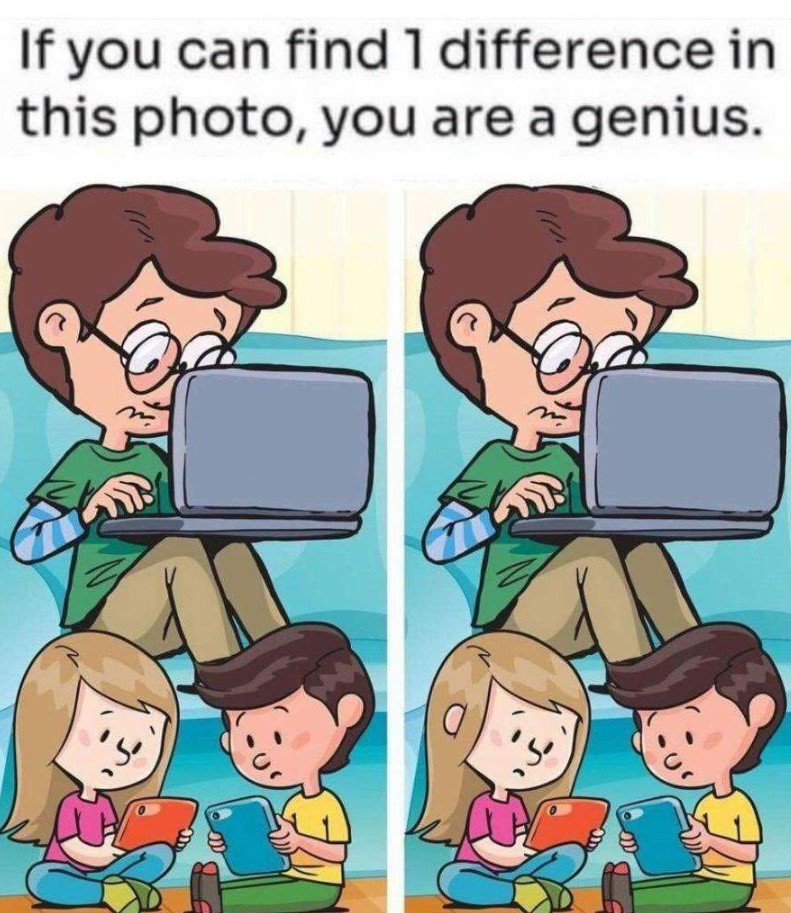
At first glance, the two pictures in this puzzle appear to be almost perfectly identical. You can see a father relaxing beside a sofa while concentrating on his laptop, while his two children sit on the floor, completely absorbed in their handheld devices.
It looks like an ordinary family moment—quiet, comfortable, and familiar.
But there is a catch.
The two images are not exactly the same.
Somewhere inside this seemingly ordinary scene, one or more small details have been changed. Your challenge is to carefully compare the pictures and discover what is different.
It sounds easy, right?
Don’t be too confident.
The changes are deliberately subtle, which means your eyes may scan across them several times without noticing anything unusual. This is a classic test of concentration, observation, and patience.
So, take a close look at the two pictures and see whether you can find the difference before checking the answer.
Can You Spot the Difference?
Start by looking at both images side by side.
Don’t immediately zoom in on one particular object. First, take in the entire scene.
You can see the father wearing glasses and working on his laptop. Nearby, his two children are sitting on the floor with their own electronic devices.
Everything seems normal.
The arrangement of the people looks the same.
The furniture appears to be in the same place.
The children’s devices look nearly identical.
But somewhere in those details is a change that the puzzle creator has deliberately hidden.
Your mission is to find it.
Why Does This Puzzle Look So Easy?
Spot-the-difference puzzles are often harder than they appear because our brains are naturally very good at recognizing familiar scenes.
When we look at two pictures that are mostly identical, we tend to process them as a single familiar image rather than carefully comparing every individual detail.
Once your brain recognizes the general scene, it may automatically assume that everything else is unchanged.
That’s where the puzzle tricks you.
The difference may be extremely small—perhaps a missing object, a slightly altered shape, a changed position, or a detail in the background.
Because the rest of the illustration remains the same, that tiny change can easily blend into the surrounding picture.
Start With the Dad
One of the best ways to solve the puzzle is to divide the image into sections.
Begin with the father.
Look closely at his face.
Check his glasses.
Examine his hair and clothing.
Then move toward the laptop.
Look at the screen, keyboard, edges, and anything surrounding the computer.
Don’t just look at the objects themselves. Pay attention to their shape, position, and small details.
A difference can sometimes be hidden in a place you would normally ignore.
Now Examine the Children
Once you’ve carefully checked the father, move your attention toward the two children.
Look at their faces and hair.
Compare their positions.
Then examine the devices they are holding.
Ask yourself whether anything appears different between the two versions of the image.
You might notice a small alteration in the shape of a device, a missing feature, or something that has been moved slightly.
The key is to compare rather than simply observe.
Try looking at the same area in both pictures one after another.
Don’t Forget the Background
Many people concentrate so heavily on the characters that they completely ignore the surroundings.
That’s a mistake.
The sofa, floor, furniture, and other background elements can contain important clues.
Look at the edges of the sofa.
Check the space around the family.
Examine any visible patterns, lines, shapes, or small objects.
Sometimes the difference is deliberately placed somewhere that doesn’t attract much attention.
The less important an object seems, the more carefully you should examine it.
A Simple Strategy That Can Help
If you’re having trouble, don’t keep staring randomly at the entire picture.
Instead, divide it into sections.
For example:
Section 1: The father and his face
Section 2: The laptop and surrounding area
Section 3: The first child
Section 4: The second child
Section 5: The sofa and background
Section 6: The floor and remaining details
Compare each section carefully before moving on.
This method makes the challenge much easier because you aren’t trying to process the entire image at once.
You’re giving your brain a smaller amount of information to analyze.
Look for Something That Feels “Off”
Sometimes you don’t immediately recognize the difference, but something about the picture simply doesn’t feel right.
Trust that feeling.
If your eyes keep returning to a particular area, examine it more carefully.
Ask yourself:
Is something missing?
Has something moved?
Is a shape slightly different?
Does an object have a different number of details?
Is a pattern or line changed?
These questions can help guide your eyes toward the hidden difference.
Don’t Rush
Although many online puzzles encourage people to solve them quickly, speed isn’t always the best strategy.
If you rush, your brain is more likely to focus on the major objects and overlook tiny changes.
Instead, slow down.
Look at one detail.
Compare it.
Move to the next.
It may take longer, but careful observation is usually more effective than randomly scanning the picture.
And if you don’t find the answer immediately, don’t get frustrated.
Take a short break.
Look away from the image.
Then return and start again.
A fresh look can sometimes reveal something that you completely missed before.
Try the “Moving Eyes” Method
Here’s another technique you can use.
Instead of looking at both pictures independently, move your eyes back and forth between exactly the same locations.
For example, look at the father’s glasses in the first picture, then immediately look at the glasses in the second.
Move to the laptop.
Compare it.
Then move to the first child.
Compare.
Then the second child.
Continue through the background.
This side-by-side comparison makes small changes much easier to notice.
Why Spot-the-Difference Puzzles Are So Enjoyable
There’s a reason these puzzles remain popular.
They are simple to understand, but solving them can be surprisingly challenging.
You don’t need special knowledge or complicated equipment. All you need is a picture, a little patience, and a willingness to look carefully.
The satisfaction comes from discovering something that was hiding in plain sight.
At first, you may feel certain that the two pictures are identical.
Then you suddenly notice the difference.
That moment is incredibly satisfying.
A Fun Challenge for Friends and Family
Once you’ve found the answer, don’t immediately reveal it.
Instead, challenge someone else.
Send them the picture and ask:
“Can you spot the difference?”
Give them a time limit if you want to make the challenge more competitive.
You could give everyone one minute and see who can find the hidden change first.
Or make it more difficult by refusing to provide hints.
These puzzles can become surprisingly competitive when several people are trying to prove who has the sharpest eyes.
What Skills Does This Puzzle Test?
While this is primarily a fun visual challenge, it also requires several useful mental skills.
Attention to Detail
You need to notice small changes that might otherwise go unnoticed.
Concentration
The puzzle requires you to stay focused instead of allowing your attention to wander.
Visual Comparison
You have to compare two very similar images and identify what doesn’t match.
Patience
Sometimes the answer isn’t obvious, so persistence becomes important.
Pattern Recognition
Your brain needs to recognize what normally belongs in the picture before it can identify what has been changed.
The original article similarly presents the challenge as an exercise in careful observation, patience, and visual processing.
Still Can’t Find It?
Don’t worry if you’re struggling.
That’s exactly what makes a good spot-the-difference puzzle challenging.
Go back through the image one more time, but change your approach.
Instead of looking at the entire picture, focus on small areas.
Start with the father.
Then the laptop.
Then each child.
Then the sofa and background.
Compare each part carefully.
If you’ve already spent several minutes searching, take a short break and return to the puzzle later. Your brain can become accustomed to seeing the same image, making it harder to notice something unusual.
A fresh perspective can make all the difference.
The Answer
Have you found it yet?
Before looking at the answer, make one final attempt.
Compare the two pictures from top to bottom and left to right.
Look especially carefully at the small details around the family members and their surroundings.
The original article includes an answer image showing the intended difference.
If you spotted it without any help, congratulations!
You’ve got a sharp eye for detail.
If you needed several attempts—or even had to check the answer—don’t worry. These puzzles are specifically designed to make your brain overlook a tiny change among a large number of matching details.
Did You Find It Quickly?
Here’s a fun way to judge your performance:
Under 10 seconds: Excellent! Your observation skills are impressive.
10–30 seconds: Very good—you noticed the change with careful comparison.
30–60 seconds: Not bad at all. You took your time and eventually found it.
More than a minute: No problem! The challenge is designed to be tricky.
You needed the answer: That’s completely fine. Now that you’ve seen the difference, you probably won’t miss it next time.
Why the Difference Can Be So Difficult to See
The clever part of this puzzle is that the changed detail is surrounded by many things that remain exactly the same.
Your brain uses those repeated patterns as shortcuts.
When most of the image matches, your brain essentially says, “I’ve seen this already.”
That means your eyes may technically pass over the altered area without your brain consciously registering it.
This is why slowing down and deliberately comparing the images is so important.
The goal isn’t simply to look.
It’s to look with a purpose.
Final Thoughts
This computer dad and kids tablet puzzle is a great reminder that small details can easily disappear when we’re looking at a familiar scene.
The father working on his laptop, the children using their devices, and the surrounding furniture create a simple everyday setting. Because almost everything appears to match, the hidden difference can be surprisingly difficult to identify.
The best approach is to slow down, divide the picture into sections, and compare each part carefully.
Don’t rely on your first impression.
Don’t assume that two images are identical just because they look the same at a glance.
And most importantly, don’t give up if you can’t find the answer immediately.
So, were you able to spot the difference?
If you found it quickly, give yourself some credit—you have excellent attention to detail. If it took you longer, that’s perfectly fine too. The real fun is in the challenge.
Now share the puzzle with a friend or family member and ask them the same question:
“Can you spot the difference?”
You might be surprised by who finds it first!