
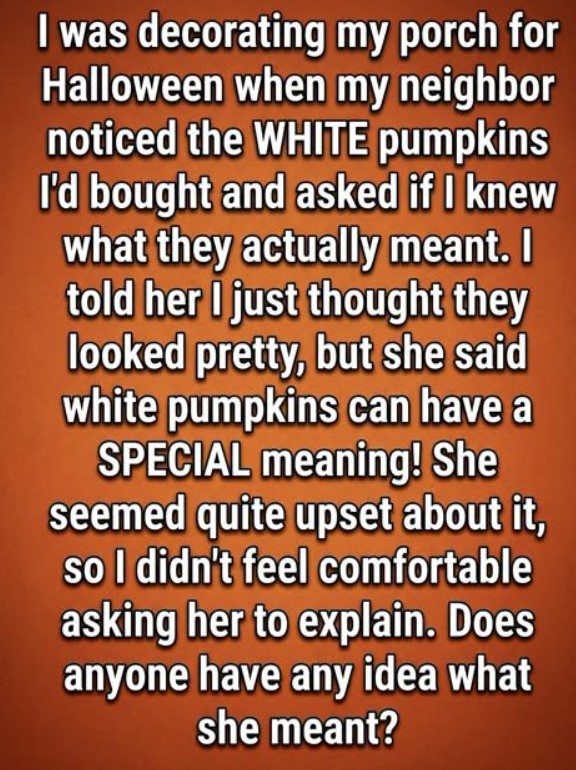
When October arrives, pumpkins begin appearing on porches, doorsteps, and front lawns. Most people are familiar with the traditional orange pumpkin, often carved into a smiling or frightening face for Halloween. However, if you look around during the fall season, you may also notice pumpkins with pale white or ivory-colored skin.
At first glance, white pumpkins might seem like nothing more than an unusual decoration. Their soft color looks elegant beside autumn leaves, candles, and other seasonal ornaments. But in some households, displaying a white pumpkin can carry a much deeper meaning.
White pumpkins are associated with several things, including seasonal decorating, Halloween folklore, and, in a particularly meaningful modern tradition, remembrance for families who have experienced pregnancy or infant loss. The meaning depends on the person displaying the pumpkin, so it is important not to assume that every white pumpkin represents the same message.
Here is what white pumpkins can symbolize, why they have become popular, and what you should know if you see one outside someone’s home this Halloween.
1. White Pumpkins Can Represent Remembrance and Loss
One of the most touching meanings associated with white pumpkins is remembrance of babies who have died during pregnancy, at birth, or during infancy.
For some grieving parents, October can be an especially emotional month. Halloween decorations fill neighborhoods, families visit pumpkin patches, and children take part in seasonal activities. These celebrations can bring happiness, but they may also remind parents of a child who is no longer physically present in their lives.
Displaying a white pumpkin offers some families a quiet way to acknowledge that loss. It can serve as a small memorial, allowing parents to include their child in their family’s autumn traditions.
The pumpkin may be displayed on a porch, placed beside other seasonal decorations, or personalized with a baby’s name. Some families simply choose a white pumpkin because its gentle appearance feels appropriate for remembering a child.
The practice is sometimes associated with the White Pumpkin Project, an informal remembrance tradition within the pregnancy and infant loss community. It gives families a visible way to honor children who died too soon and can help grieving parents feel less alone.
This meaning is particularly significant because a white pumpkin may look like an ordinary decoration to passersby while representing a deeply personal story to the family who chose it.
2. The Connection to Pregnancy and Infant Loss Awareness
October is recognized in the United States as Pregnancy and Infant Loss Awareness Month. October 15 is also observed as Pregnancy and Infant Loss Remembrance Day.
These observances provide opportunities to recognize families affected by miscarriage, stillbirth, and the death of an infant. They also encourage compassionate conversations about grief, which can sometimes be difficult for people to discuss openly.
The white pumpkin tradition fits naturally into this period of remembrance. Instead of keeping every part of their grief private, some families choose to place a simple symbol outside their homes.
The idea gained attention through the work of Jennifer Giles, a bereaved mother who wrote a poem titled “The White Pumpkin” in 2018 after losing her daughter. The poem helped inspire the use of white pumpkins as a physical symbol of remembrance.
Over time, the idea spread among families seeking meaningful ways to honor babies who had died. Some people write a child’s name on the pumpkin, while others leave it plain as a personal tribute.
It is worth remembering that not every white pumpkin displayed in October has this meaning. Many people buy them purely for decoration. Nevertheless, knowing about the remembrance tradition can help us understand why the symbol matters so much to some families.
3. White Pumpkins Can Symbolize Peace, Purity, and Hope
Beyond remembrance, white is often associated with peace, simplicity, purity, and new beginnings in different cultural and personal contexts.
These associations are not universal rules, but they help explain why white pumpkins can feel different from traditional orange ones.
Orange pumpkins are closely connected with the harvest, falling leaves, warm colors, and the excitement of Halloween. White pumpkins, by contrast, often create a quieter atmosphere. Their pale appearance can suggest calmness, reflection, and elegance.
For a family remembering a loved one, those qualities may feel comforting. For someone decorating a home, they may simply create a peaceful autumn display.
White pumpkins can also represent hope and the continuing importance of love after a loss. Grief does not disappear because a season changes, and small memorial traditions can help people make room for both sadness and meaningful family memories.
The symbolism ultimately depends on the person choosing the pumpkin. Its significance may be spiritual, emotional, decorative, or a combination of these things.
4. White Pumpkins Have Their Own Place in Halloween Decorating
Not every white pumpkin has a hidden message. In fact, many are chosen because they look beautiful in seasonal displays.
White pumpkins work well with a wide range of decorating styles. They can create a modern, minimalist look, complement rustic farmhouse decorations, or add contrast to traditional orange and black Halloween colors.
A white pumpkin placed beside dried flowers, wooden signs, or autumn leaves can make a porch look warm without being overly colorful. Smaller varieties also work well on dining tables, shelves, fireplace mantels, and entryway tables.
Some people carve white pumpkins into jack-o’-lanterns. Their pale outer skin creates an interesting contrast with the orange flesh underneath, and the carved faces can look particularly striking when illuminated from within using a safe battery-operated light.
Others prefer to leave them whole and decorate them with ribbons, paint, leaves, or simple lettering.
The popularity of white pumpkins shows that Halloween decorations do not have to follow one traditional color scheme. A pumpkin can be festive, elegant, meaningful, or all three at once.
5. Are White Pumpkins Naturally White?
Yes, many white pumpkins grow naturally with pale or ivory-colored skin. They are not all ordinary orange pumpkins that have been painted.
White pumpkin varieties include Casper, Lumina, Baby Boo, and Snowball. They come in different sizes and shapes, ranging from tiny decorative pumpkins to larger varieties suitable for carving.
Their pale appearance is caused by differences in pigmentation. Like other pumpkins, they belong to the squash family, but their outer skin develops a different color.
Interestingly, a naturally white pumpkin does not necessarily have white flesh inside. Many varieties have orange or yellowish-orange flesh, although the exact color and texture depend on the variety.
White pumpkins can be used for decoration, and some are also suitable for cooking. However, not every ornamental pumpkin is intended to be eaten, so it is best to check the variety before preparing one as food.
Their natural color is one reason they have become a popular alternative to traditional orange pumpkins during the fall season.
6. Why Are White Pumpkins Becoming More Popular?
White pumpkins have attracted attention because they offer something different from the familiar orange decorations associated with Halloween.
Homeowners and decorators often look for ways to create displays that feel personal rather than ordinary. White pumpkins provide a neutral background that works well with almost any color scheme.
They can be paired with orange pumpkins for contrast, combined with black decorations for a spooky atmosphere, or displayed with cream-colored flowers and natural wood for a softer autumn look.
Social media has also helped make unusual pumpkin varieties more visible. Photographs of white pumpkins arranged on porches, tables, and doorsteps have encouraged people to experiment with different seasonal decorations.
However, their growing popularity is not only about appearance. For families involved in remembrance traditions, a white pumpkin can communicate something meaningful without requiring a lengthy explanation.
The same object can therefore have very different meanings for different people. One household may see an elegant decoration, while another sees a symbol of a child they will always remember.
7. What Should You Do If You See a White Pumpkin on Someone’s Porch?
If you notice a white pumpkin outside a neighbor’s home, there is no need to assume that it represents a particular event or personal experience.
The family may simply enjoy its appearance. They might be following a decorating trend, celebrating Halloween in a different style, or using it as part of a personal remembrance tradition.
If the pumpkin does represent pregnancy or infant loss, it may be connected to an experience the family finds deeply emotional. In that situation, sensitivity and respect are especially important.
You do not need to ask questions or make assumptions about someone’s private life. Understanding that white pumpkins can carry a personal meaning is enough to appreciate the tradition.
If a friend or relative openly shares that they are displaying a pumpkin in memory of a baby they lost, a kind response can mean a great deal. A simple acknowledgment, a listening ear, or an expression of sympathy is often more helpful than trying to find the perfect words.
Grief affects everyone differently, and a small gesture of understanding can help someone feel seen and supported.
8. Other Colored Pumpkins Can Have Special Meanings Too
White pumpkins are not the only colored pumpkins associated with awareness or remembrance. During Halloween, some families and organizations use differently colored pumpkins to draw attention to particular causes.
- Orange pumpkins: The traditional symbol of autumn, harvest celebrations, and Halloween.
- Teal pumpkins: Often associated with the Teal Pumpkin Project, which encourages households to offer non-food treats for children with food allergies or other dietary restrictions.
- Purple pumpkins: Sometimes used to raise awareness about epilepsy.
- Pink pumpkins: May be used to show support for breast cancer awareness.
- White pumpkins: Sometimes displayed in remembrance of babies lost during pregnancy or infancy.
These meanings are not universal, and colored pumpkins can also be chosen simply for decoration. A pumpkin’s color alone does not always reveal the owner’s intentions.
Nevertheless, learning about these traditions shows how an ordinary seasonal decoration can become a way to communicate support, raise awareness, or honor someone important.
Frequently Asked Questions
Does a white pumpkin always symbolize pregnancy or infant loss?
No. Some families use white pumpkins as memorials, but many people display them simply because they like the color. You cannot know the meaning of a particular pumpkin without additional context.
What is the White Pumpkin Project?
The White Pumpkin Project is an informal remembrance tradition that uses white pumpkins to honor babies who have died during pregnancy, at birth, or in infancy. Families may display or personalize a pumpkin as a way to remember their child.
Can I display a white pumpkin to honor someone I have lost?
Yes. You can use a white pumpkin as a personal memorial for someone important to you. There is no requirement to follow a particular design or tradition. You might add a name, write a meaningful date, or leave the pumpkin plain.
Are white pumpkins different from orange pumpkins?
They are different in appearance because of their pigmentation and variety. Some white pumpkins have orange flesh inside, and certain varieties are suitable for cooking. Their exact characteristics depend on the type of pumpkin.
Is displaying a white pumpkin a religious tradition?
Not necessarily. Some people attach spiritual or personal significance to white pumpkins, while others use them for seasonal decoration or remembrance. There is no single religious meaning that applies to everyone.
Conclusion
White pumpkins may look like a simple alternative to traditional orange Halloween decorations, but their meaning can extend far beyond their appearance.
For many people, they are an elegant way to decorate a home during the autumn season. For others, they serve as a quiet symbol of remembrance, particularly for families grieving the loss of a baby during pregnancy or infancy. Their pale color can also evoke peace, hope, and reflection, making them especially meaningful to those who choose to associate them with personal memories.
The important thing to remember is that not every white pumpkin tells the same story. Some are decorative, while others carry emotions and experiences that may not be visible to anyone passing by.
The next time you see a white pumpkin on a porch, you may think of it a little differently. Behind that simple seasonal decoration could be a family’s creativity, a meaningful tradition, or a loving tribute to someone who will never be forgotten.