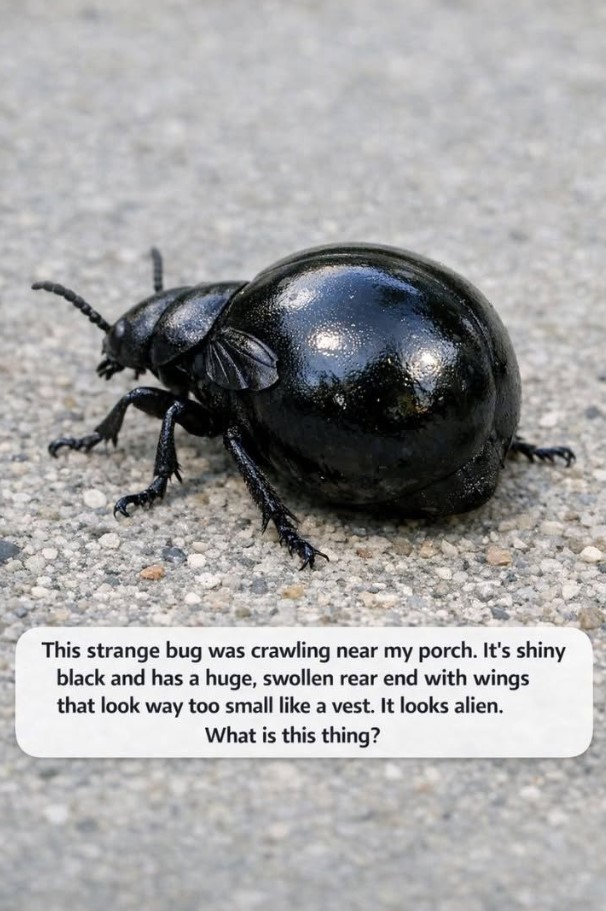
Spotting an unusual insect in your yard can be both fascinating and unsettling, especially when it looks unlike anything you’ve seen before. A shiny black body, an unusually swollen abdomen, and tiny wings that seem far too small for flight can easily make an insect appear almost alien. It’s no surprise that photos of this strange-looking bug have sparked curiosity online, with many homeowners wondering whether it’s dangerous, invasive, or something they should be concerned about.
Fortunately, appearances can be deceiving. In many cases, insects with these unusual features play important roles in the environment and pose little or no threat to people or pets. Learning to identify them not only satisfies curiosity but also helps us appreciate the incredible diversity of insects living around our homes and gardens.
In this guide, we’ll explore what this mysterious bug most likely is, why it has such an unusual appearance, whether it’s harmful, and what you should do if you encounter one near your porch or garden.
Meet the Oil Beetle
Based on its distinctive appearance, the insect shown in the image is most likely an oil beetle, a member of the Meloe genus within the blister beetle family (Meloidae).
Oil beetles are famous for their oversized, swollen abdomens, tiny wing covers, and inability to fly. Unlike many beetles whose wings are hidden beneath hard wing covers, oil beetles have short wing covers that leave much of their abdomen exposed, giving them their unusual shape.
Their glossy black or dark blue coloration adds to their striking appearance, making them look quite different from the beetles most people are familiar with.
Why Does It Have Such a Huge Abdomen?
One of the first things people notice is the insect’s enormous rear end.
In female oil beetles, the abdomen becomes especially swollen because it contains hundreds or even thousands of developing eggs. This enlarged abdomen is completely normal and helps the female carry the next generation.
Male oil beetles are generally slimmer, though they still have the same shortened wing covers and stout body.
The oversized abdomen often leads people to mistake these insects for ticks or strange parasites, but they are simply beetles with a unique body structure.
Why Are the Wings So Small?
Although oil beetles belong to the beetle family, they cannot fly.
Their hardened wing covers (called elytra) are much shorter than those of most beetles and cover only the front portion of the abdomen. Their flight wings are either greatly reduced or absent.
Instead of flying, oil beetles rely on walking to find food and mates.
Their slow movements make them easy to observe, though they should not be handled.
What Makes Them “Oil” Beetles?
The name “oil beetle” comes from an interesting defence mechanism.
When threatened, these beetles release droplets of an oily-looking liquid from the joints of their legs.
This yellowish fluid contains cantharidin, a chemical that helps protect the beetle from predators.
Although the liquid discourages animals from eating the beetle, it can also irritate human skin.
Are Oil Beetles Dangerous?
Oil beetles are not aggressive and do not bite or sting.
However, they should never be handled with bare hands.
The defensive chemical they produce can cause:
- Skin irritation
- Blistering
- Redness
- Burning sensations
- Eye irritation if transferred from the hands
Most people experience only mild irritation if exposed, but sensitive individuals may have stronger reactions.
If you accidentally touch one, wash your hands thoroughly with soap and water and avoid rubbing your eyes.
What Do Oil Beetles Eat?
Adult oil beetles primarily feed on plants.
Their diet may include:
- Grass
- Wildflowers
- Leaves
- Plant stems
- Various flowering weeds
Because they feed mainly on vegetation, they are not interested in entering homes or feeding on stored food.
A Fascinating Life Cycle
Oil beetles have one of the most remarkable life cycles in the insect world.
After the female lays her eggs in the soil, tiny larvae hatch and climb onto nearby flowers.
There, they wait for solitary bees to visit.
When a bee lands, the larvae attach themselves to its body and hitch a ride back to the bee’s underground nest.
Inside the nest, the larvae feed on the bee’s pollen stores and eventually continue developing into adult beetles.
Although this relationship may sound alarming, it is a natural part of their life cycle and has evolved over millions of years.
Where Are Oil Beetles Found?
Oil beetles occur in many parts of:
- Europe
- North America
- Asia
- North Africa
They are commonly found in:
- Gardens
- Meadows
- Woodland edges
- Grasslands
- Fields
- Rural properties
They are usually seen during spring and early summer when adults become active.
Why Did It Appear Near My Porch?
Finding an oil beetle near your porch usually isn’t cause for concern.
It may simply have been:
- Searching for vegetation
- Looking for a mate
- Crossing your driveway
- Moving toward a suitable egg-laying site
Outdoor lighting generally does not attract oil beetles as strongly as it attracts many flying insects.
Should You Remove It?
In most situations, the best approach is simply to leave it alone.
Oil beetles are beneficial members of natural ecosystems and are not household pests.
If one is in an inconvenient location, you can gently encourage it onto a piece of cardboard or use gloves to relocate it without direct contact.
Avoid crushing the beetle, as this can release its irritating defensive fluid.
Are They Rare?
Some oil beetle species have become less common due to habitat loss, changes in farming practices, and declining populations of solitary bees.
In several regions, conservationists monitor oil beetle populations because they can serve as indicators of healthy ecosystems.
Seeing one can actually be a sign that your local environment supports diverse insect life.
Similar Insects People Often Confuse with Oil Beetles
Several insects resemble oil beetles at first glance.
Blister Beetles
Oil beetles belong to the blister beetle family, but many other blister beetles have fully developed wings and can fly.
Dung Beetles
Dung beetles are usually more compact and have wing covers that completely cover the abdomen.
Darkling Beetles
Darkling beetles tend to have longer bodies and fully enclosed wing covers.
Ticks
Although the swollen abdomen may resemble a tick from a distance, ticks have eight legs, while oil beetles are true insects with six legs.
How to Stay Safe Around Oil Beetles
If you encounter one:
- Do not pick it up with bare hands.
- Keep curious children from handling it.
- Prevent pets from mouthing or chewing it.
- Wash your hands if accidental contact occurs.
- Observe it from a safe distance and enjoy its unique appearance.
Frequently Asked Questions
Can oil beetles fly?
No. Their wings are greatly reduced, making them flightless.
Do they bite?
No. Oil beetles do not bite or sting people.
Why do they release yellow liquid?
The liquid is a natural defence containing cantharidin, which helps deter predators.
Are they poisonous?
They are not poisonous to touch, but their defensive chemical can irritate the skin and should be avoided.
Should I kill one if I find it?
Generally, no. Oil beetles are valuable parts of the ecosystem and are best left undisturbed or gently relocated if necessary.
Conclusion :
At first glance, an oil beetle’s glossy black body, tiny wing covers, and dramatically swollen abdomen can make it seem like something from a science fiction movie. However, this unusual insect is a fascinating example of nature’s diversity rather than a dangerous invader. Despite its intimidating appearance, the oil beetle is not aggressive and spends its life quietly feeding on plants and continuing one of the most remarkable life cycles in the insect world.
The only real precaution is to avoid handling these beetles directly, as they can release a defensive chemical that may cause skin irritation or blistering. Otherwise, they are generally harmless to people, pets, and property. In fact, their presence often indicates a healthy outdoor environment with thriving plant and insect populations.
The next time you spot one of these unusual beetles crawling across your porch, driveway, or garden path, take a moment to admire its unique design from a safe distance. Understanding what it is—and the important role it plays in nature—can turn an alarming encounter into an opportunity to appreciate one of the many extraordinary creatures that share our world.